



By Soumoshree Mukherjee
Editor’s note: This article is based on insights from a podcast series. The views expressed in the podcast reflect the speakers’ perspectives and do not necessarily represent those of this publication. Readers are encouraged to explore the full podcast for additional context.
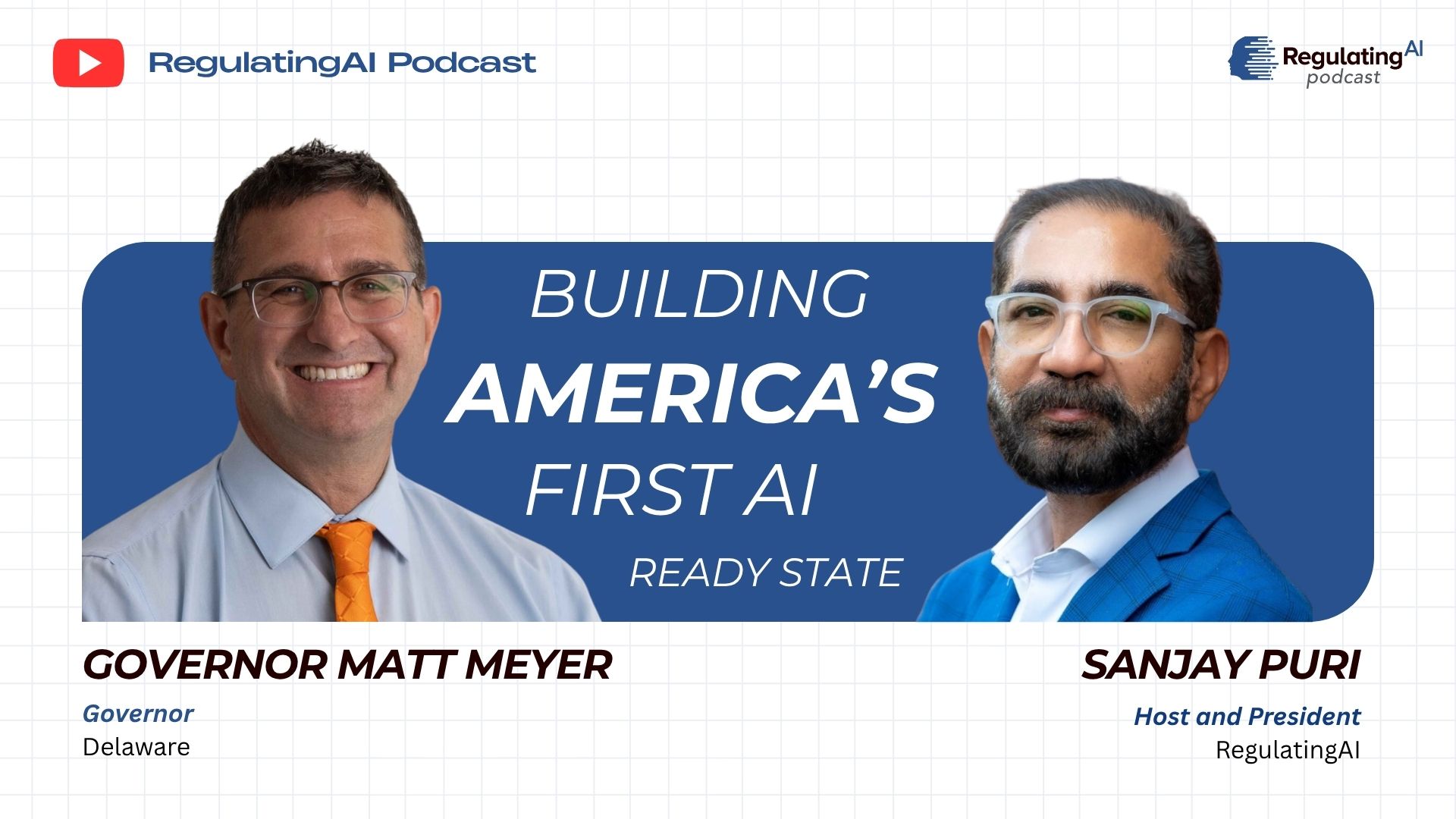
When Delaware Gov. Matt Meyer joined the “Regulating AI” podcast, hosted by Sanjay Puri, he brought more than policy talk to the table. He brought lived experience as a former public-school math teacher, startup founder in Nairobi, diplomat in Iraq, and now the 76th governor of Delaware shaping one of the most ambitious state-level approaches to artificial intelligence in the United States.
“AI is not destiny, it’s a tool,” Meyer said early in the conversation. “Our job is to figure out how do we make it a useful one. How do we make it a tool that actually improves lives and doesn’t ruin lives?” That people-first philosophy anchors Delaware’s rapid yet cautious push into AI governance.
Rather than chasing headlines, Meyer insists on substance. “You want to be the first to value, not the first to hype… The key is how do we pilot something fast? How do we measure it honestly? And how do we scale what works?” he explained.
READ: ‘Data governance is having a comeback,’ says Collibra CTO on the future of enterprise AI (
From launching an AI sandbox to partnering with OpenAI on workforce certification pathways, the state is positioning itself as a testing ground for responsible AI use.
Delaware recently became the first U.S. state to partner with OpenAI on an AI certification program for students, teachers, and workers. The aim, Meyer said, is to build real-world AI fluency. “We’re trying to enable as many Delawareans as possible to be able to put that feather in their cap earlier than residents of other states and other countries,” he noted, drawing parallels to the early days of Microsoft Word becoming a resume essential.
Yet Meyer remains wary of unchecked enthusiasm, particularly when it comes to jobs. “One of my greatest concerns with AI is job loss,” he said. While open to agentic AI, he stressed that efficiency cannot come at the cost of livelihoods. “If there is going to be job loss, we have to make sure it’s really job dislocation,” he argued, invoking the evolution from eight-track tapes to digital music as an example of progress that must still protect workers.
READ: Dr. Girish Nadkarni’s global vision for future of AI in healthcare (
Delaware’s AI sandbox reflects this balance. The supervised test environment allows companies, schools, hospitals, and agencies to experiment with AI under relaxed regulations but with strong consumer protections. “We provide a little sandbox before it becomes a whole beach,” Meyer described it.
As the corporate home to two-thirds of Fortune 500 companies, Delaware is uniquely positioned to explore how AI intersects with corporate governance, even raising provocative questions, “can you have a board member sit in a room that’s an AI engine and helping to make decisions?”
On democracy, Meyer was unequivocal. AI-driven deepfakes pose a real threat, he warned. “I can envision a world where a government that does not strictly regulate this stuff really loses its democracy.”
Ultimately, Meyer’s message to fellow policymakers is clear: don’t govern from fear. “We can’t be driven by fear, we have to be driven by opportunity… be realistic about the guardrails,” he said near the end of the conversation.
For Delaware, responsible AI isn’t about racing ahead blindly; it’s about moving fast, learning faster, and keeping humans at the center of every algorithm.