



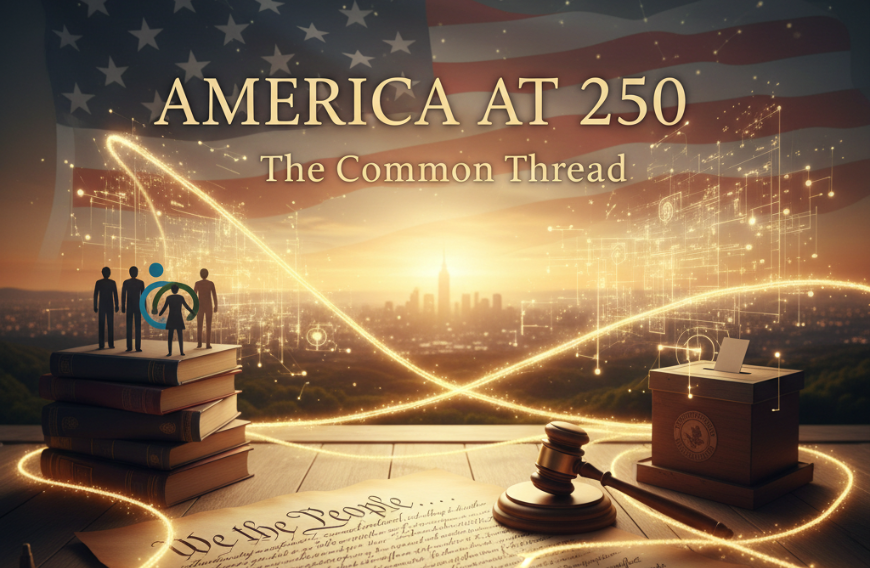
As America approaches its 250th birthday, it is impossible not to pause and reflect—not just on how far we have come, but on what it took for this nation to come into being at all. The United States was never meant to be a finished product. It was born as an idea before it was ever a country, forged in uncertainty, disagreement, and courage, and stitched together from an amalgamation of cultures, traditions, faiths, and aspirations. That diversity was not incidental to our founding; it was at the very core of it.
Walter Isaacson, in his reflection on the most famous sentence ever written, draws our attention to the quiet power of three simple words: We the People. Those words were not a claim of uniformity. They were a declaration of unity without sameness—a recognition that what binds us is not identical belief, origin, or experience, but a shared commitment to something larger than ourselves. Two hundred and fifty years later, that common thread still holds, even as it is stretched, tested, and rewoven.
If the founders could see us now, they would scarcely recognize the world we inhabit. Society has advanced in ways unimaginable during the era of musket fire and handwritten constitutions. We stand today in the midst of a revolution in intelligence itself—a new force first imagined a century ago and now unfolding before us in real time. Artificial intelligence challenges not only our economies and institutions, but our understanding of creativity, agency, and responsibility. As with every transformative moment in history, we find ourselves again on a precipice—trying to decide not just what we can do, but what we should do.
READ: FBI director Kash Patel’s Diwali post sparks backlash from MAGA supporters (
Yet for all our progress, some challenges remain stubbornly eternal. Humanity still wrestles with claims of land deemed sacred, with conflicts rooted in faith, belief, and identity. Nations still feel the ever-present threat of war, driven by shifting borders, shifting priorities, and unresolved histories. The dream of a world in perfect harmony—where every nation exists in peaceful utopia—remains aspirational, perhaps unrealistic, not because we lack ideals, but because we have not yet fully come to terms with our own vulnerabilities, fears, and mentalities.
And still, the American experiment endures.
I often think of the United States as a fabric woven on a loom. The loom itself—the Constitution, the rule of law, the enduring principles of liberty and accountability—has remained remarkably constant. But the threads have changed. New colors, new textures, new patterns have been added with every generation. Immigrants, descendants of enslaved people, indigenous communities, innovators, laborers, dreamers—all have contributed strands to the tapestry. Accepting that the fabric must evolve while the loom remains fixed may be one of the hardest truths for any society to embrace. Change can feel threatening, even when it is essential.
READ: Democracy has arrived in America, finally! (
What makes this moment so profound is its singularity. None of us—nor our great-great-grandchildren—will ever witness another 250th anniversary of the United States. This is not just a milestone; it is a once-in-many-lifetimes moment of reckoning and gratitude. It invites us to look backward with humility and forward with responsibility.
Now is the time to celebrate—not with arrogance, but with appreciation. To be grateful for the opportunities this nation has afforded us and those who came before us. To acknowledge the imperfections honestly, without losing sight of the extraordinary achievement that America represents: a society interwoven through many faiths, traditions, cultures, and beliefs that has nevertheless managed—against the odds—to hold together when so many others have fractured.
The true measure of this anniversary will not be the fireworks or speeches, but whether we choose to carry the thread forward with care. Whether we can pave a path for future generations that honors our differences without weaponizing them, that embraces progress without forgetting principle, and that remembers that We the People was never a conclusion—it was an invitation.
At 250 years, America is still becoming. And that may be its greatest strength of all.