


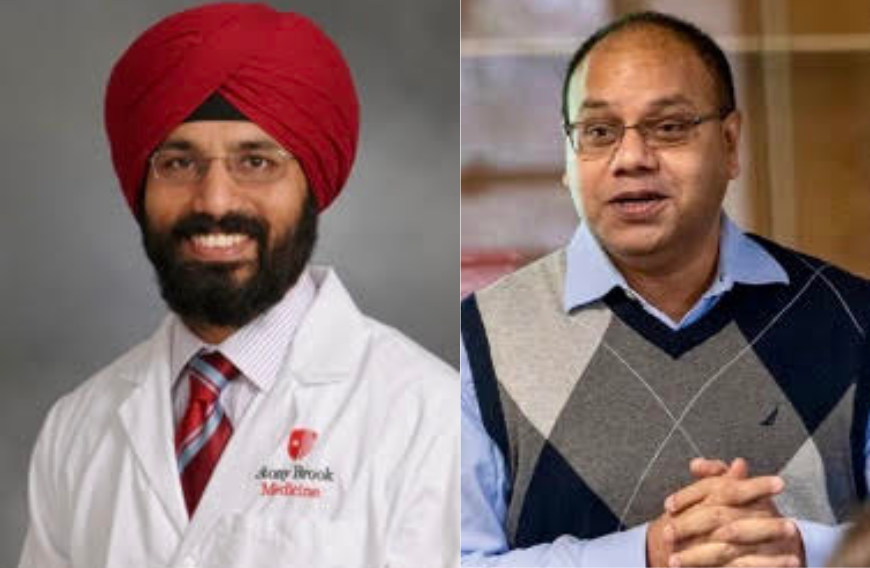
Two Indian American researchers, Anurag Purwar and Gurtej Singh, have won seed funding through a State University of New York Technology Accelerator Fund (TAF), which helps faculty inventors and scientists turn their research into market-ready technologies.
Anurag Purwar, associate professor in the Department of Mechanical Engineering in Stony Brook University’s College of Engineering and Applied Sciences, was one of four SUNY Mission TAF awardees for his research, MotionGen — An AI Platform for Intelligent Mechanism Design in Robotics.
Purwar is launching an enterprise version of MotionGen, a cloud-based AI platform that automates the robot mechanism design, reducing costs and improving quality through enhanced visualization and intelligent synthesis tools, according to a university release.
MotionGen combines machine learning with domain-specific kinematics to rapidly generate, simulate and optimize mechanism designs.
Indian Institute of Technology (IIT), Kanpur, graduate Purwar’s research interests are in bringing together rigid body kinematics and machine learning for design of mechanisms and robots. He has published 107 peer-reviewed conference and journal.
READ: Indian American Purdue scientist-led researchers develop reusable bioplastics (
Gurtej Singh, research associate professor of surgery at Stony Brook’s Renaissance School of Medicine, was one of the seven SUNY TAF recipients for his research, DEVA – A Vascularized, Shelf-Stable Skin Substitute for Advanced Wound Care.
Current skin substitutes often lack vascularization and long-term stability. Singh is advancing DEVA, a bio-printed, multilayered skin substitute with embedded vascular networks and antimicrobial properties, designed to jump-start the healing process and make chronic wounds that take months to heal a thing of the past.
IIT, Guwahati, biotechnology graduate Singh’s research interests encompass tissue engineering, cancer research and animal models of venous and arterial thrombosis.
SUNY TAF targets critical research such as feasibility studies, prototyping and testing, which demonstrate that an idea or innovation has commercial potential. The goal is to accelerate time to market for these innovations and increase their market readiness for potential investors, strategic partners and customers.
“I applaud our SUNY researchers for their visionary work and for helping secure SUNY’s position as a national leader in cutting-edge research,” said SUNY Chancellor John B. King Jr.“These investments work to increase the societal impact of our SUNY inventors and scientists by preparing their research for commercialization.”
READ: Indian American researcher explores human factors in plane crashes (
This year’s SUNY TAF program was enhanced by a $100,000 investment from the Griffiss Institute that enables SUNY faculty, researchers and students to engage with cutting-edge technology development initiatives driven by the U.S. Department of Defense, under the SUNY Mission TAF designation.
In addition to seed funding, SUNY Mission TAF recipients will receive guidance and support from the Griffiss Institute to help further commercialize their solutions, ensure they contribute to national security and bolster economic competitiveness.
Since the launch of TAF in 2011, SUNY has invested more than $4.7 million in the program to successfully advance the commercial readiness of 91 innovations born at SUNY campuses.
The program has catalyzed follow-on investment of an additional $41 million from development partners, including government agencies, industry licensees and early-stage investors.