



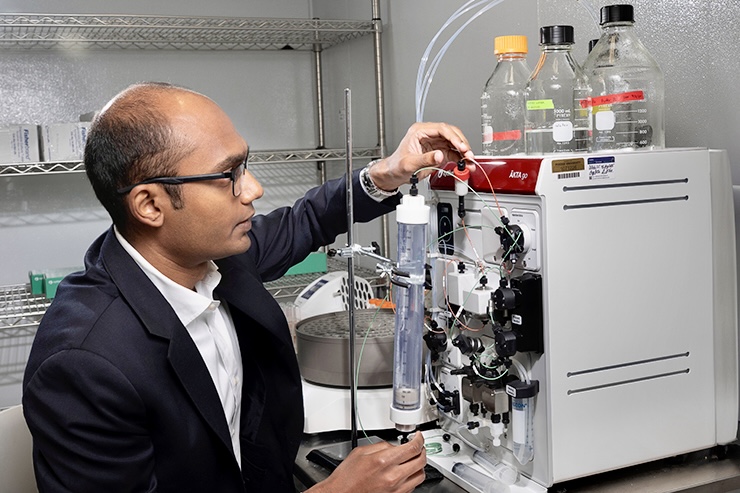
Researchers led by Karthik Sankaranarayanan, an Indian American scientist at Purdue University, are developing mechanisms to produce sturdy and reusable bioplastics to combat the problem of plastic products piling up in landfills or spilling into natural habitats.
Sankaranarayanan, assistant professor of agricultural and biological engineering at Purdue and a team of university and industry researchers have jointly received a $7 million grant from the U.S. National Science Foundation (NSF) to design novel enzymes — a type of protein that speeds up chemical reactions — that convert various biomaterials into biodegradable plastics.
In addition to their ecological benefits, these bioplastics — cultivated from domestic raw materials — may help to strengthen U.S. supply chains and manufacturing, according to a university press release.
Plastic production is a nearly $1 trillion industry with over 400 million metric tons produced in 2022. However, only about 10% of plastics are recycled.
READ: Indian American researchers develop world’s first 2D, non-silicon computer (
The enzymes developed by this research program will have similar levels of toughness and malleability to the types of plastics that currently dominate the market.
However, rather than relying on petroleum-based chemicals, these new bioplastics — polyhydroxyalkanoates (PHAs) — would be generated using domestically produced feedstocks such as corn, sugar or agricultural waste.
“Nearly 99% of the plastics produced today are made from petrochemicals derived from oil or gas, which often must be imported from outside the United States,” Sankaranarayanan said. “We want to take advantage of locally available materials, such as those commonly used throughout the state of Indiana.”
Additionally, while retaining their mechanical strength, Sankaranarayanan claims they would be infinitely recyclable.
“You can take these polymers and break them down into their individual units and reuse them again and again,” Sankaranarayanan said. “PHAs were discovered nearly a century ago, but they can be fragile and unstable at high temperatures, hindering their widespread use in consumer goods or medical devices. Our platform will enable the tuning of the chemical structure of the final polymer to have the proper level of mechanical strength and thermal stability. This will open the door for applications that range from packaging to biomedical devices.”
The primary focus of this three-year project is on biocatalysis — using enzymes to speed up highly specific reactions that produce desired products without harsh chemicals or extreme conditions. Biocatalysis makes biomanufacturing a more sustainable and efficient alternative to traditional chemical manufacturing. Creating the computational tool to identify opportunities for biocatalysis is the key to unlocking its potential.
READ: Indian American researcher explores human factors in plane crashes (
Purdue researchers are developing algorithms to select the enzymes and the reactions required for creating the desired bioplastics. Then, researchers at the University of California, San Francisco (UCSF) will engineer these enzymes using advanced protein computational design methods that harness deep learning, a machine learning technique that mimics how the brain recognizes patterns.
Once the enzymes are engineered, they will be sent to researchers at Stanford University to test their functionality and then to Purdue, where researchers will analyze the speed of their reactions as well as their ability to tune the chemical structure of the polymer.
Finally, researchers at the University of California, Berkeley will determine their properties and commercialization potential, as well as how microorganisms can be engineered to scale up for biomanufacturing.
Sankaranarayanan cites finding adaptable enzymes as one of the major challenges associated with this project.
“The enzymes that we’re working with — polyketide synthases (PKSs) — are sophisticated enzymes capable of catalyzing sequential chemical reactions in an assembly-line fashion to produce complex antibiotics,” Sankaranarayanan said. “However, they aren’t designed to work in the types of industrial processes that create bioplastics. So we’re trying to figure out how we can both alter their natural chemical reaction to produce desired bioplastics and simultaneously improve the stability of the engineered enzymes so that they’re amenable to biomanufacturing at scale.”
READ: Aravind Srinivas: The Indian American researcher taking on big tech with Perplexity (
Another challenge to using these enzymes in a manufacturing setting is the makeup of their DNA. PKSs have a high content of guanine and cytosine — two of the four bases that carry genetic information in DNA — which poses significant challenges for synthetic manufacturing of the DNA for subsequent enzyme production. Twist Bioscience, an additional partner on the project, has developed the technology that will enable researchers to engineer the necessary enzymes.
Sankaranarayanan said they will also provide open-source access to all their tools and workflows since, with some minor tweaks, they can be applied to pharmaceuticals, agrochemicals, pesticides or herbicides, and even other types of biomaterials, such as rubber. They will also develop a workshop on protein design led by UCSF with Purdue contributing modules on designing step-by-step enzyme processes.
“One thing I really enjoy about this grant is we have investigators, postdocs and graduate students from all these different universities, each of whom bring a unique set of strengths,” Sankaranarayanan said. “So, this opportunity for students here at Purdue to interact with some of these other faculty members and their lab members is quite exciting.”