



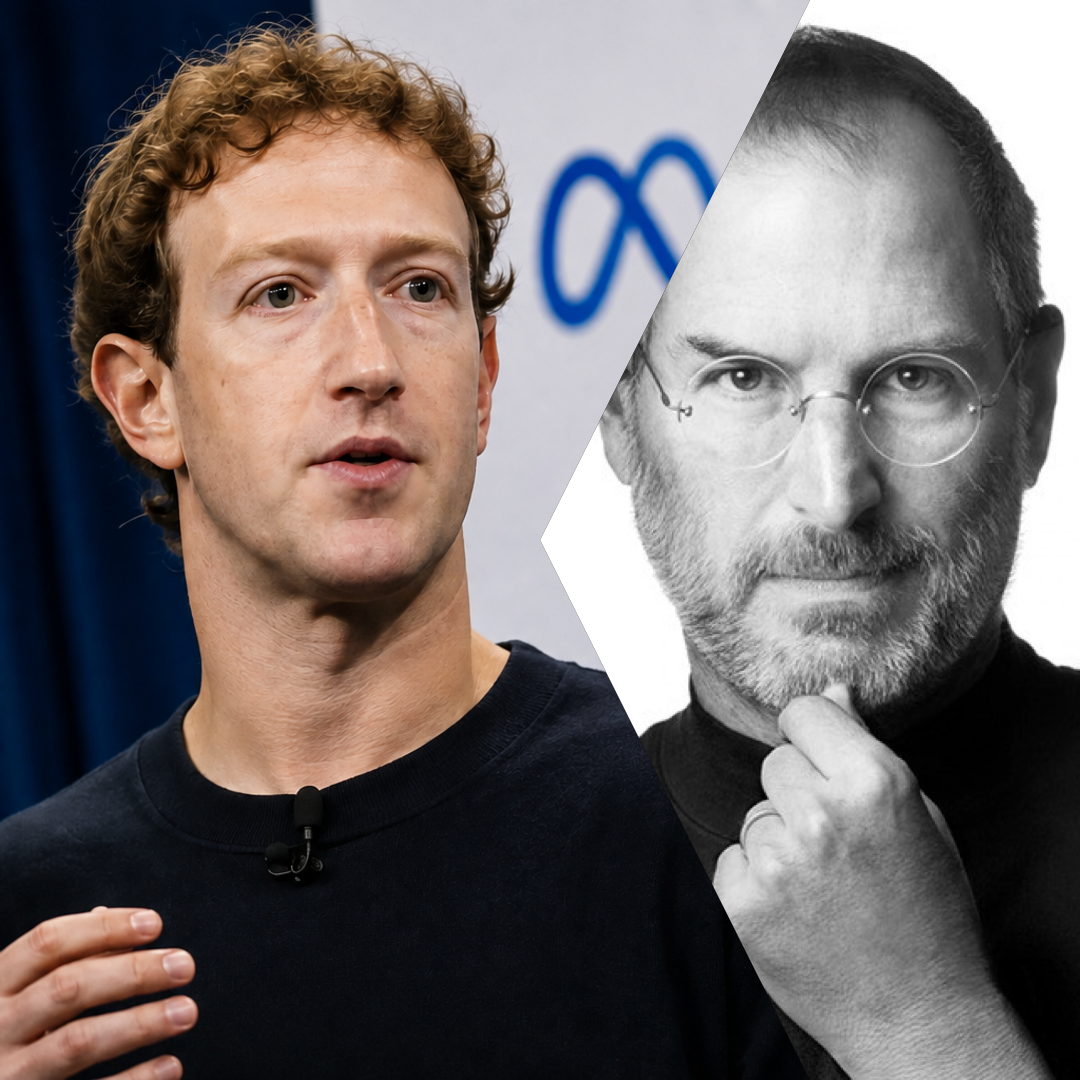
There is a question about the smartphone that we have largely avoided because the technology has delivered so many extraordinary benefits: did we create the most pervasive addiction in human history, and did Steve Jobs and Mark Zuckerberg, in very different ways, help build the infrastructure that made it possible?
I am not suggesting that Jobs set out to create an addictive device or that Zuckerberg set out to make billions of people psychologically dependent on social media. Or did they?
Both men created extraordinary technologies that transformed how we communicate and interact with the world but at what cost ?
The real issue is what happened when the smartphone, social media, algorithms, behavioral psychology and an advertising-driven business model converged into a device that most of us now carry everywhere. It’s another appendage.
The recent verdict against Meta in New Mexico gives us an opportunity to ask that question. A judge ordered Meta to pay $567 million related to harms involving young people, following a previous $375 million jury verdict, bringing the total financial consequences in the case to approximately $942 million. Meta has said it disagrees with the ruling and plans to appeal.
The significance of the case, however, goes far beyond the dollar amount because it reflects a growing willingness to examine whether the design of digital platforms can itself contribute to harm rather than treating harmful behavior as simply the result of individual.
READ: Sreedhar Potarazu | Indians may be more connected. But are we connecting ? (August 2, 2026)
Facebook was simply a way to connect with friends, Instagram was simply a way to share photographs and the smartphone was simply a more convenient telephone. What we underestimated was the power created when these technologies were combined into a system in which the device is always available.
The scale of the transformation is extraordinary. The International Telecommunication Union estimates that approximately 82 percent of people aged 10 and older worldwide own a mobile phone, while the GSMA estimates that about 4.4 billion people were using their own smartphones to access mobile internet by the end of 2024. We are therefore not talking about a niche technology; the smartphone has become one of the most ubiquitous objects ever created.
The smartphone fundamentally changed that relationship by transforming the telephone into a portable computer and camera that connects to an endless stream of information, entertainment and social interaction.
Jobs helped create the device and interface that made computing intimate and portable, while Zuckerberg helped create the social environment that gave billions of people a reason to continually return to that device.
The television could capture our attention, but we had to sit in front of it. The desktop computer could connect us to the internet, but it generally remained on a desk. The smartphone eliminated those boundaries because the internet now accompanies us everywhere we go.
That is where the psychology becomes particularly interesting. Every time we reach for the phone, there is the possibility that something interesting will be waiting for us: a message, a photograph, a funny video, a news story, a financial update or simply something that makes us angry enough to continue scrolling. The reward is unpredictable, and that uncertainty can be a powerful mechanism for encouraging repeated behavior.
READ: Sreedhar Potarazu | AI is burning through free cash flow (July 25, 2026)
An image from space from would probably show most people with their head down on their phone.
This is also where the comparison with vaping becomes uncomfortable, although the comparison should not be taken literally because smartphones are obviously not nicotine delivery systems. The more useful comparison is about product design.
Imagine giving billions of people a device that delivered a substance and then discovering that changing its formulation, packaging or delivery mechanism caused people to consume it more frequently. Imagine also having billions of data points showing exactly which changes increased consumption and which ones caused people to come back for more. We would reasonably ask whether the manufacturer was simply selling a product or deliberately optimizing a system for repeated consumption.
Now replace the substance with attention.
That is essentially the business model behind much of the digital economy. The longer we remain engaged, the more advertising can be shown, the more behavioral data can be collected and the more precisely the platform can learn what keeps us coming back. The economic incentive is therefore to increase engagement, but what is good for engagement is not necessarily what is good for the human being.
A user might benefit from putting the phone down after twenty minutes, having dinner with the family or simply sitting quietly and thinking. The platform has little economic reason to celebrate that decision. It benefits when the user watches another video, reads another post, responds to another notification or continues scrolling.
This is why I think the more important question is not simply whether people are addicted to their phones, but whether we have created an environment that systematically rewards companies for making it harder for people to put their phones down.
We often place the entire responsibility on the individual, saying that people need more discipline or that parents need to impose better limits on their children. Individual responsibility certainly matters, but that explanation becomes inadequate when billions of people exhibit similar behaviors in response to similar technological environments.
READ: Sreedhar Potarazu | AI is burning through free cash flow
We did not accidentally create a system in which people check their phones dozens of times a day; we built an ecosystem in which every notification, recommendation and new piece of content provides another reason to look.
The irony is that the smartphone has unquestionably improved our lives. It allows us to communicate across continents, navigate unfamiliar places, access medical information, manage our finances, work remotely and learn almost anything.
The problem is not that the technology is bad. The problem is that we have never really established how much of our finite human attention we are willing to surrender in exchange for that convenience.
If someone spends four hours a day on a smartphone, that is roughly 1,460 hours a year, or more than sixty full twenty-four-hour days.
Perhaps the greatest consequence is that the smartphone has made boredom almost impossible. Waiting in line, sitting in a doctor’s office or simply being alone no longer requires us to sit with our thoughts because there is always something available on the screen. Yet boredom and silence once gave the mind room to wander, reflect and make connections that were not being supplied by an algorithm.
I would therefore hesitate to say that Jobs and Zuckerberg personally created the greatest addiction in human history. That is too simplistic.
READ: Sreedhar Potarazu | Chatbots can Auto-Tune our minds and voice: The Maya of AI (
What they helped create were two critical components of a much larger system: the smartphone became the delivery mechanism, social media became the content, algorithms provided personalization, behavioral science provided an understanding of reinforcement and advertising provided the economic incentive to capture attention.
The New Mexico verdict may ultimately be remembered not because Meta was forced to pay nearly a billion dollars, but because it represents a broader question about whether technology companies should be allowed to optimize indefinitely for engagement when the commodity being optimized is human attention, particularly when the users are children.
If we can put the phone down because we have consciously chosen to do so, the phone remains a tool.
If we repeatedly reach for it even when we have nothing to accomplish, nothing to communicate and nothing we actually need to see, perhaps we need to acknowledge that the relationship has changed.
The technology was supposed to serve us. The question now is whether we have reached the point where we are serving it.