



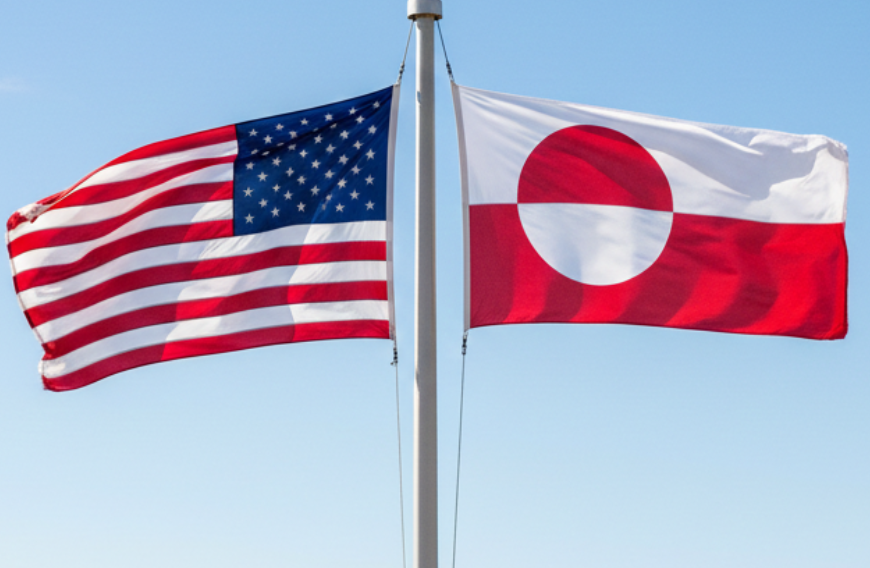
President Donald Trump has once again raised the idea of the United States acquiring Greenland,
calling the Arctic island strategically important and questioning its ability to defend itself against
growing global threats.
Speaking to reporters, Trump said Greenland’s current defense capabilities are limited, describing
them dismissively as “two dog sleds.” He argued that without stronger protection, the island could
become a target for influence from Russia or China. “If we don’t take it, somebody else will,” Trump
said, adding that the United States cannot allow rivals to gain control of such a critical location.
Greenland, the world’s largest island, is a self-governing territory under Denmark. While it manages
its own internal affairs, Denmark remains responsible for defense and foreign policy. The United
States already has a military presence there, including the Pituffik Space Base, formerly known as
Thule Air Base, which plays an important role in missile defence and space monitoring.
Trump, however, said that military cooperation is not enough. He suggested that full ownership of
Greenland would better protect U.S. national security interests, especially as competition in the
Arctic continues to increase. The region has gained attention in recent years due to melting ice,
which is opening new shipping routes and access to valuable natural resources.
Denmark and Greenland have strongly rejected Trump’s remarks. Danish leaders have repeatedly
stated that Greenland is not for sale, calling earlier suggestions unrealistic and inappropriate.
Greenland’s government has also emphasized that its people have the right to decide their own
future and have no interest in becoming part of the United States.
The renewed comments have raised concerns among U.S. allies and lawmakers. Critics say Trump’s
language risks damaging relations with Denmark, a longtime NATO ally, and could weaken
cooperation at a time when unity is important for global security. Some officials also worry that
openly discussing territorial acquisition sends the wrong message internationally.
Experts say Trump’s focus on Greenland reflects broader geopolitical tensions in the Arctic. Russia
has expanded its military presence in the region, while China has shown interest through research
projects and investments. These developments have pushed the United States and its allies to pay
closer attention to Arctic security.
While Trump insisted that the U.S. must act to protect its interests, he said he preferred a deal
rather than force. Still, his remarks about taking Greenland “one way or another” have caused
unease, both at home and abroad.
For now, Greenland and Denmark remain firm in their stance. The island is not for sale, and its
leaders say decisions about its future will be made by its people not foreign governments.
In a separate but equally controversial move, Trump recently posted a digitally altered image on his social media platform declaring himself the “Acting President of Venezuela,” a claim that quickly went viral and drew sharp global attention. The image, styled to resemble a Wikipedia page listing him in this role as of January 2026, emerged in the wake of the U.S. military operation that led to the capture of Venezuelan President Nicolás Maduro and his wife, who were transported to New York to face federal charges.
Despite this provocative post, there is no legal or internationally recognized basis for Trump’s self-designation, and Venezuela’s own Supreme Tribunal of Justice had already sworn in Vice President Delcy Rodríguez as interim president under the country’s constitutional process. The declaration has sparked widespread debate over U.S. involvement in Venezuela’s political affairs and raised fresh concerns about respect for national sovereignty.