


By Soumoshree Mukherjee
Editor’s note: This article is based on insights from a podcast series. The views expressed in the podcast reflect the speakers’ perspectives and do not necessarily represent those of this publication. Readers are encouraged to explore the full podcast for additional context.
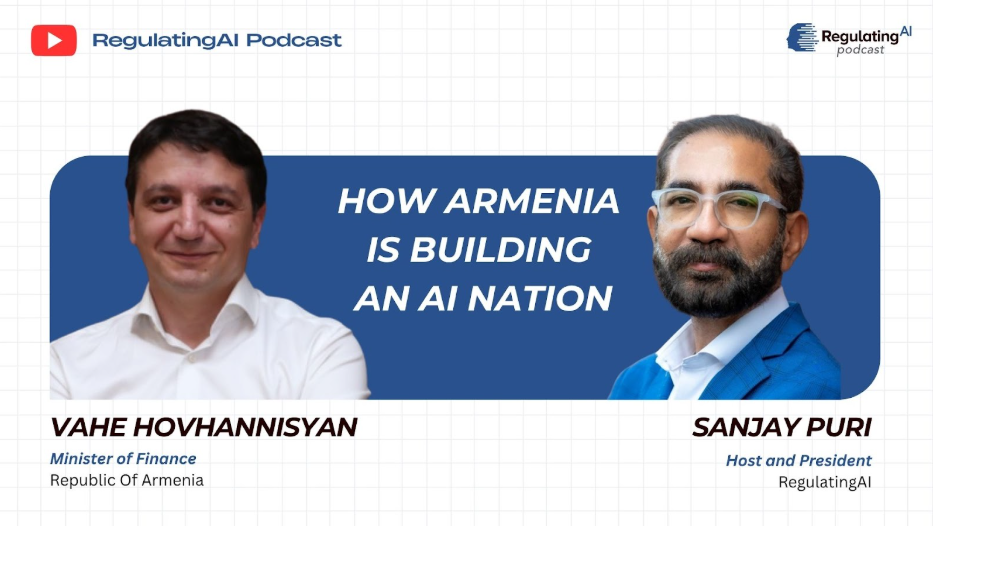
On an episode of the “Regulating AI” podcast hosted by Sanjay Puri, Armenia’s Minister of Finance, Vahe Hovhannisyan, discussed how the country is positioning itself within the rapidly evolving global artificial intelligence landscape. The conversation, recorded during the World Bank and IMF meetings, explored how a small nation with strong technical roots is aligning its economic vision with the realities of the AI era.
Introducing the guest, Puri noted that Armenia “straddles digital ambitions, security pressures, and the ever-evolving AI frontier.” The minister, an economist who previously worked with the Asian Development Bank, outlined how Armenia’s renewed technological ambitions build on a legacy that dates back to its Soviet past.
“In the 1980s, 3 percent of our population were engineers,” Hovhannisyan recalled, describing how Armenia had once been “one of the technological centers of the Soviet Union.”
He acknowledged that the 1990s brought a loss of capacity but emphasized that the country is “regaining its natural strength” through a growing high-tech ecosystem and partnerships with international firms.
READ: Nebraska’s Attorney General Mike Hilgers shares his take on AI-enabled child exploitation (
Among the most notable initiatives is a collaboration with Nvidia to establish an “AI Factory”—a large-scale data center designed to serve regional data processing needs. “This is a big data center, which will have huge capacity for the region,” Hovhannisyan said. Armenia’s surplus energy supply and engineering talent, he added, make it a suitable location for such infrastructure-intensive projects.
The discussion also highlighted Armenia’s growing reputation as a research and development hub. Companies such as Synopsys have operated in Armenia for years, while others, including Yandex and Nvidia’s R&D division, have moved operations there amid regional changes. “They know there is an existing ecosystem,” Hovhannisyan observed, describing Armenia as “a good place to live and to work.”
AI and the economy: Change, not a bubble
When asked whether current AI investments could form a speculative bubble, the minister disagreed. “I don’t think this is a bubble,” he said. “AI will replace some people and will challenge human beings to spend more time on personal development.” He characterized AI as a transformative force that will improve efficiency, allowing governments to redirect resources toward education and creative industries.
Within the ministry of finance, AI is already being used to enhance analytical and operational capacity. “We are using AI in our tax system,” Hovhannisyan explained, citing gains in data analysis, audit accuracy, and time management. Pilot projects are also planned in treasury and procurement functions, reflecting a wider effort to modernize fiscal administration.
On the governance side, the minister emphasized the need to preserve human engagement in public service. “Lots of people want their problem solved without dealing with anybody,” he said, “but we should keep the human touch.” Armenia has established agencies for digitalization and cybersecurity, with discussions underway to create a dedicated AI authority.
At the end of the podcast, Hovhannisyan referred to Armenia’s recent peace agreement with Azerbaijan and a new cooperation framework with the United States covering power, technology, and AI. These developments, he said, make Armenia “an interesting place on the map to explore” for investors and innovators.
Puri concluded that Armenia’s example—grounded in education, infrastructure, and responsible innovation—illustrates how smaller economies can leverage AI for national growth. As the minister remarked, “We are starting the process… the big change has not yet happened.”