



By Soumoshree Mukherjee
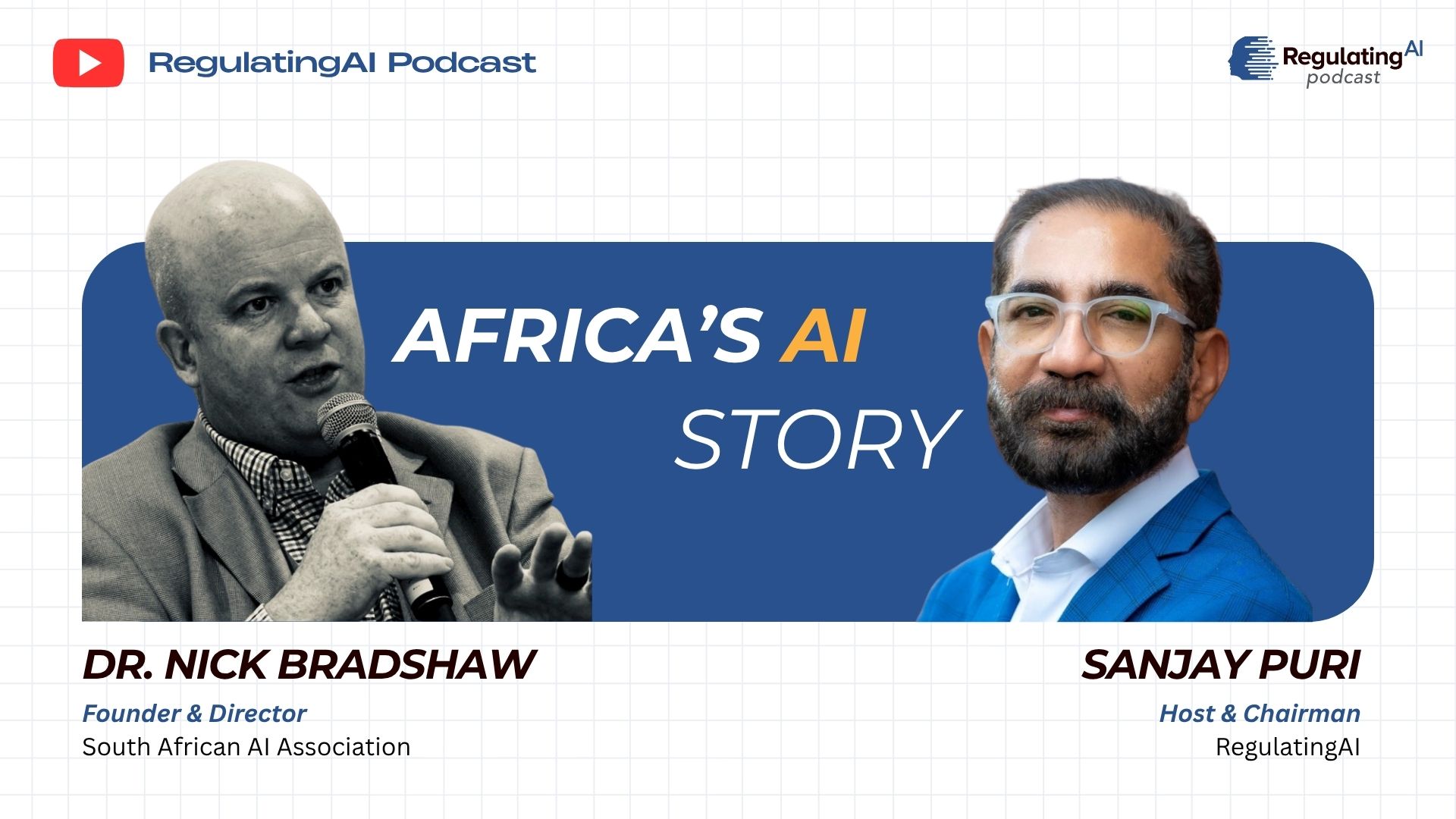
In a world where the AI narrative is dominated by the U.S., China and Europe, the “Regulating AI Podcast” recently shifted the spotlight southward. Host Sanjay Puri sat down with Dr. Nick Bradshaw, founder of the South African Artificial Intelligence Association and creator of AI Expo Africa, for a conversation that revealed why Africa may be one of the most important frontiers in the future of AI.
From the outset, Puri introduces Bradshaw as “someone who has seen AI from the global North’s boardrooms and the global South’s innovation hubs.” With 25 years of experience in Europe and North America and now 16 years in South Africa, Bradshaw has become one of the continent’s most vocal champions of homegrown AI innovation.
READ: ‘We were AI before AI was cool’: Emerson CTO Peter Zornio on boundless innovation (August 18, 2025)
Reflecting on his work since 2017, Bradshaw explains that the journey began with a “complete absence of data” about Africa’s AI ecosystem. This gap inspired his team to create the State of AI in Africa report, the Synapse magazine, and the continent’s largest enterprise AI gathering, AI Expo Africa.
All of these, he says, help ensure that Africa “doesn’t necessarily just simply want to be a consumer, it wants to be a contributor and to build its own ecosystem, its own frameworks, its own models” in the global AI landscape.
Yet Africa’s size and diversity also shape its unique challenges. He noted that Africa is a geography where you can fit North America, China, India and South America, “but actually, across the whole of the continent, the number of companies with a declared specialism in AI is about the same as the total number of companies in the state of California.” South Africa leads, with Nigeria close behind, but Bradshaw emphasizes innovation across the continent, from Tunisia to Kenya.
One of the biggest questions from listeners was whether Africa could compete without massive compute infrastructure. Bradshaw was direct: “The number one path is collaboration.” Hyperscalers like Microsoft, Google and Amazon are expanding their presence, while new initiatives such as Cassava’s plan for AI factories signal a shift. Entrepreneurs, Bradshaw suggests, must leverage global cloud programs and regional partnerships.
On concerns about data colonialism, Bradshaw returns repeatedly to data sovereignty. “Don’t try to reinvent the pen. Just be clever what you do with your story,” he says, arguing that Africa must own its data and models even if it doesn’t manufacture chips.
Language representation is another frontier. With over 2,000 African languages, many still lack basic NLP support. Bradshaw highlights the Masukane Project, calling it a vital step in ensuring that lived realities are represented in AI systems.
On job losses, Bradshaw is pragmatic yet hopeful. Call centers may be vulnerable, but remote work and youth adoption of AI hint at a leapfrog moment similar to Africa’s early lead in mobile money.
Bradshaw added, the first AI for Good Impact Africa Summit prepares to launch alongside AI Expo Africa, set to bring together thousands of voices, the continent is positioning itself not on the sidelines, but at the center of the global AI movement.
As the conversation wrapped up, one thing became clear: Africa’s AI future is not a distant aspiration but an active, collective undertaking driven by builders like Dr. Nick Bradshaw. His call for collaboration, sovereignty, and locally rooted innovation echoed as both a challenge and an invitation to the global community.