


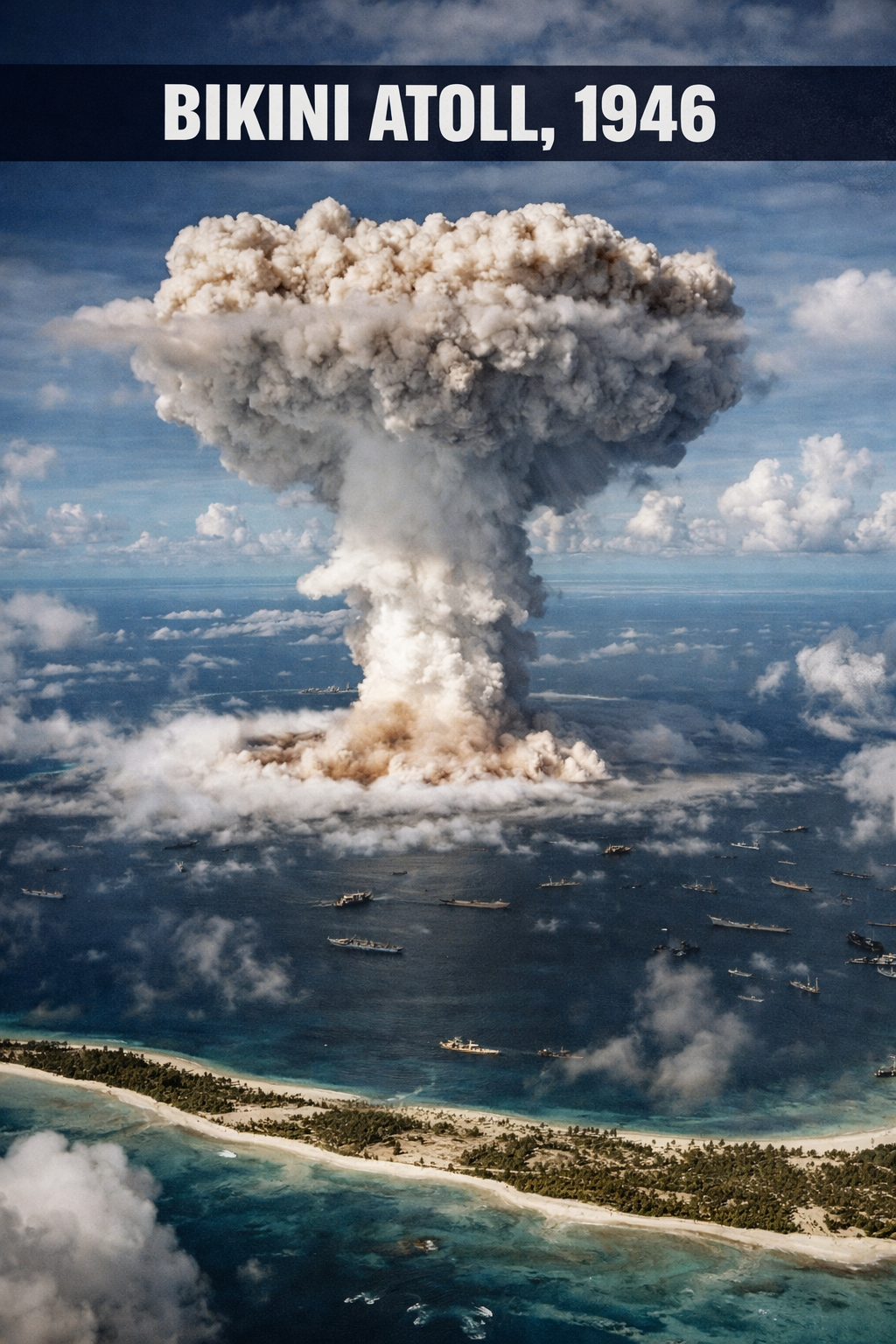
Bikini Atoll, 1946.
Here’s the scene: children are playing on white sand beaches, women are weaving pandanus leaves into sleeping mats, men are preparing outrigger canoes for the day’s fishing. Within weeks, these 167 Bikinians would be relocated from their ancestral home so that America could test whether humanity had perfected the art of its own extinction.
On July 1, 1946, the world watched, literally, through newsreels and radio broadcasts, as the United States detonated “Able,” the first of 23 nuclear tests that would transform Bikini Atoll from paradise to laboratory. The Baker test followed on July 25, creating the iconic mushroom cloud photograph that would become shorthand for the atomic age.

Over the next twelve years, the U.S. conducted a total of 67 nuclear tests across the Marshall Islands, with Bikini serving as ground zero for some of the most powerful explosions ever created by human hands, including the 15-megaton “Castle Bravo” shot in 1954, the largest nuclear device America ever detonated, and one that was twice as powerful as predicted.
The islanders were told they were leaving temporarily, that they would return when the tests concluded. That was 80 years ago. They never went back to their old lives.
The Bikinians were moved first to Rongerik Atoll, where food was scarce and starvation loomed. Then to Kwajalein, where they lived in tents. Finally to Kili Island, where the absence of a lagoon made traditional fishing impossible. A 1968 attempt at resettlement failed when scientists discovered radiation levels remained dangerously high. Those who did return temporarily showed elevated levels of cesium-137 in their bodies. By 1978, they were evacuated again.
The health consequences materialized gradually, then devastatingly. Studies of Marshall Islanders exposed to fallout from nuclear testing have documented thyroid cancers, leukemia, and other radiation-related illnesses at rates far exceeding background levels. A 2019 study published in the Proceedings of the National Academy of Sciences found radiation levels in the lagoon sediments and groundwater of several Marshall Islands atolls, including Bikini, still exceed U.S. safety standards by factors of ten to thousands. The half-life of plutonium-239 is 24,000 years. The Marshall Islands will be radioactive long after our civilization’s memory of them fades.
The Review by Ajay Raju: Warning: Contains upsetting comments (about Philadelphia’s leaders) (
Meanwhile, four days after the Baker test in July 1946, French designer Louis Réard unveiled his scandalous two-piece swimsuit at a Paris fashion show, naming it the “bikini” because he hoped it would create an “explosive” reaction. He was right. The garment sparked moral outrage across conservative circles even as it revolutionized beachwear. The Vatican declared it sinful. Spain and Italy banned it from beaches. But, by the 1960s, the bikini had become ubiquitous in Western popular culture, immortalized by Ursula Andress emerging from Caribbean waters in Dr. No and celebrated in Brian Hyland’s hit song “Itsy Bitsy Teenie Weenie Yellow Polka Dot Bikini.”
Today, if you mention “Bikini” to most people under forty, they think of swimwear, not nuclear testing. The global swimwear market, valued at $18.6 billion, is projected to reach $26.2 billion by 2030. The word itself has become completely severed from its origin, a linguistic appropriation that erased trauma beneath fashion and commerce.
Is this how progress forgets its costs? Is this how innovation papers over the names of those who paid for it?
I’ve been thinking about these questions because of a conversation I had recently with my friend Wadud Ahmad during one of our regular visits. Wadud has this gift for teaching me history I should know but somehow don’t, for expanding the aperture of my lens when it’s narrowed too much by the familiar. This time, he mentioned Tuskegee.
I’m ashamed to admit I didn’t know much about that history. The name was vaguely familiar, something I’d heard in passing, but the details had never penetrated my consciousness. Perhaps because it happened to a different “other” than the communities I’m most attuned to. Perhaps because our education conveniently omits certain chapters. Perhaps because I, like most of us, am better at remembering injustices that feel closer to home.
As Wadud explained what the U.S. Public Health Service had done, studying untreated syphilis in Black men for forty years, denying them life saving, standard treatment, I felt a familiar discomfort. Not unfamiliar terrain, exactly, but a recognition of a pattern I’d seen before without quite naming it.
I wonder if there’s a pattern to these stories of progress built on bodies? Do these tragedies always seem to happen to different types of “other,” and does that very fragmentation, that division into separate categories of suffering, prevent us from seeing the larger architecture of how innovation so often proceeds?
When I began pulling on the threads of the Bikini story, I followed the seams to wherever it led. I first dug into the Tuskegee Syphilis Study. 600 African American men, 399 with syphilis, 201 without, enrolled between 1932 and 1972 in a U.S. Public Health Service study that promised free medical care but actually withheld treatment to observe the disease’s natural progression. Penicillin became the standard treatment for syphilis in 1947, but researchers continued the study, denying treatment to these men who believed they were receiving healthcare. At least 128 participants died from syphilis or related complications. Wives became infected. Children were born with congenital syphilis. The study only ended when a whistleblower leaked information to the press in 1972.
The medical knowledge gained was negligible. European researchers had already documented syphilis progression decades earlier. But the damage to African American trust in medical institutions persists to this day, manifesting in lower rates of participation in clinical trials and vaccination programs, health disparities that echo across generations. President Clinton formally apologized in 1997, but apologies don’t resurrect the dead or heal institutional betrayal.
My next stop was Henrietta Lacks and her contributions to cancer research. Her cervical cancer cells, harvested without her knowledge or consent in 1951 at Johns Hopkins Hospital, became the immortal HeLa cell line that revolutionized medical research. Those cells have been bought and sold gazillions of times over. They’ve been instrumental in developing the polio vaccine, advancing cancer research, AIDS treatment, gene mapping, and countless other breakthroughs. Yet Henrietta Lacks died in poverty at age 31, her family never receiving compensation and remaining unaware of her contribution to science until the 1970s.
Her cells were sent to space, exposed to nuclear testing, used by pharmaceutical companies generating billions in revenue. Only in 2013, after Rebecca Skloot’s book The Immortal Life of Henrietta Lacks sparked public consciousness, did the NIH finally grant the Lacks family some control over how her cells could be used. Even now, while her name is increasingly known, the broader principle remains unchanged: informed consent in medical research was practically nonexistent for poor and minority patients in mid-century America. How many other Henriettas are there, whose biological material enriched pharmaceutical companies while their descendants struggled?
The Review by Ajay Raju: Postcard from Dubai (
I eventually travelled back further, to the thousands of Chinese laborers who built the transcontinental railroad, that spine of American expansion and industrial might. Between 1863 and 1869, approximately 12,000 Chinese workers, perhaps more, were employed by the Central Pacific Railroad to blast through the Sierra Nevada mountains, enduring brutal conditions, avalanches, explosives accidents, and industrial disease. They were paid roughly two-thirds what white workers earned, despite doing the most dangerous work. Historians estimate anywhere from 1,000 to 1,500 died during construction, though exact numbers are unknown because company records didn’t carefully document Chinese casualties.
When the golden spike was driven at Promontory Summit, Utah, on May 10, 1869, marking the railroad’s completion, that iconic photograph reproduced in every American history textbook, not a single Chinese face appears in the frame. They were explicitly excluded from the ceremony. The railroad made fortunes, accelerated Western settlement, and knitted the nation together economically. But the Chinese Exclusion Act followed in 1882, and for decades, Chinese railroad workers were written out of the triumph narrative, remembered only as nameless coolies rather than the engineers and laborers who made continental connection possible.
The Radium Girls are another example in this anthology of forgotten sacrifice. In the 1920s, young women working in watch factories would paint luminous radium onto clock and watch dials, instructed to lick their brushes to maintain a fine point, a technique called “lip pointing.” The radium made their work glow beautifully. It also made their bones disintegrate and their jaws literally fall off.
The women began developing devastating illnesses: anemia, bone fractures, necrosis of the jaw (known gruesomely as “radium jaw”). When they sued their employers, U.S. Radium Corporation and others, the companies fought viciously, hiring doctors to produce fraudulent reports attributing deaths to other causes, arguing the women had syphilis rather than radiation poisoning. The legal battle stretched for years. Many women died before receiving any compensation. Yet their suffering eventually led to landmark occupational safety standards, improved labor laws, and stricter regulations around workplace exposure to toxic substances. The glow-in-the-dark watches and clocks that Americans loved were made possible by young women whose names most of us will never learn.
These stories share a pattern: vulnerable populations, geographically isolated, economically disadvantaged, racially marginalized, bearing disproportionate costs for advances that benefit the powerful and the many. The progress is real. Atomic energy did reshape geopolitics and provide carbon-free power. Medical research has saved millions. The transcontinental railroad built modern America. Labor protections now prevent some of the abuses that killed the Radium Girls.
But why does progress so often demand this particular math, where the powerless are denominated as acceptable losses?
We have not learned from these tragedies. The same pattern is repeating itself in modern cobalt mining in the Democratic Republic of Congo, where approximately 70% of the world’s cobalt essential for lithium-ion batteries powering electric vehicles and smartphones is extracted. Child labor, unsafe working conditions, and environmental devastation are the reality in these Congolese cobalt mines, even as consumers, like me, congratulate ourselves on purchasing “green” technology. The electric vehicle revolution is built, in part, on the backs of Congolese miners earning $1-2 per day in collapsing tunnels.
In biotech space, clinical trials are increasingly conducted in lower-income countries where regulatory oversight is weaker and “treatment-naive” populations provide cleaner data. While trials in low- and middle-income countries generated data leading to drug approvals in wealthy nations, the resulting medications often remain unaffordable to populations in countries where testing occurred. Progress for some, at the expense of others. Often the same choreography, different dancers.
The uncomfortable truth is that consent and compensation often arrive only after harm becomes undeniable and victims gain enough voice to demand acknowledgment. The Bikinians received a Nuclear Claims Tribunal award of $563 million in compensation, but the U.S. has paid only a fraction through a trust fund generating approximately $15 million annually, nowhere near adequate to address health care costs, relocation expenses, and lost homeland. The Marshall Islands government has repeatedly petitioned for additional compensation. As of January 2026, most claims remain unsettled.
Henrietta Lacks’ family reached a settlement with Thermo Fisher Scientific in 2023 for undisclosed terms. Better late than never? Or too little, too late? The Radium Girls’ lawsuits eventually succeeded, but only after many plaintiffs died. The Chinese railroad workers have no living descendants who can seek recompense for specific harms; the injustice is too old, the victims too dispersed, the records too sparse. Time itself becomes a form of erasure.
So what do we do with this history? How do we hold both the marvel of progress and the memory of its price?
Perhaps we begin by refusing the false binary that innovation requires sacrifice of the vulnerable, that advancement must be purchased with someone else’s suffering. This framing serves power by naturalizing harm as inevitable. But history also provides counter-examples: Jonas Salk refusing to patent the polio vaccine, saying “Could you patent the sun?” Or, the development of informed consent protocols in medicine. Environmental impact reviews. Occupational safety regulations. These represent progress learning from its own brutality, though always belatedly, always after bodies accumulate.
The Review by Ajay Raju: Hero wanted: Paging Dr. Fajgenbaum (
We might also resist the linguistic erasures that allow us to forget. Every time we say “bikini,” we could remember Bikini Atoll. Not in morbid obsession, but in honest accounting. The swimwear need not be renamed, but the history should be taught. When we use medical advances, we might acknowledge the Henrietta Lacks and Tuskegee victims whose involuntary contributions made them possible. Memory is the least we owe, and even that we’re reluctant to pay.
There’s a broader question here about how societies metabolize uncomfortable truths. We prefer heroic narratives, brilliant scientists, visionary industrialists, determined engineers conquering nature and disease. These stories aren’t false, but they’re incomplete. The full story includes the Bikinians watching their islands vaporize from a Navy ship, the Chinese railroad workers buried in unmarked graves, the Radium Girls whose bones glowed in the dark long after death.
Recent years have witnessed growing recognition of these forgotten costs. The #MeToo movement revealed systemic abuse behind entertainment empires, investigations into tech industry labor practices exposing exploitation in supply chains, environmental justice movements documenting how pollution concentrates in poor and minority neighborhoods. Perhaps we’re entering an era of greater accountability, where progress is measured not just by innovation but by equity in its distribution and honesty about its costs.
Or perhaps this, too, is wishful thinking. As I write in early 2026, artificial intelligence is being hailed as the next frontier, transformative potential comparable to electricity or the internet. The leading AI companies are already facing questions about whose work trained their models without compensation, whose jobs will be displaced, whose communities will bear the costs of massive data centers and energy consumption. Will we learn from Bikini Atoll and Henrietta Lacks? Or will we reproduce the same pattern: dazzling innovation, concentrated benefits, diffused costs borne by the powerless, followed by belated apologies?
The Bikinians remain scattered across the Marshall Islands and in diaspora communities in the United States, particularly in Arkansas and Oklahoma. In 2010, Bikini Atoll was designated a UNESCO World Heritage Site, recognized for its role in nuclear testing history. Tourists can now dive the radioactive lagoon to see sunken naval vessels from Operation Crossroads, the very tests that displaced the islanders. The irony is sharp enough to cut: their homeland transformed into an attraction for adventure seekers, while the Bikinians themselves cannot safely return.
Louis Réard died in 1984, having lived long enough to see his bikini become a multibillion-dollar global industry. The last surviving Bikinian who remembered life before the tests died in 2021, taking with him unmediated memory of what was lost. Soon there will be no one left who can describe Bikini Atoll as a living home rather than a scientific curiosity or etymological footnote.
I guess this is how forgetting happens: not in dramatic erasure, but in gradual fading, in the replacement of complex human stories with simplified commercial associations, in the death of witnesses, in the failure to pass memory to new generations. The bikini swims on in popular culture. The Bikinians fade into historical obscurity.
We cannot undo what was done. The bombs detonated. The cells were taken. The workers died. But we can resist the secondary violence of forgetting. We can tell the full story of our progress, acknowledging that the march of innovation often trampled specific people with names and faces and children who inherited their suffering. We can build new frameworks where consent matters, where compensation arrives before harm becomes irreversible, where the vulnerable have voice enough to refuse being sacrificed on the altar of advancement.
Or we can continue as we have, marveling at our achievements while the Bikinians wait for justice, while new populations we haven’t yet named pay costs we haven’t yet calculated for progress we’ll celebrate without acknowledging its price.
The choice, as always, is ours. But are we willing to look clearly at what we’ve done, to whom, and whether we’ll do differently going forward?
The mushroom clouds have long since dispersed. The radiation remains. And somewhere, a woman walks on a beach wearing a bikini, the word weightless on her tongue, emptied of its history, floating free of the island that gave it meaning, innocent of the price paid so that progress could stride forward while forgetting to look back at whom it stepped on along the way.