



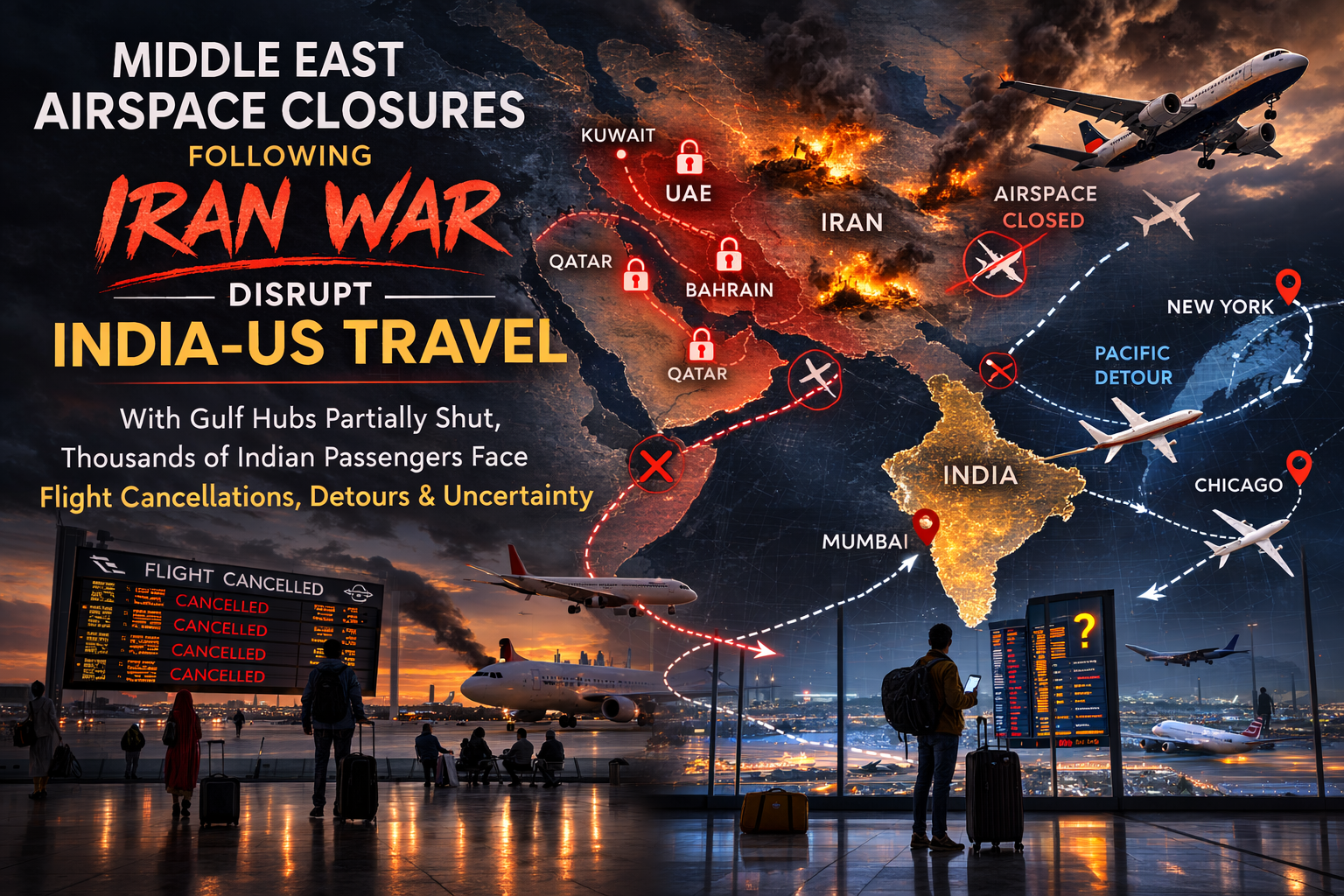
With Gulf hubs partially shut and Air India suspending regional flights, thousands of Indian passengers face cancellations, longer Pacific detours, and mounting uncertainty as war reshapes global air routes.
U.S.-Israeli military strikes on Iran, launched on Saturday, have triggered cascading disruptions in global air travel, throwing thousands of passengers, including Indian travelers bound for the United States and Canada into uncertainty as key Middle Eastern air corridors shut down.
With Israel and Iran directly engaged in hostilities, several Gulf nations, including the United Arab Emirates, Qatar, Bahrain, and Kuwait, have fully or partially closed their airspace as a precaution.
The ripple effects are being felt far beyond the conflict zone. For Indian passengers, many of whom rely on Gulf hubs to connect to North America and Europe, the closures have meant cancelled flights, extended layovers, and in some cases being stranded in India while scrambling for alternate routes — often via the Pacific.
The escalation follows weeks of rising tensions between Israel and Iran, culminating in coordinated U.S.-Israeli strikes targeting Iranian military infrastructure. Iran has vowed retaliation, raising fears of a broader regional war that could engulf much of the Middle East. As missile and drone threats loom over the Gulf, aviation authorities are prioritizing safety over continuity.
READ: AI, war in Iran, and the sovereignty struggle over autonomous technology (
In an Instagram post, the UAE’s General Civil Aviation Authority said the country’s airspace had been “partially closed as an exceptional precautionary measure aimed at ensuring the safety of flights and aircrews, and safeguarding the UAE’s territory, amid rapidly evolving regional security developments.”
The UAE is home to some of the world’s busiest transit hubs, including Dubai and Abu Dhabi, making even partial closures deeply consequential.
The Gulf and wider Middle East form a critical aviation bridge between Europe and Asia. For Indian travelers especially, hubs such as Dubai, Abu Dhabi, and Doha serve as indispensable gateways to the West.
With Russian and Ukrainian airspace already closed to most airlines because of the ongoing war in Eastern Europe, global flight paths have grown increasingly constrained. The latest Middle East closures further squeeze available routes, forcing airlines to undertake longer and more expensive detours.
Air India announced it would temporarily avoid the Middle East altogether. In a travel advisory posted on X, the airline said: “In view of the current situation in the Middle East, Air India has cancelled all flights to destinations in the region until 2359 hours on 1 March.”
On social media, anxious passengers flooded airline comment sections, posting their flight details and travel schedules while seeking clarity. Several users shared specific routes, asking whether their journeys would proceed as planned. One user simply wrote, “Mumbai to New York,” while another said they were scheduled to travel to Chicago, reflecting the uncertainty faced by long-haul travelers.
Investor Basant Maheshwari wrote on X: “A friend is taking a flight from Washington DC to Dubai in a few hours and @emirates call center is shut. No one is taking the call! What are the call centers for??” His post underscored the frustration many travelers say they are experiencing as they struggle to reach airlines for updates amid the rapidly evolving situation.
The Gulf’s centrality to Indian aviation cannot be overstated. According to Aviation Business, about 41 percent of India’s international passenger traffic connects through Middle Eastern carriers and destinations. These Gulf airlines dominate India’s long-haul connecting market, often carrying the largest share of Indian passengers traveling beyond South Asia.
An aviation blogger, citing Business Standard, noted that historically more than 70 percent of Indian international travelers prefer connecting through Middle Eastern hub airports when flying long-haul. One key reason is frequency and accessibility: Gulf carriers offer daily or multiple daily departures from major Indian metros as well as Tier 2 and Tier 3 cities. This allows passengers to bypass congested hubs such as Delhi or Mumbai, connecting seamlessly through Dubai, Doha, or Abu Dhabi to cities across North America and Europe.
Now, with those corridors compromised, airlines and passengers alike are being forced to rethink travel strategies. Routes via Southeast Asia and across the Pacific are emerging as alternatives, though often at higher cost and with longer travel times.
As the conflict intensifies, aviation has become one of its most immediate civilian casualties, an illustration of how regional wars can quickly disrupt global mobility, commerce, and the everyday journeys of travelers thousands of miles away.