



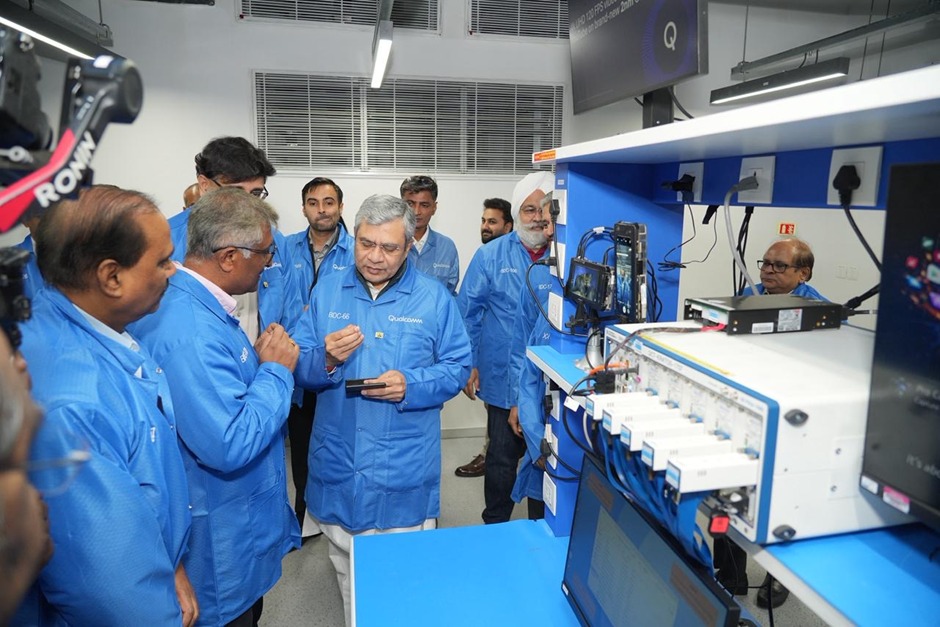
Leading American chipmaker Qualcomm Technologies has announced the tape-out of its 2nm semiconductor design, marking a significant moment in advanced chip design amid India’s rapidly expanding semiconductor ecosystem.
The breakthrough, developed with key contributions from Qualcomm’s engineering centres in Bengaluru, Chennai and Hyderabad, reinforces India’s rising stature as a global hub for cutting-edge chip design.
The company said the achievement reflects the depth of its India engineering footprint, now its largest outside the United States, and highlights the country’s expanding role in advanced semiconductor innovation.
The milestone was showcased at Qualcomm’s Bengaluru facility during a visit by Ashwini Vaishnaw, Indian Minister for Railways, Information & Broadcasting, and Electronics & IT, according to Indian media reports.
“India is increasingly at the center of how advanced semiconductor technologies are being designed for the future,” Vishnaw said, calling the development a testament to the growing maturity of the country’s design ecosystem and aligned with its ambition to build a globally competitive semiconductor industry.
With more than two decades of continuous investment in India, Qualcomm has built deep capabilities spanning wireless, compute, artificial intelligence and system-level engineering. Its India teams contribute across design implementation, validation, Al optimisation and system integration, supporting global architecture and platforms that power billions of devices worldwide.
Read: China probes Qualcomm amid Trump’s 100% tariff dispute
Amitesh Kumar Sinha, Additional Secretary, Ministry of Electronics & IT and CEO, India Semiconductor Mission said, “India’s Semiconductor Mission is progressing with strong momentum, supported by a strengthening design ecosystem and sustained industry participation.
“Investments in advanced engineering and R&D capabilities are important to building long-term semiconductor capacity in the country,” he said. “Qualcomm’s long-term commitment to India reflects the growing depth of India’s semiconductor design ecosystem and contributes to India’s broader ambition of becoming a globally competitive hub for semiconductor innovation.”
Srini Maddali, Senior Vice President, Engineering at Qualcomm India, described the 2nm tape-out as a validation of the engineering depth in the country. “Working closely with global program and architecture teams on advanced semiconductor design requires the very best talent, and our India teams consistently deliver at a global standard,” he said.
Read: Qualcomm announces plans to launch data center processors that link to Nvidia chips (
Qualcomm said its India R&D centres now contribute across multiple layers of system design — from architecture to software platforms and Al-driven use-case optimisation — particularly critical in the era of intelligent and connected systems.
The successful 2nm tape-out comes at a time when India is accelerating efforts to position itself as a global semiconductor hub through policy support, ecosystem incentives and industry partnerships. Qualcomm’s latest milestone adds momentum to that push, signalling that India is not just assembling chips for the world, but increasingly helping design the future of them.
San Diego headquartered Qualcomm’s presence in India spans over 20 years of continuous investment, during which the company has built one of its largest engineering development capabilities outside the United States.