


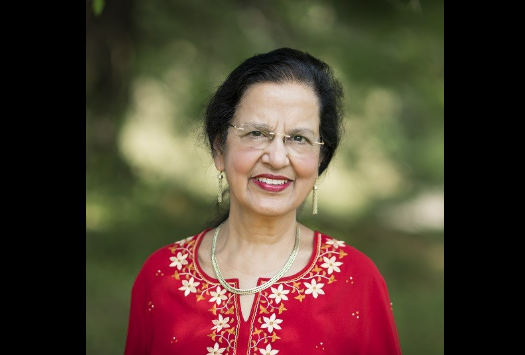
In October 1957, a 7-year-old girl stood in a backyard in Lucknow, India, watching a tiny point of light streak across the dawn sky. That glimpse of Sputnik, the world’s first artificial satellite, sparked a dream that would eventually bridge three continents and define the optics of modern astronomy.
Dr. Hashima Hasan, now a veteran NASA program scientist, shares her journey of turning “the impossible dream” into a career that ensured the world’s most famous telescopes stayed in focus, in an article on NASA website. Her story is not just one of scientific achievement, but of a persistent push against the social pressures that often sidelined women in physics during the mid-20th century.
After earning a doctorate in theoretical nuclear physics from the University of Oxford in 1976, Hasan navigated the precarious path of international academia. By the mid-1980s, she arrived in the United States with two infant sons and a resume that oscillated between nuclear research and environmental science. It was this versatility that led her to the Space Telescope Science Institute in Baltimore.
Read: mA life among the stars: Sunita Williams retires from NASA after 27 years
There, Hasan was tasked with a monumental challenge: writing the software to simulate the optics for the Hubble Space Telescope. When Hubble launched in 1990 with a flawed primary mirror a tiny error no thicker than a human hair, Hasan became the “optical telescope assembly scientist.” It was her job to keep the observatory from drifting out of focus until a physical fix could be installed.
“I have the dubious distinction of being the first and only scientist whose task was to keep the Hubble ‘in focus’ until a fix could be designed,” Hasan noted, recalling how she successfully focused the telescope in a single attempt during the historic 1993 servicing mission.
Her leadership extended far beyond Hubble. Hasan played a foundational role in the James Webb Space Telescope (JWST) when it was still a conceptual “Next Generation Space Telescope” in the 1990s.
She navigated complex international negotiations with European and Canadian space agencies and oversaw the selection of the Mid-Infrared Instrument (MIRI), which now peers through cosmic dust to see the birth of stars.
Reflecting on decades at NASA, Hasan views the success of these missions as a testament to a “can-do” spirit that thrives on collaboration. She remains a vocal advocate for the idea that space exploration is a universal right.
“The sky belongs to all of us,” Hasan said, encouraging the next generation of researchers to ignore the skeptics. Her career serves as a reminder that the path to the stars often begins with a single, clear night and the courage to look up.