


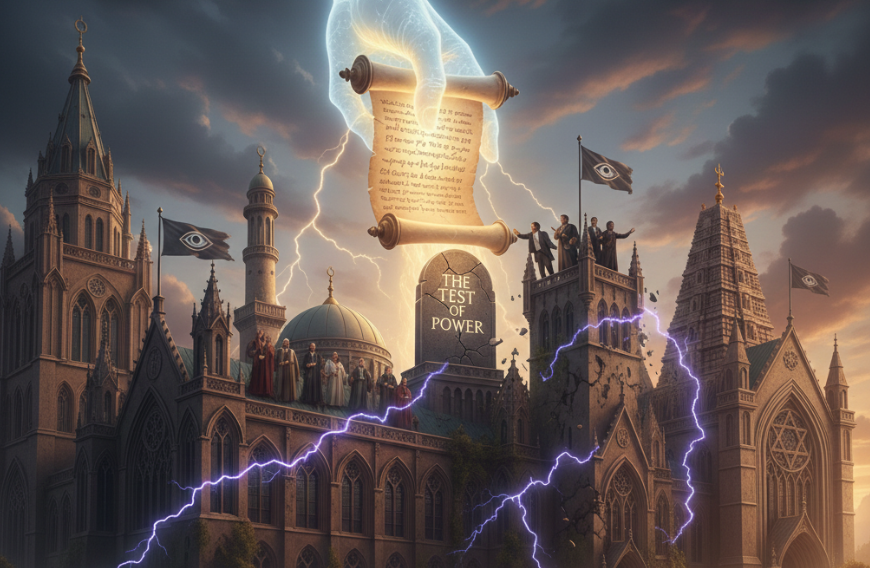
Two aliens from a distant world look down at Earth and try to understand who is in charge.
One asks, “Who are the rulers, the leaders, or is there higher power?”
The other watches the people below and says, “There are nearly two hundred countries, each with its own government, army, and borders. But billions of people on Earth also believe in a ‘higher power’ that stands above their authority. So who is their ruler?”
On one side of the globe they see people who express their faith through the Bible, which teaches that God is eternal and above earthly kings. “In Christianity, Jesus teaches that people should give the government its due but also remember their duty to God.”
On the other side, they see people defined by its constitution as a secular republic, who follow the teachings found in the Bhagavad Gita, which describes divine authority as higher than human rule and links moral order to spiritual truth.
Then they look over to the middle of the globe.
“In regions shaped by Islam, believers speak of Allah as the ultimate authority over the universe. In Judaism, the Torah describes a covenant between God and the people.”
They now seem confused and wonder, “If these faiths all suggest that there is a power higher than man, what happens when governments fight over land, resources, or political power? At what point does human authority begin to act as if it is higher than the moral principles people say they believe in?”
They see smoke and missiles flying across the globe but don’t know why.
From the perspective of the two observers, a war from afar appears less like a single event and more like the expression of a deeper human question.
READ: Sreedhar Potarazu | AI sovereignty race: US and China lead, India watches (
The first alien finally says, “Humans seem to have very sophisticated technology and built complex governments, but they still struggle with the ancient problem of how to balance belief, authority, and survival.”
The universal divide
Throughout recorded history, conflicts in which religion played a central or contributing role have likely resulted in tens of millions of deaths. Some historians estimate that the number of deaths associated with religiously framed or sectarian conflicts could be roughly in the range of 70-100 million or more, though such figures vary depending on how one defines the role of religion in those conflicts. What is most important is not the precise count but the recognition that faith, when fused with political ambition, identity struggles, or territorial power, has at times been used to justify enormous human suffering.
No matter the historical or political cause, violence in the name of religion, ideology, or national ambition cannot be morally justified when it results in the deliberate destruction of innocent human life. History may explain why violence occurs, but explanation is not the same as moral endorsement, and the suffering of civilians should never be accepted as a necessary cost of faith, power, or political victory.
Most people across the world would agree that Ayatollah Ali Khamenei needed to be removed from power for the atrocities, repression, and systemic human rights violations committed over several decades under his authority. Theocratic rule in Iran, institutionalized since the 1979 revolution, fused absolute political power with clerical supremacy, leaving little room for dissent, pluralism, or democratic evolution.
The resulting vacuum in a Shia-majority state long governed by a Supreme Leader who derived authority from religious doctrine rather than electoral legitimacy now raises urgent and uncomfortable questions. When a nation’s highest office is defined not merely by constitutional structure but by theological mandate, what forces shape the future of leadership once that mandate is disrupted? Who determines whether governance remains tethered to religious guardianship or transitions toward secular sovereignty?
To understand the deeper fault lines, one must begin with the historical schism within Islam itself.
The division between Shia and Sunni Muslims originated in 632 CE following the death of the Prophet Muhammad. The dispute centered not on theology but on succession. Sunni Muslims, who constitute approximately 85–90 percent of the world’s nearly two billion Muslims, believed that leadership should be determined by consensus within the community, resulting in the selection of Abu Bakr as the first caliph. Shia Muslims, comprising roughly 10–15 percent of the global Muslim population, held that leadership belonged to the Prophet’s family, specifically to Ali ibn Abi Talib, his cousin and son-in-law.
READ: Sreedhar Potarazu | AI, war in Iran, and the sovereignty struggle over autonomous technology (
Over centuries, this political disagreement evolved into doctrinal divergence, ritual distinctions, and, at times, violent conflict. Today, the geopolitical tensions between Shia-majority Iran and Sunni-majority states in the Middle East cannot be disentangled from this centuries-old fracture. What began as a succession dispute became a defining axis of regional power and identity.
Wars were often holy
Yet Islam is not unique in this interweaving of governance and faith. Across recorded history, religion has not merely influenced political decision-making but has frequently defined legitimacy itself.
In medieval Europe, from the coronation of Charlemagne in 800 CE to the consolidation of monarchies in France, Spain, and England, the authority of kings was justified through the Christian doctrine of divine right, reinforced by papal endorsement. The Investiture Controversy of 1075–1122 between Pope Gregory VII and Holy Roman Emperor Henry IV demonstrated how fiercely contested the boundary between spiritual and temporal power could be.
The Protestant Reformation, ignited in 1517 when Martin Luther published his Ninety-Five Theses, fractured Western Christendom and led to a century of upheaval, including the Thirty Years’ War from 1618 to 1648, which redrew borders across Central Europe and culminated in the Peace of Westphalia, a foundational moment in the development of state sovereignty.
Within Judaism, governance in ancient Israel under kings such as David and Solomon were inseparable from covenantal law derived from the Torah, and after the destruction of the Second Temple in 70 CE, rabbinic authority preserved a legal-religious framework that shaped communal governance in diaspora communities. In modern Israel, founded in 1948, ongoing debates over settlements, military service exemptions for the ultra-Orthodox, and the definition of a Jewish state reflect the persistent tension between secular democratic institutions and religious interpretations of Jewish identity.
Hinduism’s influence on governance in India stretches back over two millennia to texts such as the ‘Arthashastra,’ traditionally dated to the 4th century BCE, which articulated principles of statecraft, and the ‘Manusmriti,’ which codified social and moral order within a dharmic framework.
The reign of Emperor Ashoka in the 3rd century BCE illustrates how Buddhist principles could shape imperial governance, as he embraced and promoted dharma following the Kalinga War around 261 BCE. In East and Southeast Asia, from Sri Lanka to Thailand and parts of China and Japan, rulers were often regarded as protectors of the Buddhist order, deriving legitimacy through patronage of monasteries and adherence to moral law.
Even in ostensibly secular modern states formed in the 18th, 19th, and 20th centuries, these civilizational imprints remain deeply embedded in national consciousness, influencing law, identity, and political rhetoric in ways that are often subtle yet profoundly enduring.
The great empires of history, including the Roman Empire, the campaigns of Alexander the Great, and the expansion of the empire of Genghis Khan, were, however, driven primarily by visions of political dominance, strategic control, and civilizational expansion rather than by a single religious mission. While religion sometimes played a role in legitimizing authority or shaping cultural identity within these empires, their conquests were ultimately expressions of power, survival, and the historical human drive to organize and control.
Do leaders speak for god?
Leadership decisions, therefore, are invariably colored by core beliefs, whether acknowledged or denied. It does not matter whether one examines the United States, India, Iran, Israel, or any other nation. The leaders of these countries may operate within constitutional frameworks that proclaim secularism, yet their moral reasoning, policy instincts, and thresholds for compromise are shaped by deeply internalized narratives about justice, destiny, morality, and divine purpose.
An American president influenced by Judeo-Christian ethics may frame foreign policy in terms of good versus evil. An Indian prime minister shaped by Hindu civilizational identity may interpret national resurgence through cultural restoration. An Iranian Supreme Leader explicitly grounds authority in Shiite theology. Even in countries that pride themselves on secular rationalism, the undercurrent of religious heritage influences collective identity and political rhetoric.
And to be clear, no matter the faith, persecution and violence should not be condoned.
At some point, however, should leadership confront the limits of its authority? Political power, even when democratically conferred, is temporal and finite. Religious traditions, by contrast, invoke transcendent accountability. When leaders acknowledge principles articulated by Jesus in Christianity, by Allah in Islam, by the Buddha in Buddhism, or by Vishnu and Shiva within Hindu philosophy, they are reminded—at least in theory—that governance exists within a larger moral order.
This recognition distinguishes the politician who seeks power for expedience, the statesman who governs with historical perspective, and the Godmen who interprets events through spiritual absolutism. Each stands upon a different pedestal, yet each is guided by core beliefs that shape decisions. The tension arises when earthly authority presumes supremacy over transcendent principle, or when transcendent principle is weaponized to justify earthly dominance.
What is the line in the sand?
The balance between governance and religious belief is therefore among the most delicate challenges any nation faces. India and Pakistan were partitioned in 1947 primarily along religious lines, despite Mahatma Gandhi’s objections to dividing a civilization by faith.
Israel continues to wrestle with territorial claims that are deeply intertwined with biblical narratives and historical trauma. Across the Middle East, sectarian divisions fuel conflicts that transcend economics or resource allocation. Even in Western democracies, debates over education policy, immigration, reproductive rights, and national identity frequently trace back to religious values, however subtly expressed.
The United Nations, formed in the aftermath of global war to manage state sovereignty and prevent conflict, was not designed to adjudicate theological disputes embedded within national identity. As populations intermingle across eight billion people in an interconnected world, isolation is no longer possible, and neither is the pretense that governance can be entirely divorced from belief.
The opportunity before major powers such as the United States, India, China, and emerging nations is to recognize a greater responsibility in defining how religion and governance will coexist in a globalized century. Secular constitutions alone are insufficient if the underlying cultural narratives remain unexamined. The question is not whether religion influences governance, because history demonstrates that it always has. The question is whether leaders possess the humility to acknowledge their own cognitive and moral biases while crafting policy for pluralistic societies.
READ: Sreedhar Potarazu | The math and myth of AI valuations (February 24, 2026)
An even larger question now looms on the horizon.
As humanity develops increasingly sophisticated forms of artificial intelligence and contemplates teaching machines to reason as we do, what beliefs will we encode within them?
Even in sacred traditions such as the Bhagavad Gita, conflict was sometimes framed within a moral and spiritual context of duty and righteousness, reflecting the belief that war could be justified under specific and narrowly defined circumstances.
In contrast, modern warfare occurs in a world where civilian populations are far more exposed, destruction is far more widespread, and the human cost of conflict is measured not only in military outcomes but in the irreversible suffering of innocent people. While ancient narratives often sought to reconcile violence with cosmic or moral order, today’s world faces a deeper ethical challenge — ensuring that diplomacy, restraint, and respect for human life remain higher than the temptation to resolve disputes through force.
If our governance structures remain unconsciously guided by unresolved sectarian narratives, how will a higher intelligence interpret justice, mercy, sovereignty, or moral authority? Before we teach machines to think like us, we must first confront the unexamined assumptions that have shaped centuries of division.
The events unfolding in the Middle East serve not merely as geopolitical flashpoints but as reminders that power, untampered by humility, and belief, untampered by tolerance, create cycles of conflict that transcend generations.
The call of this moment is not for the erasure of religion from public life, nor for the dominance of one faith over another, but for a higher calling in leadership that recognizes both the power and the peril of belief.
The separation of church and state may remain an aspirational ideal in democratic theory, yet history suggests that complete separation is illusory. The true task is not separation but integration with restraint, where governance respects faith without surrendering to dogma, and faith informs conscience without coercing citizenship. Only through such reflection can nations hope to move beyond cycles of sectarian division and toward a more mature understanding of shared humanity.
In God we trust… absolutely.