



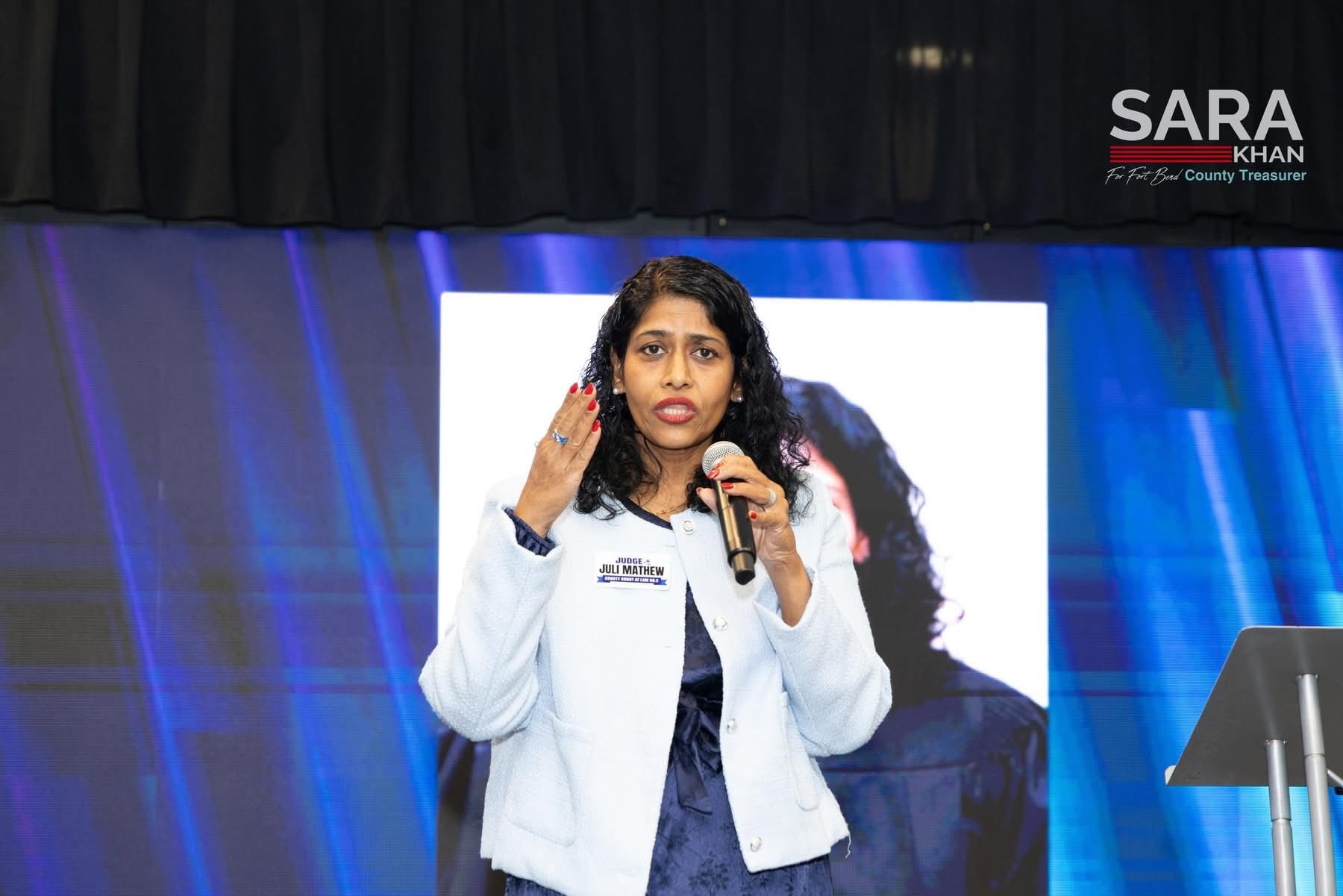
Juli Mathew, the first Indian American woman elected to the bench in the United States and the first Asian American judge in Fort Bend County, Texas, is seeking a third term.
A trailblazer in the American legal community, Mathew made history in November 2018 when she was elected to the bench. Before her election, Mathew built a career in law and public service, gaining respect for her commitment to fair, impartial justice. In her role on the county court, she has focused on community engagement, upholding constitutional principles, and ensuring access to the legal system for all residents. Mathew continues to be active in local civic life while campaigning for reelection.
Democrats and Republicans will decide Tuesday, March 3, which candidates will advance to the November midterm ballot, as voters head to the polls from 7 a.m. to 7 p.m. As the incumbent, Mathew faces challenger Paula Miller in the Democratic primary. The next General Election will be held on Nov. 3.
In between campaigning, Mathew managed to find time to talk to The American Bazaar and discuss her career and influence on the political landscape of the county, and how she holds on to constitutional values in an increasingly polarized climate.
READ: Indian American jurist Kalyan Deshpande named top US patents judge (
You’re the first Indian American woman to be elected to the bench in the United States. How is it shaping your campaign now?
So, one thing is, since I’ve been elected, there have been many other Indian American females who have been elected as well, which brings joy to me because it’s amazing to have others of various sects. We’ve had a Sikh woman, we’ve had someone in another county in Texas, so there are more and more judicial candidates of Indian descent on the ballot and have won their races. That’s amazing. I always said that I may be the first but I hope to not be the last.
Can you talk more about your new campaign, and what your goals are this time?
Well, this is my third term running for the same office. I do enjoy what I do, and I feel that there’s so much more I can do. It’s been an amazing experience so far. One of the things that happen when you are successful is that people then desire the same things. I had a part in turning this county blue. And now that it’s more attainable and people realize that they can also do it, I’m facing some competition in my race. But I hope to overcome that and come out victorious on March 3.
Texas has been one of the states that has seen a lot of polarized climate regarding immigration. Any thoughts on that or how it affected your approach?
As an immigrant myself, what I’ve seen is quite concerning, but as a judge, I unfortunately cannot comment on these things, but I truly believe in the Constitution of the United States, the Due Process Clause, and things that people in the U.S. have rights to. I will always protect that.
There’s been many incidents of hate against Indian Americans of late. Has that affected you in any way, personally or professionally?
In this country, the great thing about it is we are a melting pot, and so the fact that people have the freedom to enjoy their shows, enjoy various religious events, as long as it’s not interfering in regard to public safety or noise ordinances, I don’t think there should be an issue. The hate is unjustified on many levels. But it’s something that we can work towards educating.
I had come to the U.S. from India when I was a child in the ‘80s, and many people then had never seen an Indian American. There may be parts of the U.S. that have never dealt with anyone of Indian descent. People are aware of cultural differences, and being more cognizant of it and being involved in the community will change that.
What does long-term success look like for you?
It is definitely being content in what you do, and if you’re not content in what you’re doing, then that’s not success for me. I enjoy what I do. I’m truly happy with what I have accomplished thus far, and I hope that I get to make changes and do things that have an impact upon my community, and pave the way for other people. I really hope that I am a role model, and having interns come through my court and see the possibilities that are open to them. I think that gives me joy.
Read: Indian American composer Keeril Makan named MIT vice provost for the arts (February 3, 2026)
How do you hope your legacy will be remembered?
As someone who truly cared, and who made a difference in at least one person’s life. Someone who wanted to see the change in this world and went for it.
How do you view your first two terms, and you’re a trailblazer as we mentioned. What have been some of your biggest accomplishments as a judge?
I created the first juvenile intervention and mental health court that has now been studied by universities who have taken it to legislators throughout Texas to implement in other counties. But one of the things I will probably not get credit for is the very fact that I’m a Democrat, and these are… majority of the counties are still Republican. But that’s okay, the fact is that I had a part in it.
With regard to mental health, we had a lot of inmates in jail who were waiting for a bed in a mental health facility, and we were having issues in regard to proper medication for them, and I implemented a process where the county attorney’s office, the district attorney’s office, the sheriff’s department, and the courts worked together to help make sure that there is proper medication for the inmates.
I’ve also had a conference where mental health providers come, the crisis intervention team comes, and judges and attorneys who handle mental health are there, and we work together. So, basically, with this conference, everybody’s in the same area and knows what others are doing. Working together is the only way to solve these things, and so this conference has everybody there in the same location to be able to work out a plan as to how to help people within the community who are suffering mental health, because it is, even in our communities, a stigma. No one wants to talk about it, everybody wants to sweep it under the rug. I’m, happy to have facilitated that and organized it, and now in May [2026], it’ll be our third annual mental health conference.