



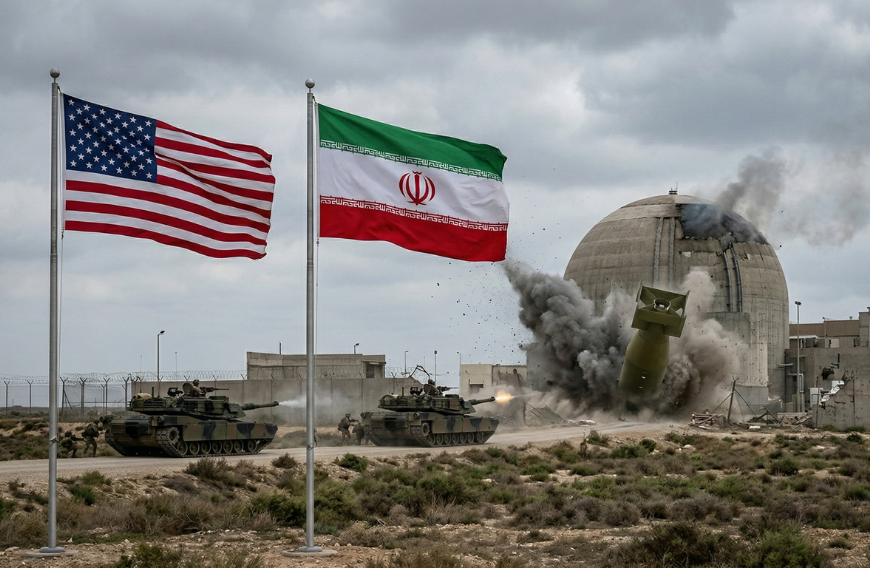
The Trump administration officials acknowledged in closed-door briefings with congressional staff on Sunday that there was no intelligence suggesting Iran planned to attack U.S. forces first, two people familiar with the matter said.
The United States and Israel launched a coordinated military offensive against Iran, marking a major escalation in long-running tensions over Tehran’s nuclear program, regional influence, and proxy conflicts. The joint campaign, described in reports as “Operation Epic Fury,” involved airstrikes on multiple Iranian military and infrastructure targets.
Iran’s Supreme Leader Ali Khamenei was killed in the opening strikes, though this has not been consistently confirmed by all major international news organizations.
In response, Iran launched missile and drone attacks against Israeli territory and U.S. military bases across parts of the Gulf region. The conflict has reportedly drawn in allied forces and Iranian-backed militias, including Hezbollah in Lebanon, which has fired rockets into northern Israel. Casualties have been reported on multiple sides, though figures vary significantly by source.
READ: Who decides when the world burns? (
Pentagon officials briefed Democratic and Republican staff of several national security committees in both the Senate and the House of Representatives for more than 90 minutes on the unfolding U.S. attack in Iran, White House spokesperson Dylan Johnson said earlier.
The two sources, speaking on condition of anonymity, told Reuters that in the briefings, administration officials emphasized that Iran’s ballistic missiles and proxy forces in the region posed an imminent threat to U.S. interests, but there was no intelligence about Tehran attacking U.S. forces first.
The war has disrupted civilian life in Israel, prompted emergency security measures, and raised fears of broader regional escalation. The Strait of Hormuz has become an economic flashpoint, with threats to shipping contributing to volatility in global oil markets and wider economic uncertainty. International leaders have called for restraint as tensions continue to develop.
Trump said the attack, which is expected to run for weeks, aimed to ensure Iran could not have a nuclear weapon, contain its missile program and eliminate threats to the United States and its allies.
READ: Iran conflict threatens global oil supply, crude prices on edge (
For Iran, this conflict represents one of the most consequential turning points in the history of the Islamic Republic. Beyond the immediate military damage, the strikes challenge the regime’s internal stability, succession planning, and long-term strategic posture. Tehran now faces a sensitive transition period as power factions within the security establishment, clerical leadership, and the Islamic Revolutionary Guard Corps navigate succession and control, the outcome of which remains uncertain.
Economically, Iran is expected to experience intensified sanctions enforcement, capital flight, currency pressure, and infrastructure strain, compounding years of hardship. The depth and duration of these economic consequences will depend on how long the conflict continues and whether additional international measures are imposed.
Iran’s deterrence model, built on proxy networks and missile capabilities, will be tested. Whether these networks significantly escalate attacks or instead become constrained or weakened remains unclear. Domestically, public reaction is difficult to predict: external conflict could consolidate nationalist support around the government, yet prolonged instability or economic deterioration may generate renewed internal unrest.