


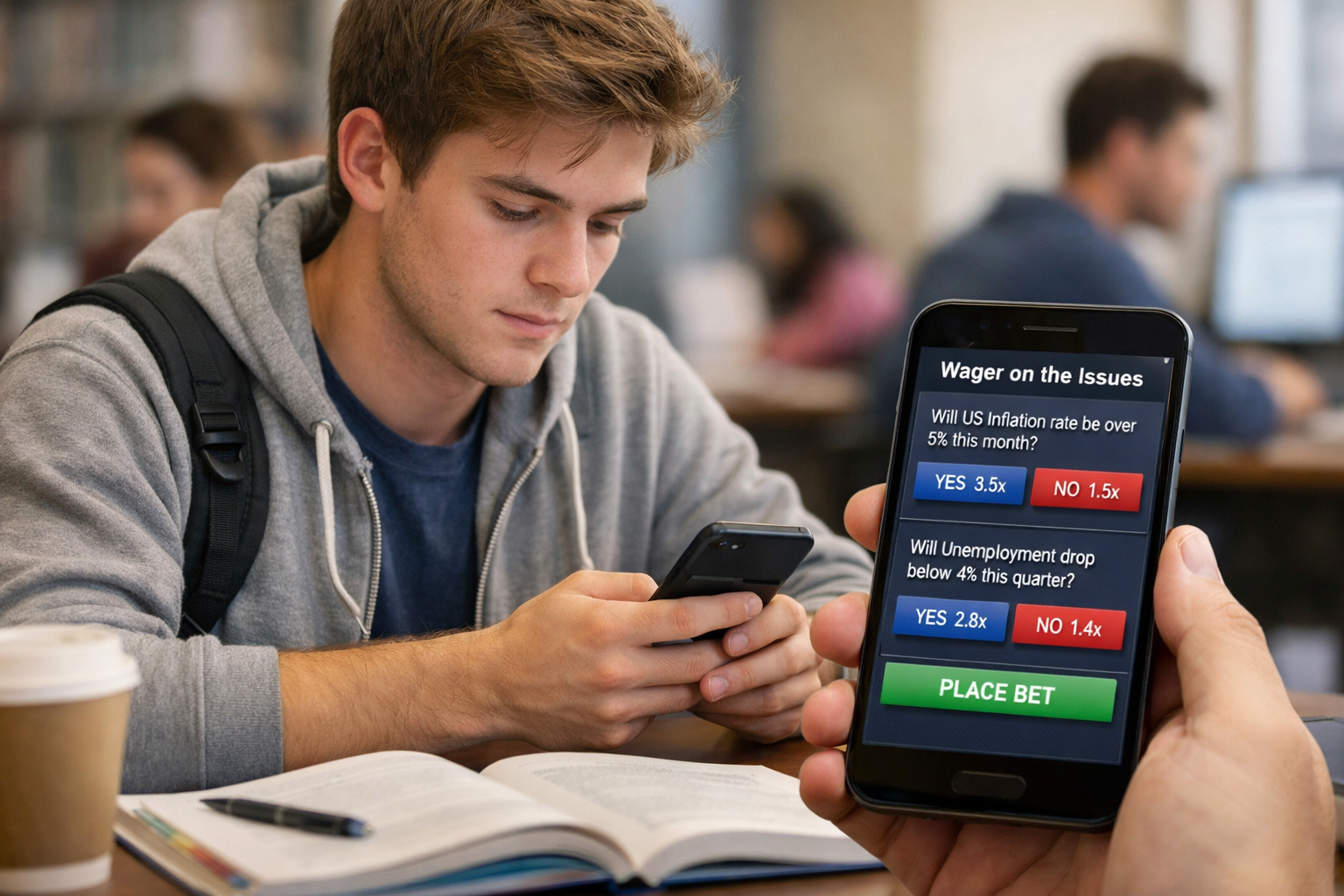
On a typical evening in a college dormitory, a student scrolling through his phone may not be browsing social media or watching videos but instead placing small wagers on whether inflation will rise, whether a political candidate will win a primary election, or whether a geopolitical event will occur within a specified time frame.
What begins as casual curiosity—an experiment in predicting the future—can quickly evolve into a pattern of repeated bets placed throughout the day, each one accompanied by the same anticipation and adrenaline once associated with casino gambling.
The stakes may initially appear modest, often only a few dollars at a time, but the psychological hook lies not in the size of the wager but in the constant cycle of prediction, uncertainty, and reward. For many young users, these platforms blur the boundary between information consumption and financial speculation, creating an environment where betting becomes intertwined with the everyday act of following the news.
A new form of gambling is spreading quietly across college campuses and among younger generations, and unlike traditional casinos or sports betting, it is embedded seamlessly into the digital ecosystems that young adults already inhabit. Online prediction markets—platforms where users wager on the outcomes of real-world events ranging from elections to economic indicators—are rapidly gaining traction among students and young professionals who increasingly view them not as gambling but as a sophisticated form of speculation or “information trading.” Yet emerging research suggests that the behavioral dynamics underlying these platforms may pose significant risks.
A study published in JAMA Internal Medicine examining the rapid expansion of sports betting found that total wagers in the United States skyrocketed from $4.9 billion in 2017 to $121.1 billion in 2023, with 94 percent of those wagers now placed online, illustrating how digital platforms have transformed betting into a constant and easily accessible activity.
READ: Sreedhar| Who’s making money from your data in dynamic pricing (March 6, 2026)
The researchers also documented a 23 percent increase in internet searches related to gambling addiction following the expansion of legal sports betting, with some states experiencing increases as high as 50 percent after online sportsbooks were introduced, suggesting that accessibility through smartphones may be accelerating the development of gambling disorders.
Understanding how this phenomenon emerged requires looking back to a pivotal moment in American regulatory history. In 2018, the U.S. Supreme Court issued its decision in Murphy v. National Collegiate Athletic Association, striking down the Professional and Amateur Sports Protection Act and effectively allowing states to legalize sports betting for the first time in decades.
Prior to that ruling, legal sports wagering in the United States had been largely confined to Nevada, but the Court’s decision triggered a wave of legalization as states rushed to capture new tax revenue from gambling activity. Within a few years, the number of states with operational sportsbooks expanded from one state in 2017 to 38 states, transforming sports betting into a ubiquitous feature of the American digital economy and placing a fully functioning sportsbook in the pocket of anyone with a smartphone.
READ: Sreedhar Potarazu | India’s AI content crackdown: Why it matters to Big Tech and the US (February 10, 2026)
The rapid expansion of online betting has had particularly notable effects among younger populations and college-age users who are already immersed in digital environments where information, entertainment, and financial transactions occur seamlessly on the same device. Surveys conducted by the National Collegiate Athletic Association have found that approximately 22 percent of male college athletes report betting on sports at least once in the past year, while broader public health research estimates that 2.5 million Americans meet the criteria for severe problem gambling and another five to eight million experience mild to moderate gambling problems.
More broadly, data compiled by the American Gaming Association show that nearly half of sports bettors are under the age of 35, highlighting how younger generations have become the fastest-growing segment of the digital wagering economy. For a generation already navigating unprecedented financial pressures including student debt, housing costs, and economic uncertainty, the allure of turning information into profit can be particularly powerful.
One of the fastest-growing platforms in this emerging ecosystem is Polymarket, which operates as a blockchain-based prediction market allowing users to place financial bets on the probability of future events. Participants purchase shares representing the likelihood of an outcome—such as whether a political candidate will win an election, whether inflation will exceed a certain level, or whether a geopolitical event will occur—and those shares fluctuate in price based on the collective expectations of traders in the market.
If the predicted event occurs the shares pay out at full value, whereas if the event does not occur they expire worthless, effectively transforming uncertainty itself into a tradable financial instrument. The interface resembles a financial trading platform rather than a casino, which reinforces the perception that participants are engaging in analytical forecasting rather than gambling.
Across American college campuses, prediction markets have rapidly evolved from a niche curiosity into a full-scale social phenomenon fueled by aggressive marketing, influencer campaigns, and fraternity networks. Platforms such as Polymarket actively court college students through referral programs and campus outreach, sometimes recruiting fraternities and student organizations to help sign up new users.
READ: Sreedhar Potarazu | AI sovereignty race: US and China lead, India watches (
In one example, roughly 20 students from a fraternity chapter at Columbia University were invited to the company’s Manhattan headquarters, where they were given $10 each in betting credit to try the platform, and some students reportedly turned that initial credit into about $60 in winnings in a single afternoon while watching football games and placing bets on prediction markets.
The company also proposed referral arrangements in which fraternities would receive $10 for every new user they recruited, with another $10 deposited into the new user’s account to begin betting. These seemingly small incentives can scale quickly across tightly connected campus social networks, where information and rumors travel rapidly through group chats and social media. Some students have already reported earning substantial sums through prediction markets, including one trader who said he ultimately made more than $100,000 trading on prediction markets, money he used to pay tuition while attending the University of Wisconsin–Madison.
The fact that these platforms are regulated as financial derivatives rather than traditional gambling also means they are accessible to users as young as 18 years old, creating a three-year window during which college freshmen can legally engage in prediction betting long before they would be eligible to use most online sportsbooks. For university administrators and public-health experts, the concern is that what begins as casual experimentation with a few dollars in betting credit can quickly normalize a culture of constant wagering within campus social life.
The legal status of these markets has evolved rapidly after regulatory action by the Commodity Futures Trading Commission previously forced the company to restrict U.S. trading activity, yet ongoing regulatory debate has allowed prediction-style markets to re-emerge in new forms and gain popularity among younger users who are comfortable navigating cryptocurrency and digital finance.
Part of the powerful appeal of betting platforms—whether sportsbooks or prediction markets—lies in the fundamental neurobiology of reward. Human beings are biologically wired to respond to uncertainty and risk with bursts of dopamine, the neurotransmitter that reinforces behaviors associated with anticipation and reward.
Neuroscience research has repeatedly demonstrated that intermittent rewards tied to uncertain outcomes stimulate dopamine release more strongly than predictable rewards, which means that the act of betting itself can become reinforcing regardless of whether the individual ultimately wins or loses money. Each wager becomes a miniature experiment in anticipation, and the brain gradually learns to crave the emotional surge associated with the possibility of a favorable outcome.
Read more columns by Sreedhar Potarazu
Prediction markets amplify this dynamic because they transform nearly every news event into a potential betting opportunity, creating a continuous stream of uncertainty that encourages users to speculate repeatedly throughout the day.
Society has only recently begun to grapple with the addictive design of digital platforms, particularly social media, which employ many of the same psychological mechanisms to capture attention and maximize engagement. Universities, policymakers, and public health researchers are now actively studying the effects of social media addiction on mental health, sleep disruption, and academic performance among younger generations.
Yet prediction betting may prove even more dangerous because it introduces direct financial stakes into an already addictive digital environment. Unlike social media, where the currency of engagement is attention, prediction markets attach real money to every interaction, transforming digital participation into financial risk-taking.
Over time the psychological trajectory can begin to resemble that of substance addiction, where individuals become increasingly preoccupied with the activity, escalate their level of participation in pursuit of the same emotional reward, and continue the behavior despite mounting financial harm.
The parallels with drug addiction become particularly striking when one examines how behavior escalates once dependency begins to develop. In substance use disorders individuals often find themselves willing to pay almost any price to obtain the next dose because the pursuit of the dopamine surge becomes increasingly urgent and overrides rational judgment.
Gambling addiction follows a similar pattern in which individuals chase losses, increase the size and frequency of wagers, and devote disproportionate time and mental energy to betting activities in an attempt to recreate the emotional high associated with earlier wins. Prediction markets may accelerate this progression because they are framed not as gambling but as analytical forecasting, which creates the illusion that intellectual skill or superior information can overcome the underlying probabilities.
For young users who already view themselves as digitally sophisticated interpreters of news and data streams, the line between informed speculation and compulsive betting can blur rapidly, allowing a powerful new form of addiction to take root largely unnoticed until the financial and psychological consequences become impossible to ignore.
Universities and policymakers therefore face an emerging challenge that extends far beyond traditional concerns about campus gambling pools or sports wagering. Prediction markets and online sportsbooks are creating a generation of young adults who are learning to associate everyday information—from political news to economic data—with financial bets placed in real time.
While technological innovation has always reshaped financial markets, the speed and scale at which digital betting platforms are expanding raise important questions about consumer protection, public health, and the responsibility of institutions that educate young people.
Addressing this emerging form of addiction will require greater awareness among universities, clearer regulatory frameworks for digital prediction markets, and a broader cultural recognition that the boundary between investing, speculation, and gambling is becoming increasingly difficult to distinguish in the digital age. Without that recognition, the next major addiction crisis may not originate in a laboratory or on a street corner but rather on the screens carried in the pockets of millions of college students.