



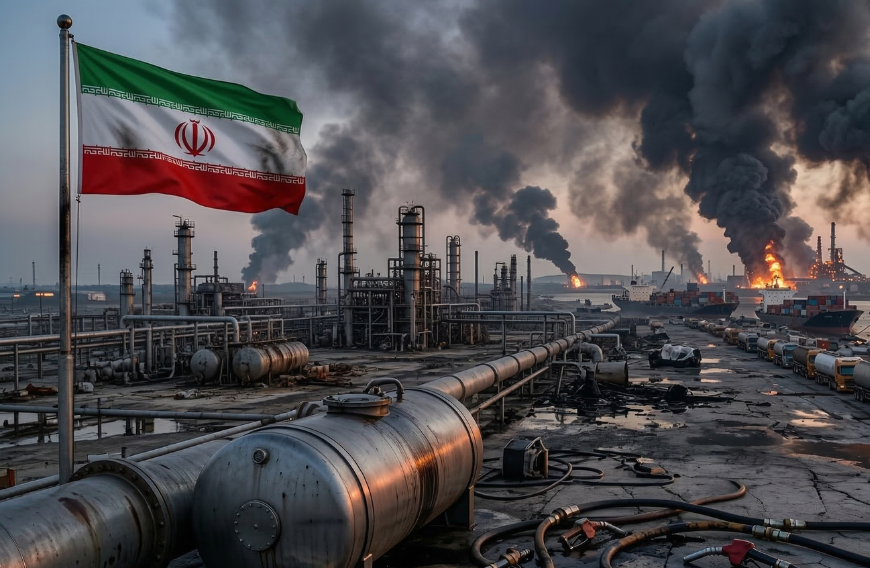
War rarely stays where it begins. The recent escalation between Iran and Israel, combined with U.S. naval movements near the Strait of Hormuz, shows how quickly conflict spreads beyond the battlefield. Its force travels outward in ways we do not always see at first.
What begins as a military or political confrontation slowly moves through global economies, supply chains, and living rooms—until a war that seemed far away begins to feel uncomfortably close.
When a stone is dropped into a still pond, the water does not simply absorb the impact and return to calm. Instead, concentric circles spread outward—each ripple carrying the energy of the initial disturbance farther and farther away from where the stone first touched the surface. This is the essence of the ripple effect: a single action triggering consequences that extend well beyond the point of origin. In geopolitics, the same principle applies.
READ: Sreedhar Potarazu | AI, war in Iran, and the sovereignty struggle over autonomous technology (February 28, 2026)
A missile strike by Iran on an Israeli military base, a U.S. naval blockade of the Strait of Hormuz, or airstrikes in Gaza may happen thousands of miles away, but the consequences reach into homes everywhere.
In a small village outside Delhi, Meera stares at an empty stove, knowing she cannot afford another LPG cylinder this month. Her children wait as she debates whether to cook one meal for the family or go without.
In Detroit, Marcus hesitates at the bus stop, watching gas prices climb again; the fare to get his daughter to school feels like a luxury he can no longer afford, while news of attacks abroad makes every neighborhood corner feel unsafe.
Across Europe, a family in Berlin huddles in a chilly apartment, calculating how much heating oil they can buy without skipping rent.
In Lagos, a shopkeeper passes on rising transportation costs to customers already struggling to afford basic food staples.
READ: Gas prices jump in the US, and drivers are going the extra mile to save March 10, 2026)
In London, for example, a father worries he may not be able to fly to Nepal to see his elderly parents.
Rising fuel prices, canceled flights, and delays caused by disruptions in global travel make a trip that should take hours feel impossible, leaving families separated by both distance and circumstance.
These are not isolated moments. They are threads in the same global web, tugged by decisions made in distant capitals. Technology carries every strike, every headline, every image across the world in seconds. Phones buzz with breaking news; televisions replay flames, smoke, and human suffering over and over. Each report becomes a pulse of anxiety that ripples outward, connecting lives in ways the people launching missiles could never imagine.
The war may be far away, but its consequences are intimate and immediate. Families rethink meals, commuters rethink routines, travelers rethink journeys, and entire communities brace for higher costs and scarier realities. What once took weeks or months to spread now travels at the speed of light, linking humanity in a shared vulnerability—and proving that no door is too distant to feel the shock of war.
Energy markets provide perhaps the clearest example of how a localized conflict becomes a global economic shock. The narrow Strait of Hormuz—a waterway only a few dozen kilometers wide—normally carries roughly one-fifth of the world’s oil supply. When conflict disrupts shipping through this corridor, the consequences cascade across the global economy.
Tankers become stranded, insurance premiums soar, and energy prices begin to climb. Recent reports warn that the current conflict has already triggered one of the largest disruptions in global oil supply in history, removing millions of barrels of oil from the market and sending prices sharply higher. But the ripple extends far beyond oil traders and financial markets.
The global energy system is an invisible thread connecting billions of lives. When that thread is pulled tight by conflict, people everywhere feel the strain.
Importantly ripple spreads through the psychology of everyday life. Modern warfare is no longer something people learn about days later through carefully edited reports. Instead, it unfolds in real time on television screens, smartphones, and social media feeds.
Flames rising from oil facilities, terrified civilians running through streets, the aftermath of explosions—these images replay endlessly. Each time we turn on the television or refresh a news feed, another fragment of the conflict enters our consciousness. Over time, these images leave an imprint on the collective mind, quietly fueling anxiety, uncertainty, and emotional fatigue.
Meanwhile, uncertainty hangs over the global economy like a gathering storm. If shipping routes remain threatened and the Strait of Hormuz becomes inaccessible, supply chains that stretch across continents could fracture. Roughly 20 percent of global oil trade passes through that narrow corridor, meaning even a temporary disruption can send shockwaves through transportation, manufacturing, agriculture, and food prices.
Read: Oil and gold prices rise amid heightening US-Iran tensions (February 23, 2026)
The question looming over markets and households alike is simple: what happens next? Will prices stabilize, or will they climb higher as ships struggle to navigate the region and insurers refuse to cover the risk?
In the language of physics, the ripple effect eventually dissipates as energy spreads across a wider surface. But in the interconnected systems of the modern world, ripples can converge, amplify, and transform into something larger—something closer to a tidal wave.
A conflict that begins with missiles and drones can end up reshaping global trade routes, altering inflation, destabilizing markets, and reshaping the emotional climate of societies thousands of miles away.
Perhaps the deepest lesson hidden within these ripples is philosophical. We often imagine ourselves as separate—divided by borders, politics, culture, or religion. Yet moments like this reveal a different truth. The world is bound together by forces that are both economic and human: shared resources, shared fears, and shared hopes. The energy that connects us—through markets, technology, and the fragile ecosystems of the planet—is far greater than any individual nation or leader.
But in the smoke of war and the fog of ego, that reality becomes obscured. And until we recognize how deeply interconnected, we truly are, each stone thrown into the waters of conflict will continue to send waves across the entire world.