



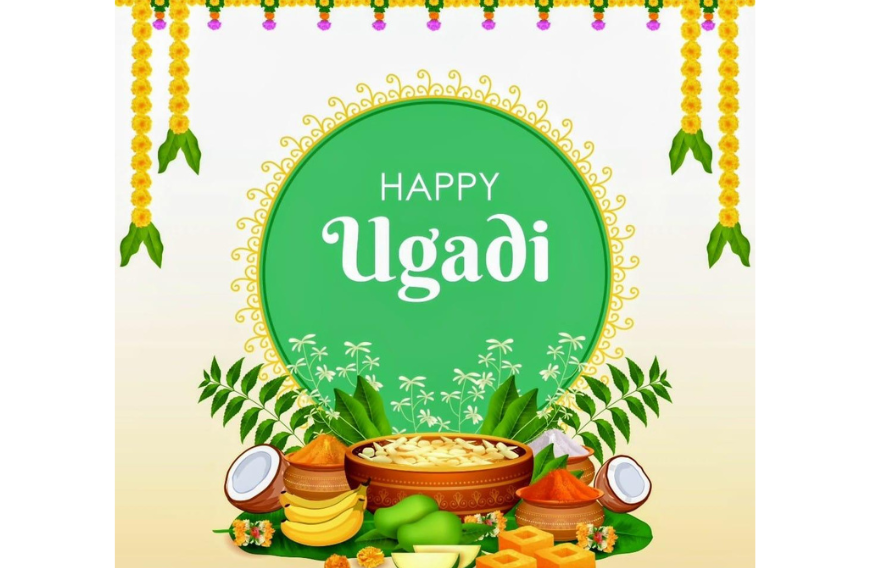
A New Year nobody knows about
Every culture marks time differently—but when the New Year belongs to the Second Lady of the United States, it becomes a moment worth noticing. Thursday March 19, is Ugadi, a centuries-old New Year tradition celebrated by millions across India, and now, by extension, part of America’s evolving cultural story through Usha Vance.
Ugadi, the New Year for millions of Indians from the states of Andhra Pradesh, Telangana, Karnataka, and parts of Maharashtra (where it is also celebrated as Gudi Padwa). For many, it is a day of renewal, reflection, and cultural pride. This year, it carries a personal resonance for Usha Vance, whose parents are originally from Andhra Pradesh—making Ugadi not just a cultural observance, but her New Year as well. In that sense, Ugadi is not just a regional celebration; it is a reminder of how deeply Indian culture has woven itself into the global fabric.
Despite being celebrated by tens of millions, Ugadi remains relatively unknown in the broader American cultural landscape—often overshadowed by more widely recognized Indian festivals like Diwali or Holi. But that may be beginning to change.
With Usha Vance now serving as Second Lady, Ugadi has a unique opportunity to step into greater national awareness. Her presence brings visibility not just to a holiday, but to an entire cultural tradition rooted in the Telugu-speaking world. In many ways, this moment reflects a broader evolution in American identity—where celebrations once confined to immigrant communities are increasingly recognized as part of the nation’s shared cultural fabric.
READ: Sreedhar Potarazu | How Medicare Advantage overpayments are quietly raising seniors’ premiums (March 16, 2026)
Ugadi is determined by the lunisolar calendar, specifically marking the first day of the Chaitra month, which begins after the new moon. Unlike the Gregorian calendar, which is purely solar, Ugadi follows astronomical rhythms that align both lunar phases and seasonal transitions.
The timing of Ugadi is not arbitrary, but rooted in ancient Indian astronomy and calendrical science. Ugadi marks the first day of the month of Chaitra in the traditional Hindu lunisolar calendar, which begins with the new moon (amavasya) that follows the sun’s transition into the zodiac sign of Aries (Mesha).
This alignment—of a lunar cycle reset with a solar seasonal shift—was designed to synchronize timekeeping with both the rhythms of the moon and the agricultural year, particularly the arrival of spring. Texts such as the Surya Siddhanta, an ancient Indian treatise on astronomy, describe these calculations in detail, reflecting a sophisticated understanding of celestial motion.
In essence, Ugadi represents a cosmic “reset,” where lunar and solar cycles converge to mark renewal, making it not just a cultural New Year, but an astronomically grounded one.
Interestingly, this year Ugadi closely coincides with Eid al-Fitr, expected to fall on Friday, marking the end of Ramadan. While the two holidays emerge from different traditions, both are anchored in lunar observation—Ugadi marking a new cycle of time, and Eid marking the sighting of the crescent moon. These overlapping rhythms highlight a shared human reliance on the skies to measure meaning, time, and celebration.
Globally, Ugadi is celebrated by an estimated 30–40 million people, primarily from the Telugu- and Kannada-speaking communities. In the United States, the number of people observing Ugadi has grown steadily with immigration and generational expansion, with estimates ranging from 500,000 to over 1 million celebrants. From temple gatherings to community festivals, Ugadi has evolved into a vibrant diasporic celebration that bridges continents.
That growth is reflected in language as well. Telugu, one of the primary languages associated with Ugadi, is now among the fastest-growing languages in the United States. According to U.S. Census data, the Telugu-speaking population has surged dramatically over the past two decades, now numbering over 400,000 speakers, driven largely by highly skilled immigration and strong community networks. What was once a regional language is now increasingly heard in American classrooms, workplaces, and cultural institutions—a testament to the expanding influence of the Indian diaspora.
READ: Sreedhar Potarazu | AI, war in Iran, and the sovereignty struggle over autonomous technology (February 28, 2026)
For many second-generation Indian Americans, however, the question remains: is Ugadi truly “New Year’s Day” in the same way January 1 is? Growing up in the United States, their lives are structured around the Gregorian calendar, where the cultural, academic, and professional year resets on January 1. Ugadi, by contrast, often feels symbolic rather than systemic—celebrated at home or in community spaces, but rarely reflected in school calendars or workplace rhythms. Reconciling the two requires holding dual frameworks of time: one cultural, one civic.
Interestingly, this tension has been less pronounced among Chinese Americans celebrating Chinese New Year. There, a more unified cultural identity, stronger institutional recognition, and broader mainstream visibility have helped establish Lunar New Year as a widely acknowledged “second New Year.”
In contrast, India’s diversity—multiple languages, regional calendars, and different New Year traditions like Ugadi, Gudi Padwa, and others—has diffused that recognition. The result is not a lack of tradition, but a fragmentation of it, leaving many second-generation Indians navigating identity across calendars rather than anchoring to a single, widely recognized one.
Ugadi, then, is more than a New Year. It is a story of continuity—of calendars that predate modernity, of traditions that travel across oceans, and of identities that evolve without losing their roots. And this year, as Usha Vance celebrates her New Year, it serves as a quiet but powerful reminder: the story of America is, in many ways, a story of the world.