



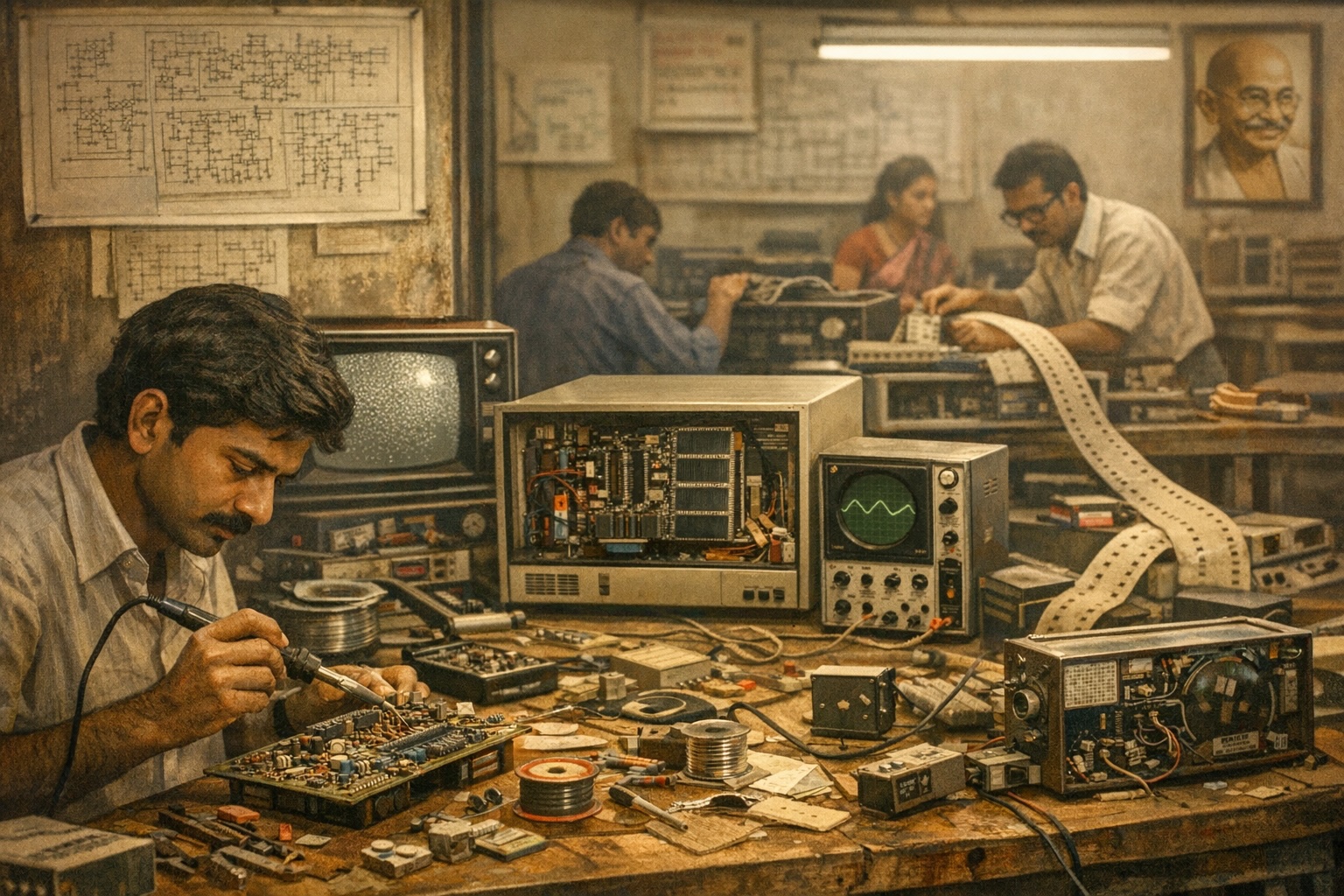
The country’s hardware legacy built resilience and scale, but frontier leadership in chips, AI hardware, and quantum systems demands a very different mindset.
India remembers its hardware past with a certain pride: the years of constraint when ingenuity was measured in how deftly one could make do. Import restrictions were tight, capital scarce, and supply chains unreliable.
Yet firms assembled radios, televisions and early computers in workshops that learned to live with power cuts and policy swings. Circuits were reverse-engineered, kits improvised, margins squeezed into submission. It was a triumph of execution. It taught a generation how to build reliably under pressure. It also taught the wrong lesson for what comes next.
The instinct to celebrate that era is understandable. It forged resilience. It rewarded discipline. It produced managers who could coax output from imperfect inputs. But the habits it ingrained — optimize what exists, adapt what arrives, extract value from constraint—are not the habits that create new technological frontiers. They are, in a deeper sense, upside down. What ensured survival then can quietly prevent origination now.
READ: Satish Jha | The price of the Embrace (March 18, 2026)
Consider the difference between assembling a device and inventing the technology inside it. The former is a problem of coordination: sourcing components, aligning processes, controlling defects, scaling production. The latter is a problem of discovery: pushing the limits of physics, tolerating failure, investing for years without commercial certainty. Assembly rewards precision and cost discipline. Discovery rewards risk, patience and a tolerance for wasted effort that would look irrational on a factory floor.
India has become very good at the first. It has not yet committed itself to the second.
Walk through a modern electronics plant under India’s production-linked incentive schemes and you will see a kind of mastery that deserves recognition. Lines hum with efficiency. Workers execute complex sequences with near-perfect timing. Supply chains stretch across continents and are managed with impressive dexterity. Costs are shaved to the decimal. Output scales to millions.
But ask a different question—where is the chip designed, the architecture conceived, the process node advanced?—and the answer, more often than not, lies elsewhere. The core technologies that define the frontier—advanced semiconductors, specialized AI hardware, photonic systems, quantum devices—remain overwhelmingly imported. India assembles with excellence. It rarely sets the terms. This is not an accident of capital alone. It is an orientation.
READ: Satish Jha | India had the chair. It chose silence! (March 17, 2026)
For decades, the incentives were aligned toward what could be scaled quickly. Liberalization opened markets, and the fastest path to growth lay in services and assembly. Software exports surged. Manufacturing learned to plug into global supply chains. Returns were visible, risks contained, timelines short enough to satisfy both investors and policymakers.
Frontier technology asks for something different. It asks for long horizons and uncertain payoffs. It demands that money be spent before results are visible and that failure be accepted not as an aberration but as a necessary stage. It requires institutions that can withstand disappointment without retreating to safer bets. Above all, it requires a cultural shift—from proving we can execute to insisting we can originate.
History is unambiguous about how such shifts occur. No country has stumbled into technological leadership by refining the habits of a previous era. Each has, in its own way, broken with them.
Japan’s postwar transformation did not begin with comfort. Its cities were shattered, its industry hollowed out. Yet within a generation it moved to the forefront of semiconductors. This was not because conditions were favorable; they were not. It was because the state and industry chose to invest heavily in areas where the country had no immediate advantage. The VLSI project brought competing firms into collaboration, funneled public funds into research, and accepted the cost of catching up at the edge. The cultural discipline that had once ensured survival was redirected toward perfection at the frontier.
South Korea followed a different path but reached a similar conclusion. In the 1960s it was poorer than India is today, emerging from war and governed with a heavy hand. Yet it placed bets that appeared reckless at the time. Conglomerates were pushed into industries where they had little experience and were forced to compete globally. Losses were endured, learning was accelerated, and over time capabilities deepened. The country did not wait for certainty. It created it through persistence.
Taiwan’s story is often told as one of institutional ingenuity. Faced with isolation and limited resources, it built a model that did not exist: the pure-play semiconductor foundry. The state seeded the effort, recruited expertise from abroad, and sustained it long enough for credibility to take hold. What began as an experiment now anchors the global chip ecosystem. The lesson is not that Taiwan had an advantage; it is that it designed one.
READ: Satish Jha | The arithmetic of impunity (March 18, 2026)
Israel offers yet another variant. Its technological edge emerged from necessity. Security pressures forced rapid innovation, and the boundary between research and application blurred. Young engineers were given problems that mattered immediately. Venture capital followed, but it followed capability, not the other way around. The culture that formed was one that treated risk as routine and failure as information.
And then there is the United States, less a single model than a constellation of them. Its strength lies in an ecosystem that continuously renews itself: research universities, federal agencies willing to fund high-risk work, private capital that scales success, and an openness to talent from everywhere. It does not merely improve existing technologies; it repeatedly creates new categories. The pattern is not accidental. It is the result of sustained investment in discovery.
India’s trajectory has been different. Its research spending remains modest relative to its ambitions. Its best institutions produce extraordinary talent, but much of that talent flows into roles optimized for execution rather than exploration. Its industrial leaders excel at deploying capital where outcomes are visible and near-term. None of this is a flaw in isolation. It becomes one when it defines the whole.
The consequence is a cycle that reinforces itself. Limited investment in frontier research yields limited breakthroughs. Limited breakthroughs justify continued focus on proven domains. Success in those domains strengthens the belief that the model is working. Over time, the gap at the frontier widens, even as performance in the middle improves.
Breaking that cycle does not require abandoning what India does well. It requires adding what it has not yet fully attempted.
First, research must move from the periphery to the center of national strategy. This is not a matter of incremental increases but of scale and intent. Funding must be large enough to matter and structured to reward ambition. A mission-driven agency—modeled on the best of global examples but adapted to Indian realities—should be empowered to pursue high-risk projects with clear goals and the autonomy to fail without stigma. The metric should not be how many projects succeed, but whether the successful ones change the landscape.
Second, institutions must be recalibrated to value creation over replication. Universities should not be judged solely by publications but by the technologies they generate and the enterprises they spawn. Faculty incentives must align with real-world impact. Students should be encouraged to attempt problems that do not have known answers. Failure, when it occurs, should be analyzed and shared, not hidden.
READ: Satish Jha | Who decides when the world burns? (
Third, talent flows must be rethought. India produces world-class engineers and scientists; many build their careers abroad. This is not a loss if pathways exist for circulation—if those who leave can return easily, if those who never left can collaborate seamlessly with those who did, and if the system values experience gained elsewhere. Openness, not insularity, is what has sustained leadership elsewhere.
Fourth, competition within the country should be embraced. Different states can pursue different models, experiment with incentives, and build specialized clusters. Success in one region can be replicated or adapted in another. A federation of innovation hubs, each striving to outdo the other, can generate the diversity of approaches that a single centralized plan cannot.
Finally, the narrative must change. The stories a society tells about success shape the risks it is willing to take. If the highest praise is reserved for those who scale efficiently, then efficiency will dominate. If equal admiration is given to those who attempt the difficult and uncertain, then ambition will expand. Celebrating the engineer who spends years chasing a breakthrough that may never come is not indulgence; it is preparation.
None of this guarantees success. Frontier technologies, by definition, resist prediction. Many efforts will fail. Some will take longer than expected. A few will succeed in ways that cannot be anticipated at the outset. The question is not whether the path is risky. It is whether avoiding it carries a greater risk still.
India’s hardware past deserves respect. It demonstrated what could be achieved under constraint. It built capabilities that remain valuable. But it is not a blueprint for the future. The world that is emerging will be shaped not by those who assemble what exists, but by those who define what comes next.
READ: Satish Jha | Trump time: America in the mirror (March 10, 2026)
The choice is not between honoring the past and embracing the future. It is between allowing past lessons to limit imagination or using them as a foundation to leap beyond. The skills of the soldering era—precision, discipline, resilience—need not be discarded. They need to be redirected toward problems that demand more than optimization.
A country that once taught the world to think in zero can, if it chooses, learn again to think in beginnings.