



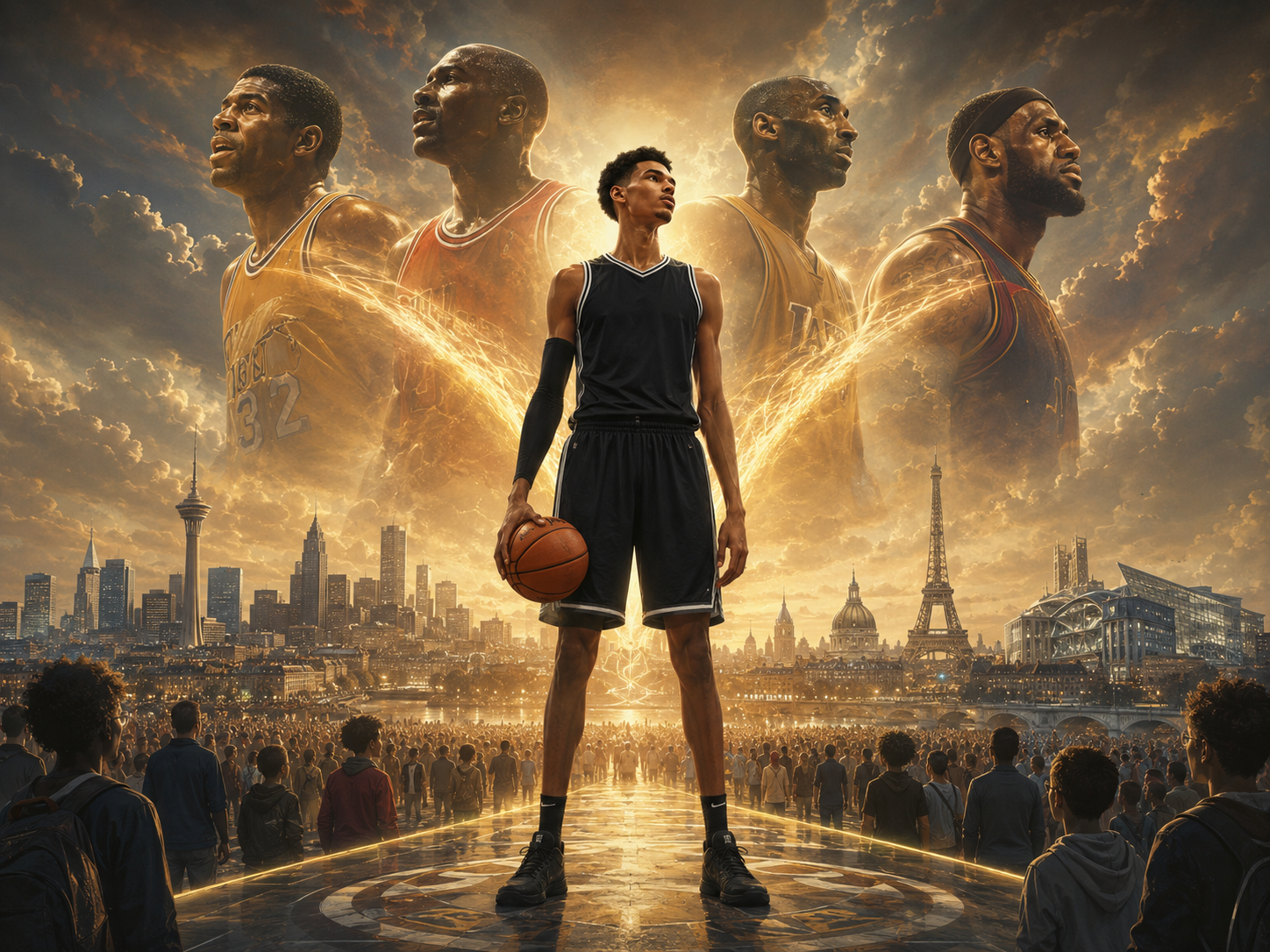
Victor Wembanyama!
7-foot-4-inches from Le Chesnay, France, 22 years young, won every first-place vote cast by every credentialed media voter in the NBA as the finest defensive player in the world. He has already made history twice in unanimous fashion: Rookie of the Year at 20, Defensive Player of the Year at 22, both by acclamation unmatched in the award’s history. He averaged 25 points, 11.5 rebounds, 3.1 assists, and 3.1 blocked shots per game in his third season. No player in NBA history had ever averaged at least three blocked shots and three made three-pointers per game across an entire campaign. And now, in the first playoff run of his career, he has done something that will further cement his already iconic career: he led his San Antonio Spurs to a dramatic 111-103 victory in Game 7 of the Western Conference Finals, eliminating the reigning champion Oklahoma City Thunder and sending San Antonio to the NBA Finals for the first time since 2014. The Finals begin June 3rd. The Spurs will face the New York Knicks, a rematch of the 1999 Finals, which the Spurs won in five games.
Wemby was unanimously named the Western Conference Finals Most Valuable Player, earning the Earvin “Magic” Johnson Trophy, the naming of which, given what I am about to argue, strikes me as something close to prophecy. Across the seven games, he averaged 27.3 points, 10.9 rebounds, 3.1 assists, 1.4 steals, and 2.7 blocks in 37.7 minutes per game. He became the first player in NBA history to record more than 15 three-pointers and 15 blocks in a single playoff series. In the decisive Game 7 on the road in Oklahoma City, with the Spurs clinging to leads they twice surrendered before reclaiming, Wemby posted 22 points and hit three three-pointers, and seven different Spurs players scored in double figures. This was not a one-man conquest, but a community arriving at the summit together, with one man holding the door.
What strikes me about Victor Wembanyama, what has struck everyone who watches him closely, from his coaches to his opponents to the 26,000 French citizens who packed the arena in Paris during the 2024 Olympics and wept when he played, is not his physical gifts, extraordinary as they are. It is his bearing. It is the unmistakable sense, communicated in every interview, every gesture on court, every word he speaks in French and English with equal fluency, that he has come here to do something larger than win games.
He has come to carry something. A city. A country. A sport. A generation.
This is a mindset, not arrogance. And it is one I have seen before, in the players who defined the NBA before Wemby arrived, and in the most exceptional people I have had the privilege to sit with on my television show Overheard on 6ABC. I believe this is the single trait that binds all truly successful people: the belief that your sense of purpose is larger than yourself, and will outlast your time.
READ: Why FIFA 2026 fans may prefer Atlanta over other US host cities (May 29, 2026)
The Lineage of the Transcendent
In 1980, a young man named Earvin Johnson from Lansing, Michigan, joined the Los Angeles Lakers. He had won an NCAA championship at Michigan State, won the Finals MVP in his very first NBA season, and retired with 5 championship rings. He had done what no rookie had done before or has done since: close out a championship series with 42 points, 15 rebounds, and 7 assists at center, a position he had never played, in place of the injured Kareem Abdul-Jabbar. He was 20 years old. But none of that captures the essential thing about Magic Johnson, which is that he never seemed to arrive simply to play basketball.
He arrived to transform the sport. To make Los Angeles the center of the sports universe. To give the Showtime era an aesthetic and an energy that would draw millions of casual observers into devoted fans. The Forum, with Magic at its helm, became something approaching a civic institution, not a basketball arena but a stage on which the city of Los Angeles performed its own mythology nightly. Magic Johnson understood this before anyone told him. The smile was not incidental to the greatness, but was an instrument of a larger purpose: to make people feel that they were part of something, that the game was for them, and that their joy mattered to him.
A decade later, a different man embodied a different version of the same impulse. Michael Jordan did not smile the way Magic did. He competed with a ferocity that bordered on the frightening. But Jordan’s orientation was identical in its essential character: he was playing, always, for something larger than points. For Chicago. For the standard of excellence itself. For the proposition that one man, if he demanded enough of himself and everyone around him, could lift an entire franchise, an entire city, into something it had never been before. He led the NBA in scoring for ten consecutive seasons, a record that has never been approached. His career playoff scoring average of 33.4 points per game remains the highest in the history of the sport. In the critical moments of close games, Jordan always asked for the ball. Not because he was certain to make the shot. Because he understood it was his to take.
Then came Kobe Bryant, who consciously and explicitly styled himself as a continuation of that tradition. He studied Jordan’s footwork, his work ethic, his competitive psychology, with the deliberateness of a monk at devotion. But Kobe also reached beyond basketball to claim a cultural identity, as the son of a professional player who had grown up in Italy, who spoke Italian and Spanish and who moved between languages and cultures with an ease that made him a genuinely global figure. He wanted to be the bridge between the American game and the world. He wanted, as he said more than once, to be the greatest player who ever lived. Not because of ego, though he had that too, but because he understood that the pursuit of that standard would produce something: a body of work, a practice of excellence, a standard others would measure themselves against, that would outlast him.
And then LeBron James, who said it most plainly of all. “My relationship with Northeast Ohio,” LeBron wrote when he announced his return to Cleveland in 2014, “is bigger than basketball. I feel my calling here goes above basketball. I have a responsibility to lead, in more ways than one, and I take that very seriously.” When he delivered that city its first major professional sports championship in 52 years, when he personally engineered the most improbable comeback in Finals history, trailing 3-1 against the Golden State Warriors who had just broken the all-time wins record, he was honoring an obligation, and not merely winning a ring.
The Boy from Le Chesnay
Victor Wembanyama arrived in the NBA understanding this lineage. He did not stumble into it. He was already living it.
At the 2024 Paris Olympics, playing in his home country before 26,000 French fans who had waited years to see him on this stage, Wemby stood bleeding from a cut on his neck after a collision in the France-Germany semifinal. When reporters asked him about the injury, he invoked the words of the French national anthem, “La Marseillaise,” a song written in the blood of revolution, steeped in the sacrifice of a people who believed their duty to nation was larger than their individual survival. “In our national anthem, we talk about blood, too,” he said. “We’re willing to spill blood on the court. If it allows us to win gold, I’m all for it.”
This was a 20-year-old articulating, in the most visceral possible terms, what he believes he is here for. He is playing for France. He is playing for the generations of French basketball players who won silver medals in Tokyo and Sydney and never quite reached the summit. He is playing for the children watching from apartments in the banlieues of Paris who see in his 7-foot-4 frame a proof that their country, their language, their culture, their flag, can produce someone who does not merely participate in the world’s greatest league but who reshapes it.
After France’s silver-medal loss to Team USA, a loss in which Wemby led all scorers but could not single-handedly overcome the gap in depth, he refused to console himself. “I’m learning,” he said, “and I’m worried for the opponents in the next couple of years.” When asked whether he meant FIBA opponents or NBA opponents, he said: “Everywhere.”
Consider what “everywhere” has come to mean in the spring of 2026. In his first-ever playoff run, leading a roster with virtually no postseason experience among its young troika of stars, Wemby dispatched the NBA’s two-time reigning MVP, Shai Gilgeous-Alexander, and the defending champion Thunder across seven hard-fought games. The series opened in Oklahoma City, where the Spurs were underdogs, and Wemby’s performance in Game 1, 41 points, 24 rebounds, drew comparisons to LeBron James’ legendary 48-point game against the Detroit Pistons in the 2007 Eastern Conference Finals. In the end, he posted 28.2 points, 11.5 rebounds and 3.0 blocks per game across the series. The Spurs stole Game 1 as 300-to-1 underdogs, went a perfect 3-0 at home, and closed it out in Oklahoma City.
Was Wemby’s declaration arrogance? I don’t think so. Arrogance is the assertion of superiority in the absence of evidence. What Wemby was articulating, two years ago, in that arena in Paris, when he said “everywhere,” is something closer to vocation: the calm, grounded certainty that his purpose is to raise the level of the game, everywhere, for everyone, and that the work of doing so is nowhere near finished. It is a posture identical, in its essential character, to that of every transformative figure who has come before him.
READ: FIFA World Cup 2026: Five things fans are not allowed to bring or do (May 29, 2026)
The Mindset, Examined
What binds Magic, Jordan, Kobe, LeBron, and now Wemby is not physical gifts alone, though all five possess gifts that strain description. What binds them is an orientation toward purpose that is explicitly larger than self. Each arrived in the league not merely wanting to win games but wanting to be the answer to a question that their city, their country, or their sport was asking.
This distinction matters enormously, and we can measure it. Gallup’s Power of Purpose study, conducted with 4,475 U.S. working adults in August 2025, found that employees with a strong sense of purpose directed outward, toward something or someone beyond themselves, are 5.6 times more likely to be engaged in their work than those with low purpose. Only 13 percent of purpose-driven individuals report frequent burnout, compared to 38 percent of those without it. McKinsey’s organizational research arrives at the same conclusion from a different direction: individuals who feel connected to a mission larger than personal gain are four times more engaged than those who do not.
But these statistics, useful as they are, describe a phenomenon that the five players above embody at a level the survey instrument cannot quite reach. It is one thing to feel connected to an organizational mission. It is another to arrive, at 19, at 20, at 22, already carrying the weight of what your city needs, what your country is waiting for, what the sport requires of this moment in history. The players described above did not develop this orientation through management training or purpose workshops. They arrived with it. It was constitutive of who they were before they ever played a professional game.
This is the mindset: not “I want to be great” but “I am the one who must be great for them.” The distinction sounds subtle, but the consequences are anything but.
Not Arrogance, but Obligation
There is a confusion, in contemporary culture, between the ambition to be exceptional and the entitlement to be celebrated. These are not the same thing, and the players above embody the distinction.
Wemby, when he was a rookie, told French media that his French national team colleague Rudy Gobert, the four-time Defensive Player of the Year, would deserve to win the award that year. “Let him win it now,” Wemby said in French, with a composure that was almost serene, “because after that, it’s no longer his turn.” This was not trash talk, but a statement of purpose. He was not demanding recognition. He was announcing a standard he intended to hold himself to, and announcing it in the full expectation that the work would speak for itself.
Two years later, having won the award unanimously, with every single first-place vote from every credentialed voter, the first time in the history of the award this had happened, Wemby deflected credit to his teammates. “I am part of a system,” he said. “I couldn’t get this award, and I couldn’t do what I do if it wasn’t for my teammates.”
Now, in these Western Conference Finals, the proof has extended beyond individual hardware to team achievement of the highest order. In the decisive Game 7, even as Wemby faced foul trouble and was on the bench for a critical stretch with the Spurs clinging to a six-point lead, his teammates held the line. The outcome was not the work of one man asserting individual will over a situation. It was the harvest of a culture, a culture of obligation, of service, of playing for one another and for the city that had waited more than a decade for this moment.
This is how transcendent competitors think and speak. The ambition is maximum, the ego investment in personal credit is minimum, and the purpose is directed outward, to the team, to the city, to the country, to the sport. The individual performance is in service of something larger than the individual. And that service, paradoxically, produces individual performances that no purely self-directed ambition has ever matched.
Michael Jordan demanded more of his teammates than any player in the modern era. He was not gentle about it. Phil Jackson documented the ferocity with which Jordan held his teammates to the standard he held himself. But what drove that demand was not Jordan’s need to look superior. It was his understanding that Chicago needed something from this team, and that it was his responsibility to ensure they delivered it. The demand was outward-facing. It was oriented toward a city that had never won, a franchise that needed him to be, as Jordan understood it, the solution.
Same Thread
In my conversations as host for Overheard on 6ABC, I have had the privilege of sitting with people who have built enterprises, changed laws, healed communities, and shaped the culture of a city that I love as my own. And without exception, without a single exception I can recall, the most extraordinary among them share this orientation.
They do not primarily think of themselves as entitled to recognition, to wealth, to power, to platform. They think of themselves as the person who is supposed to solve the problem in front of them. They have a clear sense of “for whom,” the family that depends on them, the community that needs them, the institution they are stewards of, the generation that will inherit what they build or fail to build. And that clarity of “for whom” produces a quality of commitment that no calculation of personal benefit has ever generated.
The research on servant leadership, a framework developed by Robert Greenleaf and now supported by decades of empirical study, describes this orientation in organizational terms. Leaders who prioritize the growth and well-being of those they serve, over their own advancement, produce measurably better outcomes: higher team performance, lower turnover, stronger organizational culture, greater innovation. A 2024 study in Humanities and Social Sciences Communications, drawing on data from 392 employees across project-based organizations, confirmed that servant leadership, which is the orientation toward others rather than toward self, significantly improves team performance at every level.
But the leaders I have admired most do not lead this way because they have read the research. They lead this way because they cannot conceive of any other mode. The obligation is not a strategy. It is who they are. It is what gets them up before anyone else arrives and keeps them long after everyone else has left. It is what makes them the person who volunteers to go in when it is inconvenient, who takes the difficult call, who reorganizes their life around the person or institution or community that needs them.
READ: Sonia Raman takes helm of Seattle Storm in historic WNBA milestone (May 27, 2026)
Purpose That Outlasts the Player
What is most striking about the lineage from Magic to Wemby is not what they accomplished during their playing careers, but what they left behind.
Magic Johnson did not merely win five championships and an MVP. He rebuilt the Los Angeles Lakers as a cultural institution, and then, after retiring at 32 following his HIV diagnosis, in a press conference that stopped a nation, he became one of the most consequential business figures in the history of Black America. His enterprise has invested in under-served urban communities across the country. He turned obligation into architecture: he built something that would outlast him.
Michael Jordan’s standard of excellence became the defining metric against which every subsequent generation of NBA player measures itself. Kobe Bryant, before his death, had begun to build a second career as a storyteller, an Oscar-winning storyteller, whose ambition was to expand the conversation about what athletes could be and could create. LeBron James has built a school for at-risk children in Akron, Ohio, called the I Promise School, because he had promised himself that the circumstances that nearly derailed his own childhood would not be permitted to derail the childhoods of those who came after him.
Each of these men made a choice, not once, but thousands of times over decades, to orient their extraordinary gifts toward something beyond personal glory. And in doing so, each of them became larger than the game. Their names are not merely athletic records. They are, in the truest sense, civic legacies.
Victor Wembanyama is 22 years old, and he is about to play in his first NBA Finals. His image hung on the side of the Centre Pompidou in Paris during the 2024 Olympics, a landmark of French cultural identity, a monument to art and architecture, because the country had already recognized that he represents something about who they are and who they aspire to be. The series against the Knicks carries its own history: Tim Duncan earned his first championship ring against New York in 1999. Now Wemby chases his first against the same franchise. That is not coincidence. That is a torch, passing in plain sight. He is not merely a basketball player. He is a symbol of French possibility, of San Antonio’s resurrection, of what a young person can carry when they have decided that carrying it is not a burden but a calling.
The Trait That Binds Them All
I want to be precise about what I am describing, because it is easily misunderstood.
I am not describing selflessness in the sentimental sense, the erasure of individual ambition in favor of collective harmony. Magic was ferociously competitive. Jordan was relentless. Kobe was obsessive. LeBron has spent his career making calculated decisions about his legacy with the deliberateness of a chess grandmaster. Wemby told the world, before he had played a single NBA game, that it would soon be his turn to dominate the league’s premier defensive award. These are not passive, self-effacing people.
What they share is something more precise: they are competitive on behalf of something. Their ambition is in service of a larger purpose that they can name and feel and, crucially, that gives their sacrifice its meaning. Viktor Frankl, the Austrian psychiatrist and Holocaust survivor who built an entire therapeutic framework around the human search for meaning, understood this. The survivors he observed in the concentration camps were not the strongest or the most clever. They were the ones who had something to live for, a person, a promise, a mission, that gave their suffering its direction. Frankl’s central insight was that the human will-to-meaning is not a luxury but a necessity, and that the most durable form of meaning is always, ultimately, relational: it is meaning that flows toward someone else.
The players described above illustrate this at the highest level of human performance. But it is not a phenomenon exclusive to athletes. Gallup’s 2026 State of the Global Workplace Report, drawing on 263,810 respondents across 140 countries, found that global employee engagement has fallen to 20 percent, its lowest point in years, at an estimated cost of $10 trillion in annual productivity. The crisis of disengagement is, at its root, a crisis of purpose. People are performing tasks, accruing compensation, accumulating credentials. But they do not know, in the marrow of their commitment, who they are doing it for.
The ones who do know, who have answered the question of “for whom” with a clarity that reorganizes their entire orientation, perform at a fundamentally different level. Not because they are trying harder in any simple motivational sense, but because the purpose has given them access to reserves of commitment and resilience and sacrifice that purely self-directed ambition cannot reach.
READ: NBA veteran Tristan Thompson supports Trump’s immigration policies (March 31, 2026)
The Resonant Proposition
There is a generation of young people watching Victor Wembanyama right now. They are watching him in San Antonio and in Paris and in Lagos and in Manila and in the neighborhoods of every city in the world where basketball is played and dreamed about. They are watching him block shots and drain step-back threes and weep with emotion when France wins a hard game in an Olympic arena. They are watching him, on a Saturday night in Oklahoma City, in the most hostile possible arena, against the defending champions, will his team through a Game 7 that twice slipped toward defeat, and emerge carrying the Earvin “Magic” Johnson Trophy, named for the man who held this same kind of obligation five decades ago on a different coast, in a different era, in service of the same irreducible idea.
What they are seeing, if they look clearly enough, is not merely athletic excellence. They are seeing the prototype of a kind of human being: one who arrives at whatever arena they occupy already carrying more than themselves. One who has decided, before the contest begins, that the outcome matters not merely for their own biography but for the people who are counting on them and the ones who will come after.
The most successful people I have encountered, in law and medicine and venture capital and civic life and broadcasting and the arts, are all, without exception, carrying something that belongs to someone else. A family’s sacrifice. A community’s hope. An institution’s future. A civilization’s promise. They have not been crushed by this weight. They have been clarified by it. They know who they are because they know who they are for.
Last Word
Are you playing for something larger than yourself?
If the answer is yes, if you know your “for whom,” then you have access to a source of purpose that is deeper than ambition, more durable than motivation, and more powerful than talent alone.
You have access to obligation. And obligation, when it is freely chosen and fiercely honored, is the most renewable energy in the human story.