



By Rahul Sharma
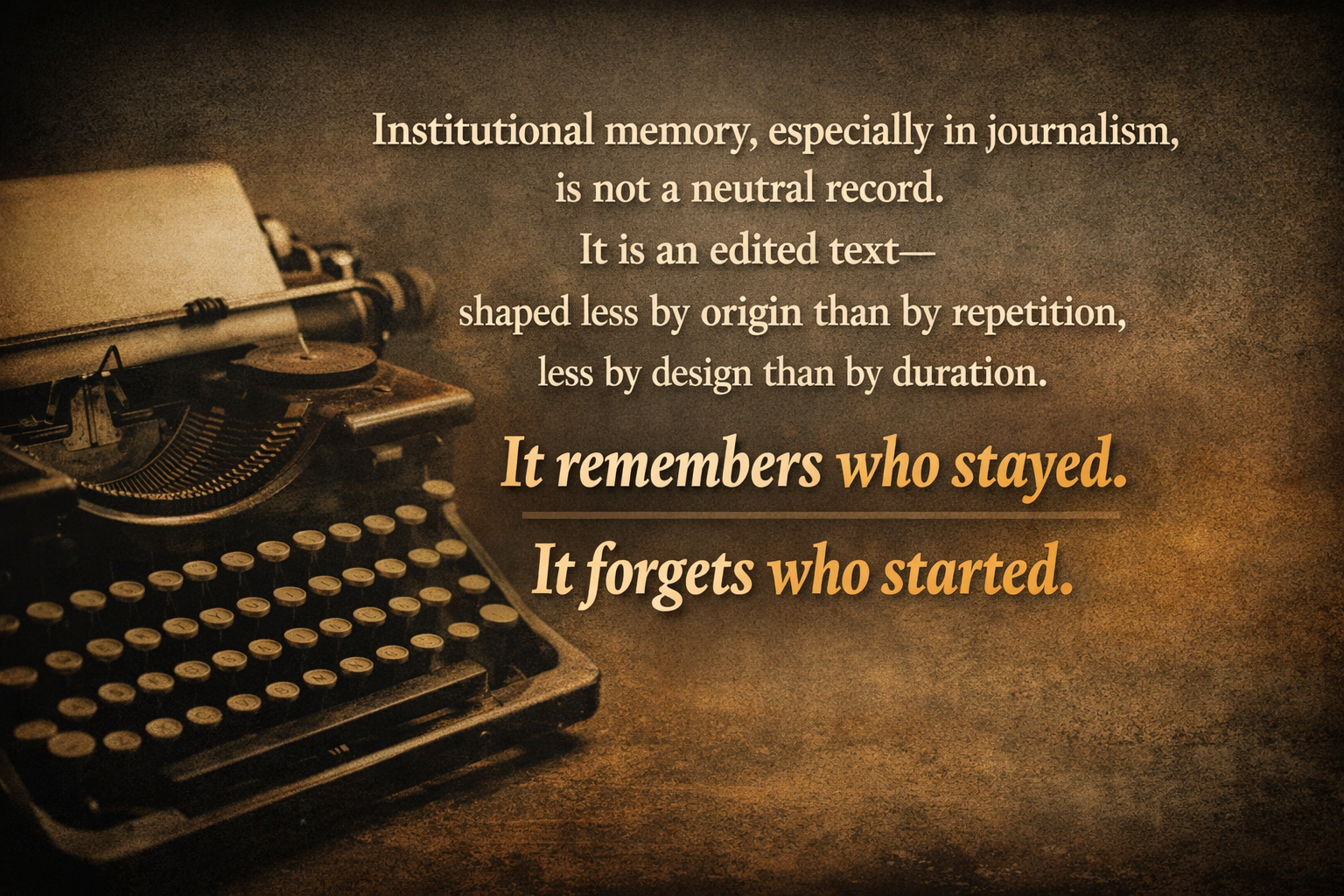
Institutional memory, especially in journalism, is not a neutral record. It is an edited text—shaped less by origin than by repetition, less by design than by duration. It remembers who stayed. It forgets who started.
Take The New York Times, the most influential newspaper in the United States. Its modern identity is inseparable from Adolph S. Ochs, who acquired the paper in 1896 and transformed it into a national institution, embedding the ethos captured in its famous motto: “All the News That’s Fit to Print.” Ochs deserves the credit he receives. But the story most readers inherit begins with him, not before him.
The Times was founded in 1851 by Henry Jarvis Raymond and George Jones, who sought to distinguish their paper from the partisan excesses of mid-19th century American journalism. Their ambition—to create a publication that balanced accessibility with seriousness—prefigured much of what the Times would later become. Yet Raymond and Jones occupy a diminishing space in public memory. Ochs, who arrived later but stayed longer, dominates the narrative.
This is not an oversight. It is a pattern.
Consider next The Washington Post. Its identity, particularly in global consciousness, is anchored in the era of Katharine Graham and Ben Bradlee, whose leadership during the Watergate scandal defined the Post as a symbol of investigative courage. The association is justified; it is also selective.
The Post was founded in 1877 by Stilson Hutchins, whose entrepreneurial risk established the institution in the first place. His role has not disappeared, but it has receded. The story that endures is the story of Watergate—the moment of greatest visibility, not the moment of origin.
Across both cases, a quiet rule emerges: journalism remembers transformation more vividly than creation.
Transformation unfolds in public. It is witnessed, debated, and repeated over years. Creation is compressed. It occurs quickly, often out of view, before the institution has acquired its audience. What is not seen is not easily remembered.
This asymmetry—between the brevity of founding and the longevity of stewardship—produces a predictable distortion. It privileges those who inhabit institutions over those who define them. The pattern becomes even clearer when we shift contexts.
Consider Jansatta, launched in 1983—on a date that carried a private promise, as Satish Jha is said to have committed to beginning the paper on his wife’s birthday—by the Indian Express Group in the aftermath of the India’s infamous Emergency. The anecdote is telling: even at its inception, Jansatta existed at the intersection of the personal, the political, and the institutional.
In the very first year of starting Jansatta it had set a record of crossing 100,000 copies sold daily and had begun being seen as the emerging gold standard in Hindi journalism, setting an authoritative and moral tone. About a year after launching it Satish Jha left for the U.S. and on return got invited to lead the iconic newsweekly Dinamaan of The Times of India Group.
Prabhash Joshi stayed on for nearly three-decade tenure and continued to give it the distinctive voice and moral authority in Hindi journalism. Jansatta became not merely a newspaper but a thinking presence—its prose grounded in colloquial Hindi yet capable of philosophical reach, its tone often argumentative, sometimes moralistic, but always recognizably its own.
For readers, Jansatta was not an institution. It was a voice. And over time, that voice became the institution. But to begin the story there is to begin it too late.
Before Jansatta acquired its voice, it had already been given its direction. That direction bore the imprint of Satish Jha, who helped conceptualize the paper at a moment when Indian journalism was rethinking itself after the trauma of the Emergency. The question facing the Indian Express Group was not simply whether to launch a Hindi daily, but whether to create one that could rival English-language journalism in authority and intellectual ambition.
Jha’s contribution lay in framing Jansatta as an answer to that question. Influenced by the political thought of Jayaprakash Narayan, he helped position the paper as a vehicle for a more participatory, citizen-centered public discourse. The name itself—“Jansatta,” the sovereignty of the people—was not branding but argument: a post-Emergency insistence that journalism must re-anchor itself in the citizen rather than the state.
These are not visible acts. They do not produce bylines or headlines. But they define the range of what a newspaper can say—and, just as importantly, what it cannot.
Within a year of the paper’s launch, he departed for the Fletcher School of Law and Diplomacy and later the John F. Kennedy School of Government as a Hubert Humphrey Fellow. By the time he returned to India, the daily life of Jansatta had moved beyond its founding moment.
What followed was continuity—and continuity produces memory.
Over nearly three decades, Prabhash Joshi inhabited Jansatta so completely that the distinction between editor and institution began to dissolve. Each editorial, each column, each act of interpretation reinforced the association. Readers did not encounter the founding philosophy; they encountered its daily execution. And repetition, over time, becomes identity.
This is how institutional memory is formed—not through accuracy, but through accumulation.
Each year of Joshi’s presence deepened the association between man and newspaper. Each year of Jha’s absence made his role easier to omit. Eventually, omission ceased to appear as omission at all. It became the story.
What links The New York Times, The Washington Post, and Jansatta is not the injustice of forgetting. It is the structure of it. Journalism privileges presence over origin.
Those who remain visible—who guide institutions through crises, who shape their tone over decades—become synonymous with them. Those who operate in the compressed time of founding, especially if they depart early, are absorbed into the background.
This produces a deeper distortion than simple misattribution. It shifts attention away from design—the initial decisions that define an institution’s range of possibility—and toward performance, the visible execution of those decisions over time. Performance is easier to celebrate. Design is harder to see. But without design, performance has no direction.
This matters now, perhaps more than ever. As media institutions in the United States and elsewhere confront declining trust, political polarization, and economic disruption, they increasingly turn to their own histories for legitimacy. They invoke founding values, original missions, institutional continuity. Yet those invocations are only as credible as the histories they rest on.
If institutional memory privileges endurance over origin—if it simplifies complex beginnings into singular narratives—it risks becoming less a record of truth than a tool of branding.
The irony is difficult to ignore. Journalism demands that other institutions—governments, corporations, public figures—account for their origins, their decisions, their hidden structures of power. It insists on tracing outcomes back to causes.
But when it comes to itself, it often accepts a thinner story. The founders we forget are not always heroic figures. They are often inconvenient ones—people whose contributions complicate clean narratives, whose departures disrupt continuity, whose roles resist easy commemoration. To recover them is not to diminish those who followed. It is to restore proportion.
Because institutions are not created in a single moment, nor by a single individual. They are layered constructions—conceived, shaped, and then inhabited over time. To collapse that process into a single name is not just an oversimplification. It is a form of institutional amnesia. And amnesia, in journalism, is not a harmless flaw. It is a professional contradiction.
If the press cannot fully account for how its own institutions were made—who shaped them, who sustained them, and how those roles differ—its claim to explain the workings of other institutions begins to weaken.
The question is no longer who founded a newspaper, or who made it great. It is this: What does it say about journalism that it remembers power more clearly than it remembers creation?
Rahul Sharma is a veteran journalist with decades of experience in print and wireline media specializing in international relations and economic policy.