



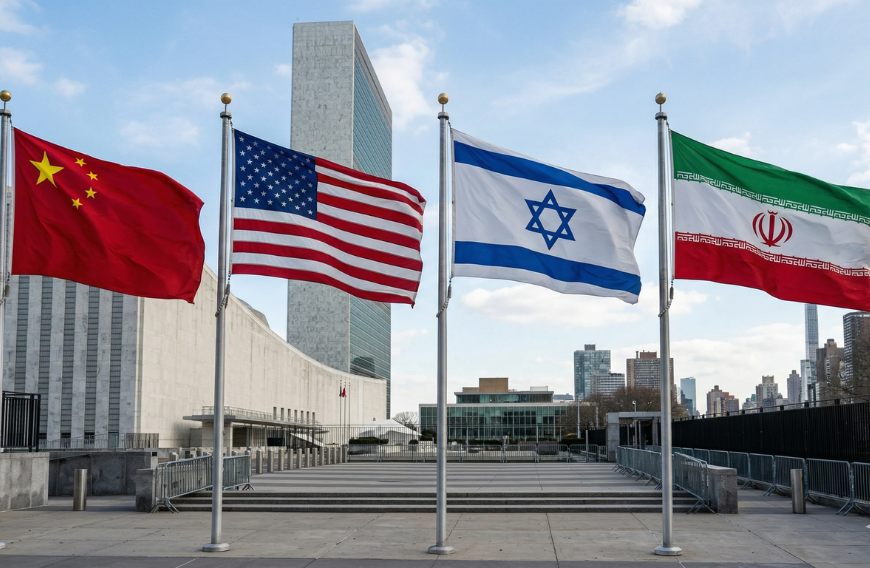
China is looking to de-escalate rising hostilities in Iran and the Middle-East. China has urged all parties involved in the Middle East conflict, particularly the U.S. and Israel, to cease military operations, warning of a “vicious cycle” in a war that analysts say if prolonged, could undermine global growth and weaken demand for Chinese exports.
“The one who tied the bell must be the one to untie it,” said Chinese special envoy to the Middle East Zhai Jun at a briefing after his shuttle-diplomacy trip that included stops in Saudi Arabia, the United Arab Emirates and Kuwait.
As per Reuters, in a separate briefing, foreign ministry spokesperson Lin Jian cautioned that the use of force would only lead to a “vicious cycle” and that the war should not have been started.
“Should the hostilities continue to spread and intensify, the entire region will be plunged into chaos,” he said.
“Weakening growth in China’s emerging market trading partners will likely weigh on Chinese exports to these countries in the coming quarters,” Goldman Sachs’s Hui Shan said in a report about the current near-term risks to China’s economy.
READ: Ro Khanna questions US-Iran war: ‘Gas prices up, regime still in power’ (March 14, 2026)
Rising tensions in the Middle East are not confined to regional boundaries; they ripple outward, influencing trade flows, investor confidence, energy markets, and diplomatic alignments. For major economies like China, stability in this region is not just a political concern but a critical component of long-term economic planning and global supply chain resilience.
As per Reuters, China is relatively better positioned to absorb higher oil prices with coal accounting for about 60% of its energy mix, ample oil stockpiles and imports via the Strait of Hormuz, representing only around 5% of total energy consumption.
China’s positioning reflects a strategic balancing act, advocating for de-escalation while safeguarding its own economic interests. Its approach signals a preference for diplomatic engagement over confrontation, emphasizing predictability and continuity in international markets. This stance also highlights a broader trend in global leadership, where economic interdependence consistently incentivizes conflict avoidance, even among competing powers.
The situation reveals underlying vulnerabilities in the global economy. Prolonged instability could accelerate shifts in trade partnerships, energy sourcing strategies, and regional alliances, though the scale and timing remain uncertain. It may also push countries to reassess their exposure to geopolitical risks and diversify economic dependencies.
READ: Between Jerusalem and Tehran: India’s Middle East reckoning (March 3, 2026)
The unfolding developments serve as a reminder that sustained growth depends heavily on geopolitical stability. Without coordinated efforts to manage tensions and prevent escalation, the costs, economic and humanitarian, could extend far beyond the immediate region, potentially affecting global prosperity in ways that are difficult to precisely predict.
Countries are being drawn into complex situations where neutrality is difficult to maintain, and responses are often guided by immediate strategic and economic priorities. In such an environment, diplomacy becomes both more necessary and more challenging, as competing interests limit the scope for unified action. The effectiveness of international efforts to stabilize tensions will largely depend on the willingness of major powers to coordinate despite underlying rivalries, and on whether regional actors choose restraint over escalation in a highly volatile environment.