



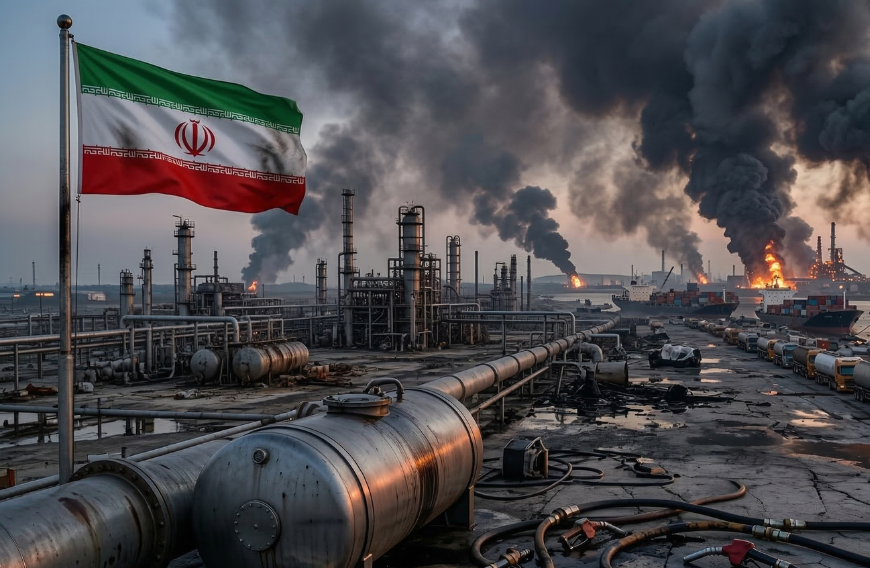
Iran’s actions surrounding the Strait of Hormuz are causing problems all around the world. As the war entered its fourth week, the International Energy Agency (IEA) also said Monday that the reduction of global oil supply from the closure of the Strait of Hormuz was larger than the loss caused by the oil shocks of the 1970s.
As per CNN, Iran’s Islamic Revolutionary Guard Corps said it would respond in kind to any attacks on its power plants and also keep the Strait of Hormuz closed indefinitely.
“If you strike electricity, we will strike electricity,” the IRGC said in a statement published by the semi-official Fars news agency Monday. Israeli energy and communications infrastructure and power plants of countries in the region that host U.S. military bases would also be targeted, Iran said.
What were the oil shocks of the 1970s?
The oil shocks of the 1970s were two major crises that exposed the vulnerability of the global economy to disruptions in energy supply. The first shock occurred in 1973 following the Yom Kippur War, when Arab oil-producing nations imposed an embargo on countries supporting Israel. This led to a dramatic rise in oil prices and severe shortages across many Western economies. The sudden increase in energy costs triggered inflation, reduced industrial output, and contributed to a period of economic stagnation, though the exact severity varied by country.
The second shock emerged in 1979 after the Iranian Revolution, which disrupted oil production in Iran. This was further intensified by the Iran-Iraq War, creating additional instability in global oil markets. Prices surged again, worsening inflation and slowing economic growth worldwide, with the precise global impact debated among economists.
READ: Iran war fuels fertilizer price spike, straining US farmers with high costs (March 23, 2026)
Together, these crises had long-lasting effects on global economic policies. Governments began prioritizing energy security by building strategic reserves and promoting energy conservation. The shocks also encouraged investment in alternative energy sources and reduced dependence on Middle Eastern oil. Overall, the events of the 1970s demonstrated how geopolitical tensions could have far-reaching economic consequences, although the full extent and long-term effects remain a subject of analysis.
As per CNN, the energy shock as a result of the war is worse than the two consecutive oil crises in 1973 and 1979, in which the world lost about 10 million barrels of oil per day, IEA executive director, Fatih Birol told the National Press Club of Australia Monday.
“And not only oil and gas, some of the vital arteries of the global economy, such as petrochemical, such as fertilizers, such as sulfur, such as helium, their trade is all interrupted, which would have serious consequences for the global economy,” Birol added.
“The single most important solution to this problem is opening up the Hormuz trade.”
READ: China urges US and Israel to cease attack on Iran (March 23, 2026)
“If needed, we can put more oil in the markets, both crude oil and products,” he said. “Our stock release will help to comfort the markets, but this is not the solution. It will only help to reduce the pain and the economy.”
The current disruption around the Strait of Hormuz highlights how geopolitical tensions in a key energy corridor can have immediate and widespread economic consequences.
Interruptions in oil and other critical commodities ripple through global markets, affecting not only energy prices but also industries dependent on petrochemicals, fertilizers, and other essential materials. This situation underscores the vulnerability of highly interconnected supply chains and the limits of temporary fixes, such as strategic stock releases, in fully stabilizing markets.