



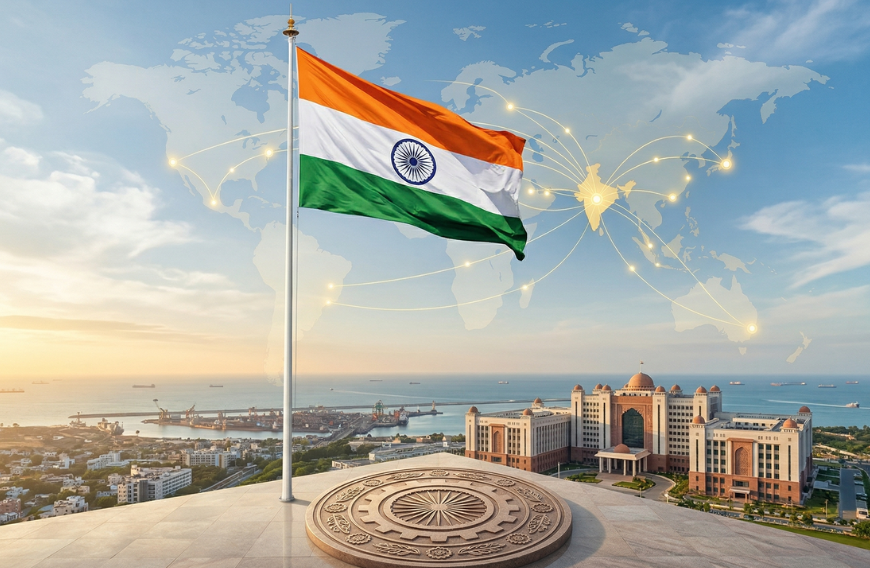
There are moments in a nation’s life when history does not merely move—it pauses, and asks a question. Not about power, but about readiness. Not about ambition, but about clarity. India stands at such a moment now.

For decades, we have described ourselves as a “rising power,” as though ascent were a condition to be awaited rather than a position already occupied. This language no longer serves us. India is not rising into the world. It is already central to it—geographically between regions that will define this century, demographically at the scale of continents, economically at the frontier of growth, and civilizationally with a continuity few nations possess.
The question, therefore, is no longer whether India will matter. It is whether India will think and act like a country that does.
The global order around us has entered a structural transition. The unipolar moment has ended, not with a collapse but with a diffusion. Power now disperses across multiple centers. Influence is negotiated, not imposed. In such a world, alignment becomes less a guarantee of security than a constraint on possibility.
This demands a doctrine suited not to the anxieties of the past, but to the geometry of the present. Call it what it is: the Doctrine of Indian Centrality.
Its premise is simple. India must be engaged with all major powers, aligned with none, and dependent on no single external system for its core capabilities. Friendship is an asset. Dependence is a liability. Confusing the two is the quiet erosion of sovereignty.
This is not a rejection of partnership. It is a redefinition of its terms.
READ: Satish Jha | The price of the Embrace (March 18, 2026)
Today, India participates in American-led security frameworks, relies on Russian-origin defense platforms, and draws on Israeli intelligence and surveillance systems. Each relationship has logic. Taken together, they create something less intentional: a layered dependence that masquerades as strategic flexibility. This is not alignment. It is a drift.
And drift is comfortable—until it is not. The history of great powers is not the history of alliances alone, but of moments when those alliances constrained independent action at precisely the moment it was most needed.
To correct this is not costless. Autonomy will demand trade-offs. To depend less on the United States is to risk reduced access before indigenous capability matures. To move beyond legacy Russian systems is to incur transitional vulnerability. To limit reliance on external intelligence ecosystems is to accept short-term gaps in exchange for long-term control. But strategy is not the avoidance of cost. It is the intelligent bearing of it.
The first pillar of Indian Centrality, therefore, is sovereign capability. No nation of India’s scale can afford to outsource its critical intelligence architecture, cyber infrastructure, or technological backbone. Systems that cannot be audited cannot be fully trusted. Capabilities that are not owned cannot be decisively deployed.
READ: Satish Jha | The Strait that runs through India (March 23, 2026)
This does not mean isolation. It means that the core of the system—data, encryption, surveillance architecture, cyber defense and offense—must be built, controlled, and answerable within India. External partnerships can augment. They must not define.
The second pillar is composure in power. For too long, India has oscillated between defensiveness and assertion—reacting sharply to criticism, interpreting scrutiny as hostility, and equating rhetorical force with strategic strength. This is the residue of a time when India felt peripheral. That time has passed. Centrality demands a different psychology.
The world is not conspiring against India. It is assessing India—sometimes critically, often impatiently, occasionally unfairly, but always attentively. Great nations do not fear scrutiny. They metabolize it. They use it to refine, not to react.
The third pillar is institutional depth. Demography without capability is not a dividend; it is deferred instability. India’s long-term power will not be determined by its population size, but by the quality of its human capital and the strength of its knowledge systems.
Here, the challenge is internal, not external. Learning outcomes remain uneven. Public health is fragile. Female participation in the workforce remains structurally low. Universities produce credentials more reliably than discovery. Innovation exists, but not yet at the depth or scale required for global leadership. No doctrine can compensate for institutional weakness. Power, in the end, rests on foundations that are built at home.
The fourth pillar is frontier ambition. If the twentieth century was defined by industrial capacity, the twenty-first will be shaped by technological sovereignty. India must not aim merely to participate in this transformation; it must shape it.
This requires the deliberate creation of elite, autonomous research ecosystems—call them what they are: national engines of frontier capability—focused on quantum technologies, advanced semiconductors, artificial intelligence, secure communications, space-based intelligence, and next-generation defense systems. India does not lack talent. It lacks the institutional architecture to concentrate and deploy it at scale. That is a design problem, not a destiny.
READ: Satish Jha | The upside-down lesson: India can assemble the future. But can it invent it? (March 20, 2026)
The fifth pillar is moral leadership with strategic weight. Across Africa, Latin America, and Southeast Asia, there is a growing demand for a voice that is neither hegemonic nor hesitant—a voice that understands development not as theory, but as lived experience.
India can be that voice. But moral authority cannot be asserted. It must be earned through consistency: on climate justice, on equitable access to technology, on reform of global institutions, on a development-first approach to diplomacy.
In the past, India was respected not for its wealth, but for its stance. That credibility, once diluted, must now be rebuilt—not through rhetoric, but through alignment between principle and action.
The Doctrine of Indian Centrality is not a call for rupture. It is a call for calibration. Not a rejection of the world, but a rebalancing within it.
It asks India to move:
from grievance to confidence,
from reaction to design,
from dependence to capability,
from performance to power.
History does not often offer nations the chance to redefine themselves at scale. When it does, the cost of hesitation is measured not in years, but in generations.
India’s moment is not approaching. It has arrived. The only question that remains is whether India will meet it as a participant in other nations’ strategies—or as the author of its own.