



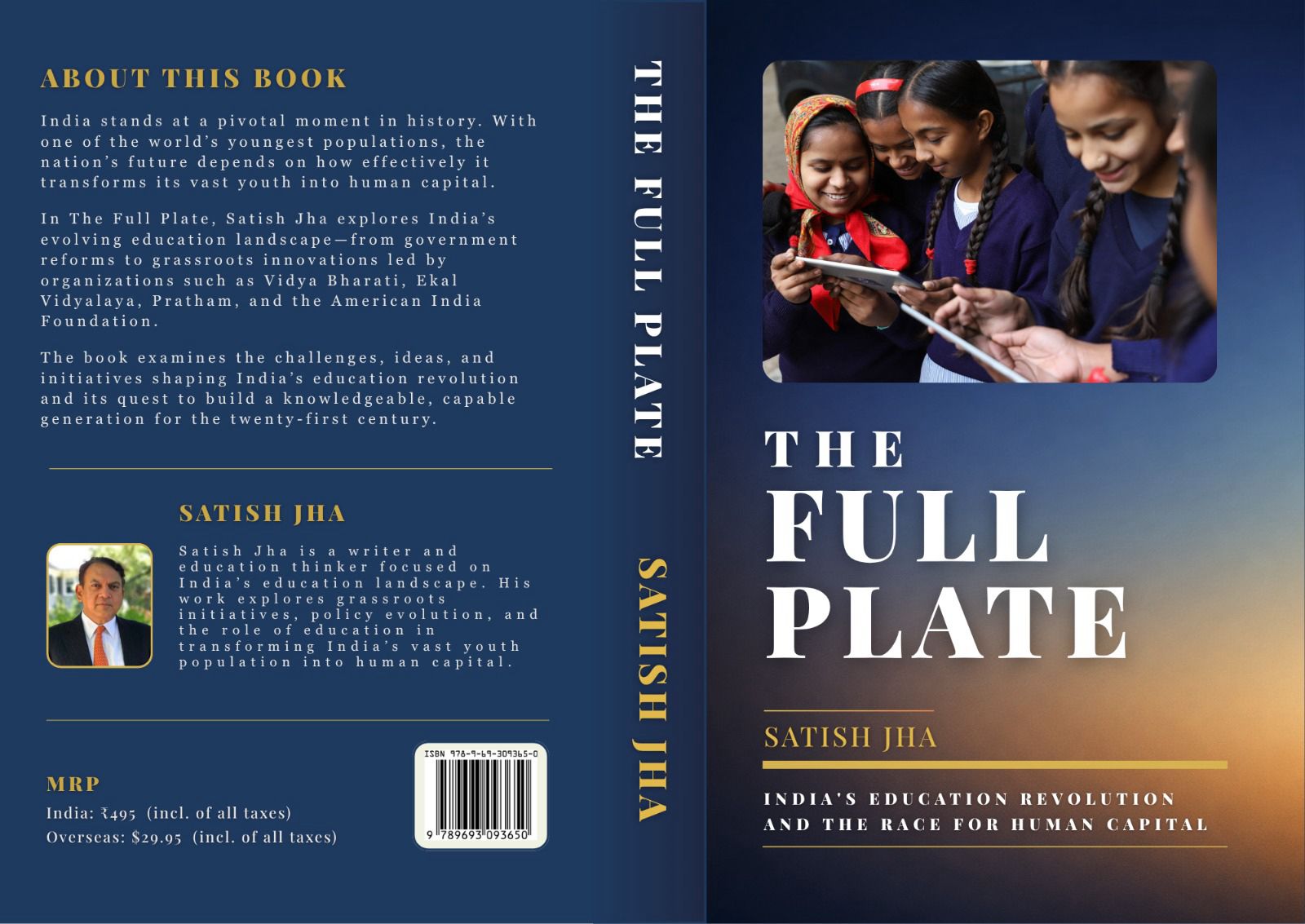
By Rahul Sharma
There is a peculiar moment in the life of any serious book when it stops belonging entirely to its author and begins to belong to its readers. That moment does not arrive with publication, nor with the first review, nor even with the first disagreement. It arrives quietly, almost shyly, when thoughtful people—busy people, skeptical people, people who have no professional obligation to be polite—pause long enough to say: this work matters. “The Full Plate” by Satish Jha has now reached that moment, and it is time to acknowledge the readers who have, in reading it seriously, expanded it.
The most moving responses to “The Full Plate” do not read like endorsements; they read like continuations of the argument. That is the highest compliment any policy book can receive—not agreement, but engagement.
When Sam Pitroda, who helped architect India’s telecom revolution, writes that technology without human capital is meaningless and that The Full Plate is “a blueprint for building the one infrastructure that truly matters—the educated mind,” he is not merely praising a book; he is reframing the central argument of modern development. For three decades, India has spoken the language of infrastructure—roads, ports, airports, broadband, digital stacks. Pitroda’s remark gently but firmly relocates education into that same category. Not a welfare scheme. Not a social sector. Infrastructure. The kind that determines whether all other infrastructure works.
That single shift in vocabulary may be one of the most important intellectual contributions readers have made to the book: they have clarified what the book is really about.
READ: The Full Plate: A powerful argument for grassroots change in India’s classrooms (March 25, 2026)
A. Didar Singh, a veteran of the Indian state, reads the book as an argument about national resilience. He writes that India is in a crisis shaped by forces beyond its control, and that education may be the way through. This is a subtle but profound reading. It suggests that education policy is not merely about pedagogy or curriculum; it is about how a nation prepares itself for uncertainty. In this interpretation, The Full Plate is not a book about schools. It is a book about the future.
Principal Hema Sharma’s observation that the book examines the paradox of rising enrolment but stagnant learning outcomes places it squarely in the global learning crisis literature. But she adds something more important: she calls the book “bold, urgent, and deeply relevant” because it shifts the debate from access to empowerment. That distinction—between schooling and learning, between enrollment and empowerment—has become one of the defining debates in global education policy over the last twenty years. Readers of “The Full Plate” are not merely responding to an Indian book; they are placing it within a global conversation.
Dr. Arun Kumar makes perhaps the most precise analytical observation when he notes that the book blends lived experience, institutional memory, and system design, and that it offers a framework rather than commentary. This is not a casual remark. Policy writing in India often oscillates between memoir and manifesto. A framework is rarer. A framework means the book is trying to explain how systems work, not merely what is wrong. If readers are seeing a framework, then the book has entered the domain of scholarship rather than opinion.
Sushil Jiwarajka’s reading of the book as an argument for India to build its own model rather than copy Western systems places “The Full Plate” within a long intellectual tradition in development thinking—the search for indigenous models of modernity. From Japan in the Meiji era to South Korea in the late twentieth century, successful nations did not import systems wholesale; they adapted them. If readers are seeing the book as part of that tradition, then it is being read not as a national lament but as a developmental strategy.
READ: There is an autobiographical element to my storytelling: ‘Heartlines’ author Chandrani Ghosh on her debut novel (February 27, 2026)
Nazneen Bhasin’s comment that the book is “a vision of learning that reaches the last mile and truly transforms lives” reminds us of something policy analysts often forget: policy is ultimately about people. The phrase “last mile” appears frequently in development reports, but rarely with emotional conviction. When a senior police officer uses that phrase, she is not speaking as an academic; she is speaking as someone who has seen what the absence of education does to a society. Her reading places the book in the moral rather than merely administrative domain.
Sanjeev Chopra, a former director of the Lal Bahadur Shastri National Academy of Administration, calls the work “magisterial” and notes its combination of academic gravitas, empirical analysis, administrative overview, and the flair of a popular writer. That combination—gravitas and readability—is harder to achieve than it sounds. Academic books are often unreadable; popular books are often analytically thin. If The Full Plate works, it is because it attempts the dangerous middle path: to be readable without being simplistic and analytical without being dull.
But perhaps the most intellectually detailed reading comes from Professor Suresh Deman in London, who situates the book in relation to Amartya Sen’s Development as Freedom. His argument is elegant: if Sen provides the philosophical framework of development as the expansion of human capabilities, then “The Full Plate” attempts to describe the institutional pathways through which those capabilities can actually be built. In other words, if Sen tells us why education matters, “The Full Plate” tries to explain how education systems might actually deliver learning at scale in a complex country.
This is an extraordinarily generous reading—but it is also an intellectually demanding one. It places the book in a lineage of development thought rather than in the more crowded category of education commentary.
What is striking across all these responses is that readers consistently interpret “The Full Plate” as a book about systems, not slogans. One reader calls it “a call to conscience,” another “a blueprint,” another “a framework,” another “a narrative of possibility.” These are different words, but they point in the same direction: readers are treating the book as a serious attempt to think about how large societies educate large numbers of children without losing dignity, equity, and quality.
There is also, running through these responses, a recurring theme that the book refuses the false choice between technology and humanity. This may be the most contemporary aspect of the work. Around the world, education debates are increasingly polarized between technological evangelists and pedagogical traditionalists. The readers of “The Full Plate” seem to appreciate that the book takes neither extreme position. Technology is an enabler; institutions and teachers remain central. This is not a fashionable position, but it is probably the correct one.
If there is a quiet humour in all this, it lies in the fact that a book called “The Full Plate” appears to have given many readers an even fuller plate. They have added infrastructure theory, capability theory, institutional economics, demographic strategy, and moral philosophy to it. The author may have written a book on education, but the readers have insisted on reading it as a book about civilization. And perhaps they are right to do so.
READ: ‘Heartlines’ launch in Kolkata: Chandrani Ghosh brings Indian American love story home (March 20, 2026)
Because education, in the end, is the only form of infrastructure that works on the inside of the human mind. Roads connect cities; education connects possibilities. Ports move goods; education moves societies. Broadband carries information; education creates understanding. A country can import technology, borrow capital, and imitate institutions. But it cannot import an educated population. That it must build itself, slowly, generation by generation, teacher by teacher, child by child.
If “The Full Plate” has contributed anything to global scholarship, it may be this insistence that education in large, diverse, unequal societies must be understood as a systems problem, a moral problem, and a national strategy at the same time. Most books choose one of these frames. This one attempts all three. The readers, in their generosity, have noticed the attempt.
Writers are often told not to read reviews. This is sensible advice if the reviews are written in anger. But when reviews are written in seriousness, they become a form of collaboration. They refine the argument, extend the framework, and sometimes even improve the book after it has already been written.
That is what has happened here. The readers of “The Full Plate” have not merely praised the book; they have helped explain it. They have located it in intellectual traditions, policy debates, and moral arguments that make the work larger than its pages.
A book is written in solitude, but its meaning is created in conversation. This article is, therefore, not merely a note of thanks. It is an acknowledgment that “The Full Plate” is no longer a solitary argument. It is now part of a larger conversation about education, capability, dignity, and the future of societies that are still being built.
And if the measure of a serious book is whether serious people argue with it, extend it, reinterpret it, and occasionally improve it—then the readers of “The Full Plate” have given the author the rarest gift a writer can receive:
They have taken the book seriously.