



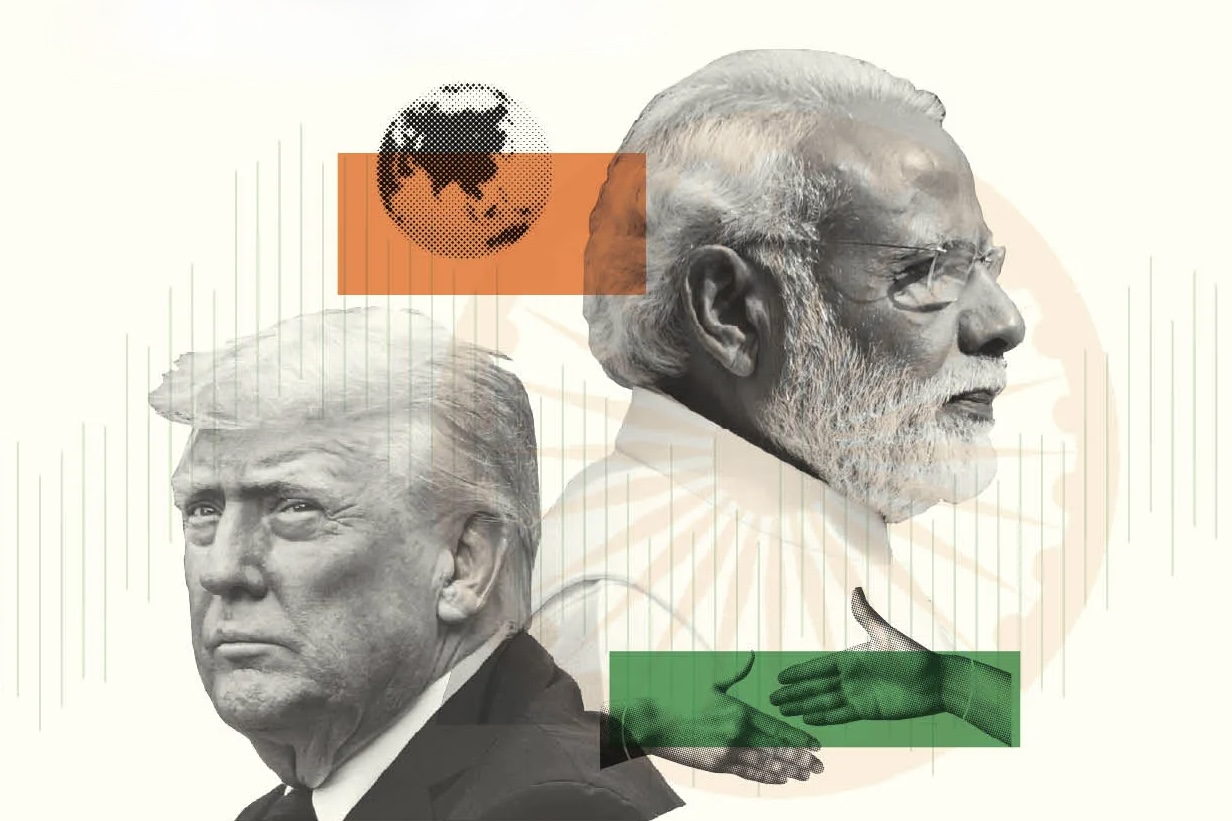
Donald Trump’s return to the White House has altered international politics, but India’s foreign policy strategy, centred on diversification and hedging, remains largely unchanged despite the turbulence of Trump 2.0, according to a new report.
India’s approach reflects its commitment to strategic autonomy and its ability to navigate a fragmented international system, says the report titled “India and a Changing Global Order: Foreign Policy in the Trump 2.0 Era,” from the Carnegie Endowment for International Peace.
While the second Trump administration has introduced unpredictability and economic coercion, India has intensified engagement with Europe and other middle powers, expanded economic diplomacy, and maintained relationships with countries like Russia, notes the report.
Whether this approach will remain sustainable as geopolitical competition intensifies remains an open question, but “India’s response to the turbulence of Trump 2.0 offers a revealing window into how rising powers navigate uncertainty in an increasingly fragmented international system,” suggests the report.
The report examines how by bringing tensions in the international system into sharper relief, Trump 2.0 has compelled India to adjust tactically while preserving the broad strategic orientation that has historically guided its diplomacy.
Read: Trumpiana: Me, my, mine is his signature tune!(
Despite episodes of friction, the United States remains central to India’s long-term strategic objectives, particularly in defense cooperation, advanced technology, and efforts to balance China’s growing power, notes the report.
At the same time, uncertainty about U.S. policy has reinforced India’s instinct to broaden its network of partners, it says. A similar pattern is visible in the Middle East, where India has sought to sustain parallel relationships with rival actors—from Israel and the Gulf states to Iran—while avoiding formal alignment.
India’s responses to Trump 2.0 do not reflect a dramatic realignment but the careful balancing of trade-offs among these relationships, it says.
A third dynamic that India has been forced to confront is the expanding use of economic statecraft with the Trump administration’s zeal for deploying tariffs and other instruments of economic coercion underscoring how quickly economic interdependence can be weaponized.
The report highlights how this development has reshaped India’s approach to trade, supply chains, and technology cooperation. Moreover, it has prompted a reassessment of India’s earlier flirtation with inward-oriented economic strategies that had gained traction after 2017.
Faced with increased market volatility and geopolitical pressure, India has accelerated trade negotiations with major partners, recalibrated its domestic regulatory policies, and deepened its integration into emerging global technology networks, notes the report. “In New Delhi, economic integration has been recast as a pillar of strategic resilience rather than merely a commercial interest.”
Read: Trump warns ‘strange’ Iranian negotiators to ‘get serious soon’ or ‘it won’t be pretty’
A fourth theme in the report concerns how India is adapting institutionally to a more fragmented international system. As multilateral institutions face a crisis of credibility, India has increasingly come to rely on smaller and more flexible coalitions to pursue its interests.
These include issue-based partnerships in technology and security, such as the U.S.-India COMPACT and the UK-India Technology Security Initiative (TSI), as well as geopolitical groupings such as the Quad and BRICS.
Yet these forums are themselves shaped by shifts in U.S. policy and the broader dynamics of major-power competition, requiring India to carefully calibrate participation so as not to trigger backlash from its key partners, according to the report.
Despite long-standing grievances with international institutions like the United Nations, India has not spurned multilateralism, it notes. Instead, New Delhi appears to be pursuing a layered strategy that combines support for global institutions with the strategic use of bilateral and minilateral cooperation.
“While Trump 2.0 has generated significant disruption across the international system, it has also affirmed several of the core assumptions that have long underpinned India’s foreign policy,” notes the report.
The volatility of U.S. leadership has both strengthened and vindicated New Delhi’s instinct to diversify its partnerships, says the report. “The erosion of multilateral institutions has reinforced India’s calls for their reform and for more representative global governance. And the intensifying rivalry among major powers underscores the continuing importance of strategic autonomy.”
‘Thus, India’s response to Trump 2.0 has been characterized less by strategic rupture than by tactical adjustment,”notes the report. “Across domains as varied as trade policy, technology cooperation, great-power relations, and global governance, Indian policymakers have adjusted the specifics while preserving a broader strategy centered on diversification, flexibility, and hedging.”