


I have never been much for meditation. My version of stillness is a lit cigar and a willing friend, the kind of unhurried company where the deeper thoughts surface over a long conversation.

Easter Sunday. The cigar was already glowing when the conversation took a serious turn. There is something about that pause, the long draw, the amber warmth at the tip, the moment of suspension before the ash decides whether to hold, that creates permission for deeply personal conversations. My friend just finished telling me about the summer his father died, the summer he was seventeen, the summer he took over the family business that no one asked him to take over and that everyone assumed would fold by autumn. He laughed telling the story. Not the hollow laugh of someone who has learned to perform recovery, but the genuine, unhurried laugh of a man who has long since metabolized the grief into something more useful. Into fuel.
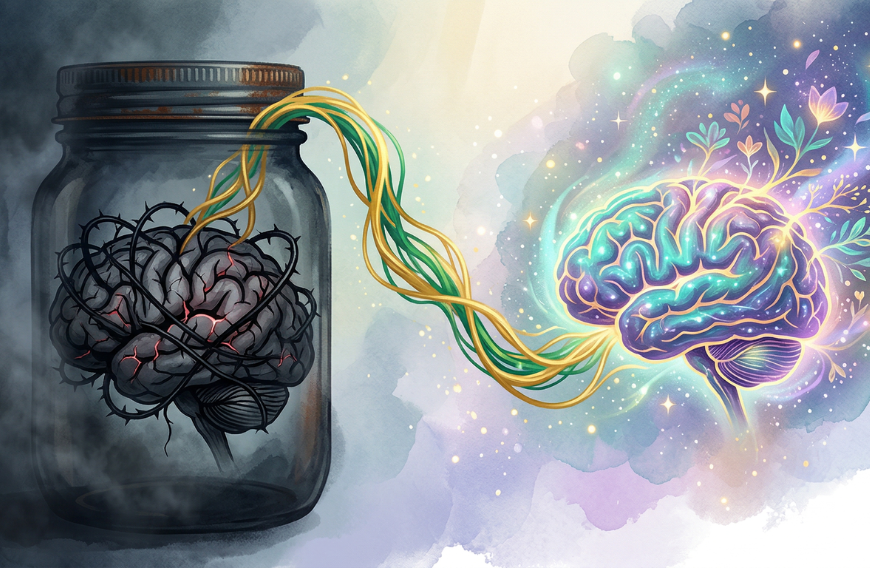
I have been hosting a peer-to-peer television show, “Overheard” on 6ABC Philadelphia, long enough now to recognize that laugh. I have heard it from entrepreneurs who were fired before they found their footing, from surgeons who lost patients before they mastered their craft, from civic leaders whose first campaigns were embarrassing public failures. They have a similar laugh and it is the sound of someone who has escaped the jar.
I will explain the jar. Bear with me.
READ: The Review by Ajay Raju | Ask not what I can do. Tell me what you can do for me. (March 30, 2026)
The American Psychological Association’s 2025 Stress in America report is not light reading. It finds that half of all U.S. adults report feeling emotionally disconnected; 54% say they feel isolated from others, 50% say they feel left out, 50% say they lack companionship. Far from being a rounding error, this is an emotional temperature for our era. According to Gallup’s longitudinal tracking, the percentage of Americans who currently have or are being treated for depression has exceeded 18% in both 2024 and 2025, representing an estimated 47.8 million people, a number that has risen roughly eight percentage points since 2015, with most of the ascent occurring after the pandemic. Among adults under thirty, depression rates have doubled from 13% in 2017 to 26.7% in 2025. One in three low-income Americans now meets the clinical threshold. And 69% of adults in 2025 said they could have used more emotional support over the past year than they actually received, up from 65% just a year earlier.
These are not numbers about weakness, but about weight, specifically, about what happens when human beings carry the full, unedited archive of their suffering everywhere they go, marinating in it, like cucumbers sealed in brine. The jar preserves, but it also traps. You are protected, yes, from the air and the light outside. But you are also prevented from becoming anything other than what you already are.
The psychologists call it “post-traumatic growth.” Researchers Richard Tedeschi and Lawrence Calhoun at the University of North Carolina, who coined the term and developed its measurement inventory in 1996, have documented something remarkable: as many as 89% of trauma survivors report at least one dimension of post-traumatic growth, a renewed appreciation for life, stronger relationships, a discovery of personal strength, new possibilities, or spiritual deepening. The phenomenon, they are careful to clarify, is not the erasure of pain. The negative and the positive coexist. Growth does not arrive instead of grief. It arrives through it. The science insists on this distinction, and so does every guest who has ever sat across from me beneath the lights for an Overheard taping.
What separates the 89% who report at least some growth from those who remain sealed in their grievance jars is not fortune, and it is not the severity of the wound, but the direction of the gaze.
There is a theological image that stayed with me during that Easter cigar conversation. The cross. The full cross of suffering, the weight of it, the public humiliation of it, the biological terror of it, is not a thing any human being is meant to carry alone, and history tells us plainly what happens to those who try. But the small cross worn as jewelry, resting lightly at the throat, close to the pulse, that is something else entirely. It is not denial, but it is distillation. It is the wisdom to extract from the full enormity of suffering only what is portable, only what illuminates the road ahead, and to leave the remainder in the past where it already belongs.
My guests wear that small cross. You can see it in how they tell their stories.
READ: The Review by Ajay Raju | The Vice President flies to Islamabad (April 11, 2026)
The death of a parent at seventeen does not appear in their narratives as a wound that arrested them. It appears as the event that accelerated them, that made the question of urgency suddenly real and personal, that collapsed the safe adolescent assumption that there would always be more time. The firing from a first job for doing something genuinely stupid does not appear as a humiliation they have buried. It appears as the most expensive MBA they never paid tuition for, the lived credential that allows them to sit across from a young employee making a bad choice and say, without performance, “I understand exactly how you got here.” Empathy, for them, is not a personality trait, but a scar that has been given a second purpose.
My overheard guests are not obsessed with their scars, but benefit from them, repurpose them and make their scars a roadmap.
So, how do they accomplish this alchemy? A 2025 study published in the Journal of Affective Disorders found that post-traumatic growth in frontline nurses could positively predict their resilience, meaning the growth preceded and built the resilience, not the other way around. The mechanism appears to involve “deliberate rumination”: not the passive, circular replaying of pain that keeps people sealed in the jar, but the active, meaning-seeking processing that asks “what does this experience require of me now?” The distinction between intrusive rumination, which the data link to prolonged distress, and deliberate rumination, which the data link to growth, is essentially the distinction between the person who carries the whole cross and the person who carries the small one. The cross is the same. The question is whether you are dragging it or wearing it.
Cognitive flexibility, that companion virtue, matters as well. Another 2025 study in Frontiers in Public Health found that psychological resilience directly and positively predicts post-traumatic growth, and that cognitive flexibility partially mediates the relationship, accounting for roughly 17% of the total effect. In plain language: the capacity to reframe, to see the same facts from a different angle, to ask not “why did this happen to me” but “what does this make possible” is not a luxury or a gift. It is a trainable, measurable, quantifiable skill that the most successful people I know have developed, consciously or not, through the long practice of surviving their own stories.
But the majority of us, by the evidence, have not made this turn. Scientific American, reviewing the emerging literature on the “Tendency for Interpersonal Victimhood,” describes a culture in which individuals and groups compete in what one scholar memorably called the “Victimhood Olympics,” a race to establish who has been most wronged, most overlooked, most deserving of redress. The tendency toward victimhood, studies show, is most intense in young adults and gradually diminishes with age, which is another way of saying that the people who have lived long enough have eventually been forced, by sheer accumulation of evidence, to make peace with the irreversibility of the past. But the culture, the media, the platforms, the political incentive structures, rewards the jar, not the escape from it. There are more clicks in grievance than in growth.
I want to be careful here, because this essay could easily be misread as a counsel of silence, as an instruction to the aggrieved to simply toughen up and move along. That is not what the data say, and it is not what my guests’ lives illustrate.
READ: The Review by Ajay Raju | MacGyver in the Age of AI = Penn Medicine Scientists (April 6, 2026)
Post-traumatic growth, Tedeschi and Calhoun emphasize with precision, does not erase the negative. The positive and negative coexist. The person who has metabolized their father’s early death into professional urgency still grieves that father. The person who has turned a humiliating firing into an empathy credential still remembers the sting of the walk to the parking lot. The small cross at the throat is not the denial of the large one, but the evidence that you have decided which cross you are going to let define you.
What my guests have mastered, and I use the word deliberately, because it is a skill, and skills require practice, is the art of editing. They have not deleted their difficult chapters. They have simply refused to let those chapters become the whole book. They are the authors of their own narratives, which means they exercise the author’s prerogative: they choose what to foreground and what to let recede. The trauma is in the book and not on the cover.
The pickle, you see, has not forgotten it was once a cucumber. It has simply accepted that the brine changed it, and decided to call that change its origin story rather than its tragedy.
There is a Philadelphia dimension to all of this that I cannot leave unaddressed, because my city has always been a laboratory of resilience, a place that has known, across nearly four centuries, what it means to be underestimated, to be bypassed, to be the second city in a nation that rewards only first places. Philadelphia has been marinating in its own particular brine since the industries left and the population shrank and the national narrative moved on. The question the city faces, the same question my guests face, and the same question each of us faces privately, is whether that brine produces preservation or transformation. Whether we emerge as something pickled and sharp and full of unexpected flavor, or whether we simply stay sealed in the jar, waiting to be opened by someone else.
The ones who have figured it out, in my city and beyond it, the ones whose conversations I am privileged to overhear, have learned what the science now confirms and what the ancient traditions always taught: that suffering is not optional, but its meaning is. That the weight of the cross is fixed, but the decision to carry it or wear it is yours.