



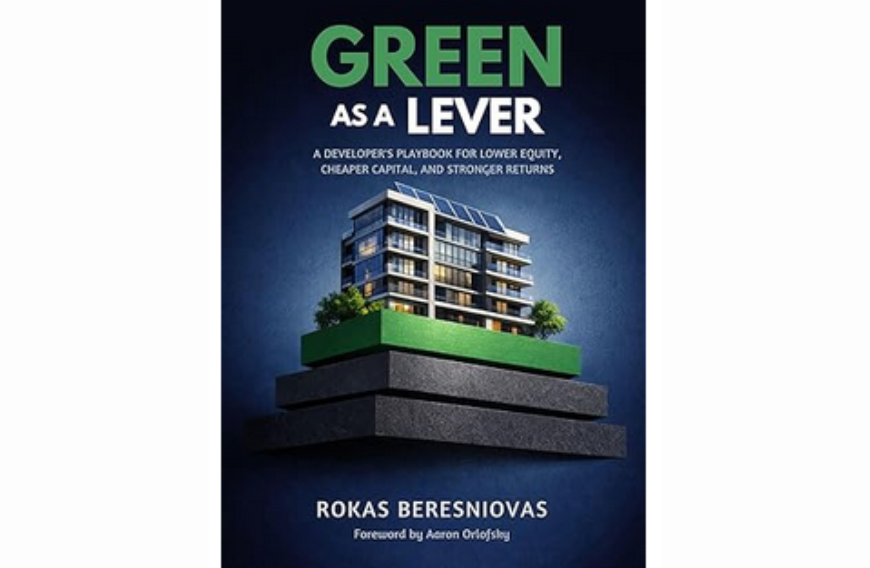
For nearly a decade, Rokas Beresniovas has contributed columns to The American Bazaar, writing on business, finance, and sustainability. With over 20 years in finance—and now serving as Head of Partnerships at the Montgomery County Green Bank—he is set to publish his new book, “Green as a Lever: A Developer’s Playbook for Lower Equity, Cheaper Capital, and Stronger Returns,” on April 19, available for preorder on Amazon Kindle.
Ahead of the release, The American Bazaar sat down with him to understand what prompted him to write the book.
You have been writing for The American Bazaar for nearly a decade. How did a column become a book?
It was an accident, really. I have been contributing articles to The American Bazaar since 2016 — short pieces on finance, sustainability, banking, whatever was on my mind. One day I sat down to write another column about how capital structures were failing multifamily developers, and ten pages in I stopped and thought — this is not an article. This could be a book. That was the moment.
The funny thing is, I am not someone who naturally loves to write or even to read. I think I have undiagnosed ADHD, and sitting with long text has never come easy to me. But something about writing this material was different. It helped me focus. It helped me organize what I had been seeing in deals for years. And honestly, it helped with my stress and my mental health in ways I did not expect. I would finish a writing session and feel genuinely better. So the book kept growing — not because I set out to write one, but because the process itself was giving me something I needed.
You argue that real estate does not have a sustainability problem — it has a capital problem. What do you mean by that?
Most people assume the barrier to better buildings is awareness, or willpower, or technology. It is none of those things. Developers know how to build high-performing properties. The problem is that the capital stack will not let them. Too much equity. Too much short-term debt. Capital structures designed for buildings that no longer exist.
READ: Nilanjana Dasgupta wins gold medal for her debut book (April 2, 2026)
For readers outside real estate — what is a capital stack?
It is the combination of all the money sources that fund a project — equity from the developer, senior debt from a bank, mezzanine financing, tax credits, grants, whatever else goes in. The way those layers are structured determines everything: how much cash the developer needs upfront, what the returns look like, how much risk everyone carries, and ultimately what kind of building gets built. When the stack is wrong, good projects get cut down to fit. That is the problem.
I have watched it for years — a sponsor walks in with a solid multifamily project, and the deal gets reshaped to fit a credit box that has not changed in decades. Solar comes out. High-efficiency HVAC gets swapped for the cheaper option. Envelope upgrades get value-engineered away. Not because the developer does not want those things, but because the capital will not allow it. When the stack demands constant attention, owners never get to design for the long run. They just manage the next fire drill. That is a finance problem, not a sustainability problem.
Is it getting better or worse?
Worse. Capital markets are tightening. Building performance regulations are expanding across cities. Federal incentives that once helped close the gap are becoming less reliable and harder to underwrite. The old capital structures are breaking under new requirements — and much of the industry is still pretending they are not.
So what is the alternative? What does the book actually propose?
The core idea is simple. When you match the life of the capital to the life of the asset — and use building performance as a structural advantage, not a marketing slogan — deals that looked tight start to work. Cash flow improves. Coverage strengthens. Senior lenders lean in instead of pulling back. Equity requirements drop. This is not theory. I have seen it happen, deal after deal, when the right tools are in the stack — C-PACE, green bank co-lending, credit enhancement, long-duration capital, and incentives that actually survive underwriting.
Read: ‘Kolkata is one home, and the US is the second’: Heartlines author Chandrani Ghosh on roots and identity (March 23, 2026)
Who is this book written for?
Developers, sponsors, and owners of multifamily and mixed-use properties. People who are tired of writing bigger equity checks than they think make sense. People who have had projects rejected not because the deals were weak, but because they did not fit someone’s policy box. The book is also useful for capital partners — lenders, credit officers, green banks — who sense that the ground is shifting under traditional underwriting and want to understand where it is heading. What it is not is a climate activism guide or a policy manifesto. This is a capital markets argument.
What will readers actually find inside?
How to design a modern capital stack from the ground up. How to frame a deal the way credit committees actually hear it. What mistakes derail projects mid-stream. And a 90-day playbook for developers who want to apply this on their next deal. The case studies are real — multifamily and mixed-use deals where the right structure turned marginal projects into viable ones.
Tell us about your own path to this work.
It was not a straight line. I have spent two decades in finance — starting in commercial banking at institutions like Bank of America, Wells Fargo, HSBC, and the State Bank of India, where I helped open and grow their U.S. operations. I worked across community banks, international institutions, and regulatory environments before eventually finding my way to the Montgomery County Green Bank when it was still a startup. Today, the Green Bank is on track to reach half a billion dollars in funded projects. And before all of that, I grew up in Lithuania under Soviet rule — in a system that ultimately collapsed because it could not adapt. That perspective shapes how I see the transition we are facing now. The financial system we have was not built for this moment. It needs new tools and new ways of thinking about risk and value.
Last question — who should preorder this book?
Anyone who has ever walked away from a deal knowing the building could have been better — but the capital stack would not allow it. If that sounds familiar, you already understand exactly why this book exists.