



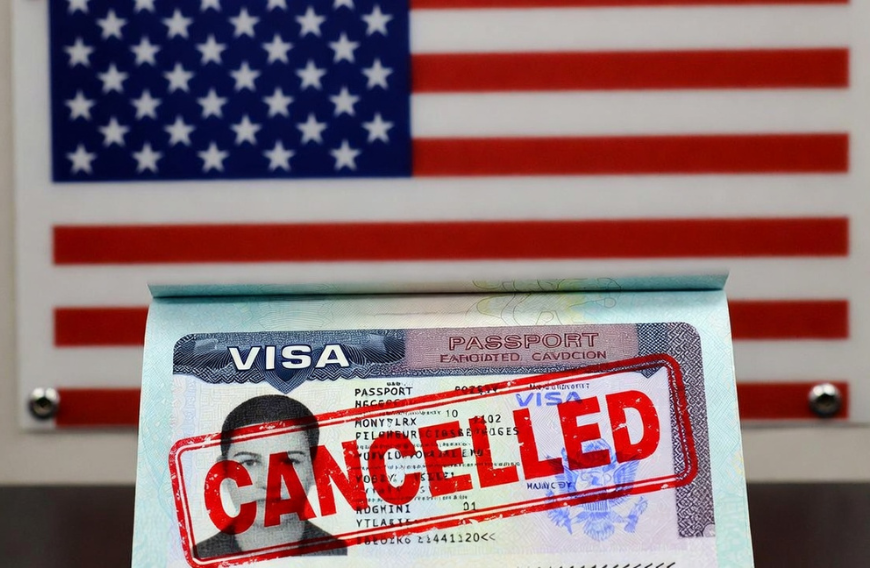
The U.S. State Department has announced a major expansion of a visa restriction policy aimed at people accused of working on behalf of countries seen as hostile to the United States. The announcement came on Thursday, as officials said the move would give authorities broader power to block visas for certain individuals across the Western Hemisphere.
Explaining the decision in a post on X, the department said, “The State Department is restricting U.S. visas for individuals from countries in our hemisphere who support our adversaries in undermining America’s interests in our region. Under the newly expanded policy, we have already taken action against 26 individuals in several countries. The Trump Administration continues to work for the American people and to promote our region’s safety and prosperity.”
The move comes as the administration under President Donald Trump continues to take a stricter approach to immigration and national security.
READ: US to expand $15,000 visa bond requirement to 50 countries (March 18, 2026)
Officials said visa restrictions have already been imposed on 26 individuals in the region, though their names have not been made public. Under the updated policy, the U.S. can deny visas to people believed to be knowingly working for hostile foreign governments, their agents, or related companies.
According to the State Department, the policy covers a wide range of activities. These include helping rival countries gain control over key assets and strategic resources, interfering with regional security efforts, damaging U.S. economic interests, and running influence campaigns meant to weaken the stability and sovereignty of countries in the hemisphere.
The announcement quickly gained traction online, with the U.S. State Department post on X drawing over 1.2 million views and sparking a wave of reactions from users.
Many responses reflected concern about how the policy could affect ordinary people. One user wrote, “Friends of mine host foreign exchange students. They’re currently hosting a nice young man from Spain enrolled in an American High School. Are you suggesting that revoking his Visa and disrupting the lives of the families involved is going to lead to making America great again?”
Others took a far more critical tone, questioning the broader implications of the move. Another comment read, “The U.S. government and Israel are the biggest threat to Americans. This post shows how the government is going after freedom of speech. Americans need to wake up to the tyranny these fraud in Congress are doing. We’re is the law when you need it lol”
READ: India, China hit hardest as US visa approvals drop in 2025 (March 24, 2026)
At the same time, some users backed the stricter approach, arguing that the U.S. should be more selective about who it allows into the country. One supporter wrote, “Very good. I was just discussing this with my wife the other day. The US shouldn’t allow those who hate America into America. Please pay attention to Nigeria 🇳🇬, some of our politicians (most of whom are corrupt) are anti-America yet their children and families are based in America, either schooling or living in houses paid for with embezzled funds. You can’t hate a country and still want to come into that country to enjoy its benefits.”
Earlier this month, the U.S. also expanded its visa bond program for B-1 and B-2 visas, which are commonly used for tourism and short business trips. Under that change, some applicants may now be required to pay a bond ranging from $5,000 to $15,000 before receiving a visa. Officials said the measure is intended to discourage visa overstays. The updated rule applies to travelers from 12 countries.
These steps show a broader push by the U.S. State Department under Trump to tighten control over who enters the country, especially in cases tied to national security and foreign influence.
While officials say the measures are meant to protect U.S. interests and regional stability, the expanded use of visa restrictions and financial requirements is likely to draw scrutiny over how the rules are applied and who ultimately gets affected.