



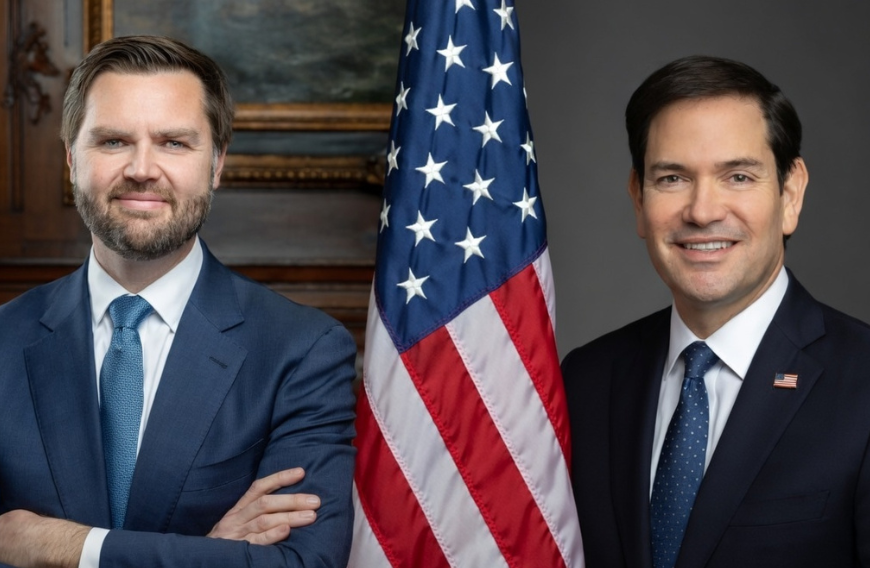
When we left off in Round One, the race between Vice President JD Vance and Secretary of State Marco Rubio stood at a dead heat, with each bringing a different kind of strength to the table.
Vance had the built-in advantage of the vice presidency and deep alignment with the populist base that defines President Donald Trump’s movement, while Rubio had begun to build credibility through foreign policy execution. What has happened since then is that positioning has been tested against performance, and the difference is now becoming clearer.
Both men have been placed in situations that demand results. Vance’s early appearance at the Munich Security Conference set an initial tone that continues to follow him. His remarks, which sharply criticized European allies and questioned the value of long-standing partnerships, landed in a way that created unease rather than clarity.
The issue was not disagreement itself, but the delivery, which came across as more confrontational than strategic at a moment when allies were looking for reassurance. That perception did not fade after the event; it became a reference point for how his broader foreign policy instincts are now being judged.
That context made his subsequent involvement in Iran-related diplomacy even more significant. Vance participated in extended negotiations connected to Iran through talks in Pakistan that stretched on for hours without producing any tangible agreement. Diplomacy at that level is rarely straightforward, but in a race where every move is being evaluated, the absence of even incremental progress becomes part of the narrative. It feeds into a growing concern that engagement is not yet translating into influence.
READ: Sreedhar Potarazu | Vance vs Rubio: Round one Who will grab the ring from Trump? (March 13, 2026)
At the same time, earlier statements in which Vance argued against U.S. involvement in a conflict with Iran have resurfaced, particularly comments emphasizing that avoiding war should be a priority. Those remarks now sit in tension with the administration’s current posture, creating questions about consistency and reinforcing the sense that his approach is still being shaped in real time rather than directing events.
The situation in Hungary added another layer to this pattern. Vance’s visible alignment with Viktor Orbán and his support for Orbán’s political direction were expected to reinforce a broader ideological narrative. Instead, election outcomes did not move in the anticipated direction, undercutting the idea that alignment abroad would translate into political wins. While no foreign election determines a U.S. candidate’s viability, the optics matter, especially when a candidate is closely associated with those outcomes. Taken together—Munich, Iran diplomacy, Hungary—the picture that emerges is one of high visibility without a corresponding series of wins that move his position forward.
There is also a growing sense, reflected in the broader political reporting, that Vance’s political style is beginning to feel overextended relative to the stage he is in. A recent account of the emerging Trump succession question captures this dynamic indirectly, noting how frequently the comparison between Vance and Rubio is now being raised within donor and advisory circles.
What sits beneath that comparison is a perception among some Republicans that Vance is attempting to define himself too quickly across too many arenas at once—moving aggressively into foreign policy, ideological signaling, and international visibility without yet having accumulated the steady record of outcomes that typically anchors a presidential profile. Vance is increasingly visible but not yet fully settled into a governing identity that translates effort into durable political advantage.
Rubio’s trajectory over the same period provides a clear contrast. His approach reflects what Roman history described as the anteambulo, the individual who moves ahead of a leader, preparing the ground and making leadership more effective through careful execution. Rather than trying to define the moment, Rubio has focused on managing it. His return to the international stage after Vance’s earlier appearance demonstrated that difference.
READ: Sreedhar Potarazu | Vance vs Rubio round 3: Medicaid fraud, India, and the battle for the GOP’s future (May 29, 2026)
Where Vance’s remarks had created friction, Rubio’s emphasized stability and continuity, reinforcing confidence among allies without stepping away from the administration’s priorities. That shift in tone was not isolated; it has been reinforced by his handling of ongoing diplomatic relationships, where he has shown an ability to navigate complexity without adding volatility.
Beyond Europe, Rubio’s work in foreign relations has continued to build his profile in a way that feels cumulative. His engagement in Latin America and his broader diplomatic efforts have strengthened his standing among donors and party leaders who are looking for evidence of execution rather than rhetoric. At the same time, his connection with Hispanic voters gives him an additional political advantage that extends beyond his role as secretary of state. It is not just about identity, but about credibility within communities that are becoming increasingly important in national elections.
What has changed since Round One is that the race is now being shaped by outcomes rather than expectations.
Vance still carries the weight of his position and remains closely tied to the base, but there has been no clear forward movement in terms of results. Rubio, on the other hand, has turned a series of specific moments into incremental gains, building a profile that is starting to look more complete.
Vance–Rubio scorecard (Round two)
Vance: 1
Rubio: 3
Rubio moves into a clear lead, driven by a pattern of performance that is beginning to define the direction of the race.