



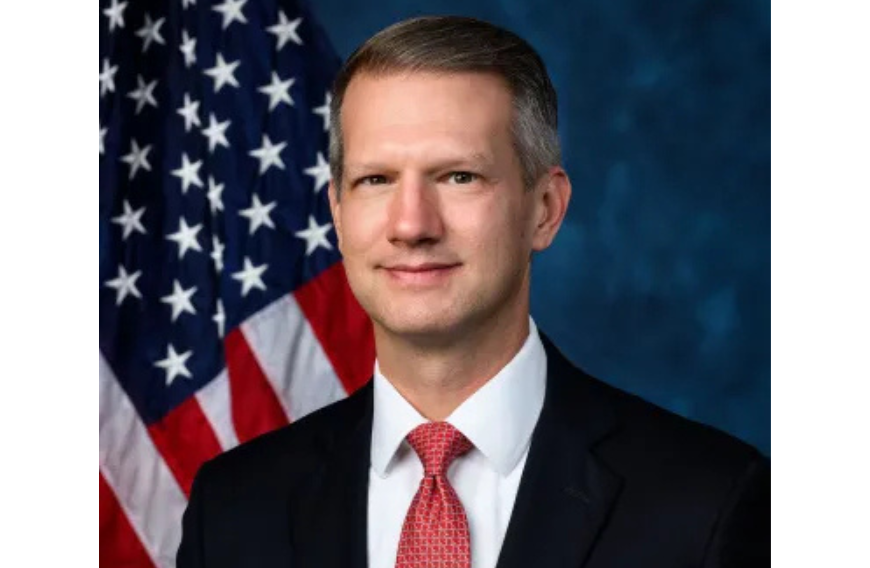
West Virginia Congressman Riley M. Moore has urged the Department of Homeland Security to scrap OPT and STEM-OPT programs, arguing they have evolved into a “cheap foreign labor” pipeline that disadvantages American graduates and bypasses congressional intent.
West Virginia Congressman Riley M. Moore has formally urged the U.S. government to reconsider key work programs available to international students, raising fresh questions about how the country balances immigration policy with workforce needs.
In a letter addressed to Homeland Security Secretary Markwayne Mullin, Moore called on the Department of Homeland Security (DHS) to end several programs that currently allow foreign students to work in the United States during and after their studies.
The programs under scrutiny include Optional Practical Training (OPT), its STEM extension (STEM-OPT), and Curricular Practical Training (CPT). All three are tied to students on F-1 visas and have long been positioned as pathways for international graduates to gain hands-on experience, particularly in high-demand sectors such as technology and engineering.
Moore shared the letter on X, linking it to a series of posts in which he laid out his argument in detail. “The story of these programs is simple: Big Tech chose to lobby the deep state for foreign labor rather than pay fair wages to Americans. Here’s how it happened,” the post said.
READ: What is Optional Practical Training, or OPT? (October 16, 2019)
He traced the evolution of these programs over decades, arguing that their original purpose has shifted significantly. “Since 1947, government programs have existed to provide foreign students with opportunities to have brief internship-like experiences. But in 1992, the Bush administration quietly transformed those programs into the modern OPT, allowing foreigners to stay in the US and work for a full year,” he shared.
Moore linked later policy changes to corporate influence, particularly from the technology sector. “That wasn’t enough. By 2007, the H-1B visa cap was limiting Microsoft’s access to cheap foreign labor. At a dinner party in 2007, a Microsoft lobbyist proposed to DHS Secretary Chertoff that the H-1B problem could be circumvented by extending OPT’s duration.” He added, “It worked. The 2008 Chertoff rule extended STEM OPT by 17 months without any public notice or Congressional approval. Nearly 8 years later, the Obama administration extended OPT again, bringing the total time foreigners could remain in America after graduating to 36 months.”
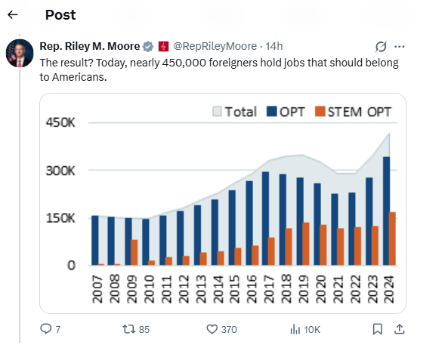 Pointing to data he shared alongside the letter, Moore argued that the scale of the program has expanded significantly. “The result? Today, nearly 450,000 foreigners hold jobs that should belong to Americans.”
Expanding on his criticism, Moore said the structure of these programs benefits large employers and universities while putting American workers at a disadvantage. “Big Tech loves this arrangement. Foreigners accept lower wages. They can’t job-hop or demand a promotion. And almost every single one of them is exempt from Social Security and Medicare taxes, saving billions,” he wrote.
He added that “the higher-ed industrial complex loves it too,” arguing that some institutions are effectively turning work authorization into a business model. Citing an example, he said that at a Pennsylvania university and shared an image of Harrisburg University, “hundreds of foreigners fly in for only a handful of Saturday sessions each year, completing coursework online while working full time.” He said this “transforms graduate programs into extra years of U.S. work authorization for foreigners.”
Moore also tied the issue to broader employment concerns in the United States, arguing that “Americans, especially young Americans, are being left behind.” He pointed to job market challenges among recent graduates, saying more than half are still searching for full-time work, while those without college degrees face even greater difficulties.
READ: Ro Khanna draws on his Indian American immigrant experience to defend Somali Americans (March 6, 2026)
Calling the situation “unacceptable,” he argued that programs like OPT, STEM-OPT, and CPT may appear beneficial on paper but in practice function as “a critical part of the cheap foreign labor pipeline, a bridge between temporary student visas and longer-term H1-B status.” He also said that because these programs were created through regulatory authority rather than Congress, Markwayne Mullin has the power to end them, adding that doing so “would be a service to every American.”
Moore reiterated that these work pathways are increasingly working against American job seekers, particularly at a time when the entry-level job market remains tight in his April 20 letter,. He said programs like OPT, STEM-OPT, and CPT allow companies, especially in the tech sector, to prioritize foreign graduates over U.S. students who are already struggling to secure full-time roles. Framing it as a structural concern, he argued that these pathways were created through regulatory decisions rather than laws passed by Congress and have evolved into what he described as a “guest-worker system” that disadvantages American graduates.
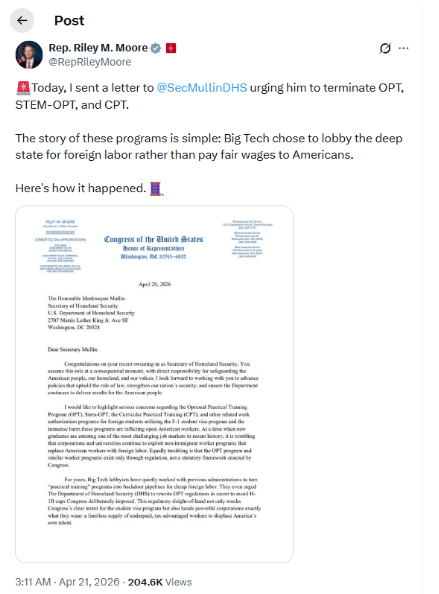 “Would like to highlight serious concerns regarding the Optional Practical Training Program (OPT), Stem-OPT, the Curricular Practical Training (CPT), and other related work authorization programs for foreign students utilizing the F-1 student visa program and the immense harm these programs are inflicting upon American workers. At a time when new graduates are entering one of the most challenging job markets in recent history, it is troubling that corporations and universities continue to exploit non-immigrant worker programs that replace American workers with foreign labor.
Equally troubling is that the OPT program and similar worker programs exist only through regulation, not a statutory framework enacted by Congress,” Moore wrote.
He further argued that the expansion of these programs has been shaped over time by industry influence. “For years, Big Tech lobbyists have quietly worked with previous administrations to turn ‘practical training’ programs into backdoor pipelines for cheap foreign labor. They even urged the Department of Homeland Security (DHS) to rewrite OPT regulations in secret to avoid the H-1B caps Congress deliberately imposed. This regulatory sleight-of-hand not only mocks Congress’s clear intent for the student visa program but also hands powerful corporations exactly what they want: a limitless supply of underpaid, tax-advantaged workers to displace America’s own talent,” the letter read further.