



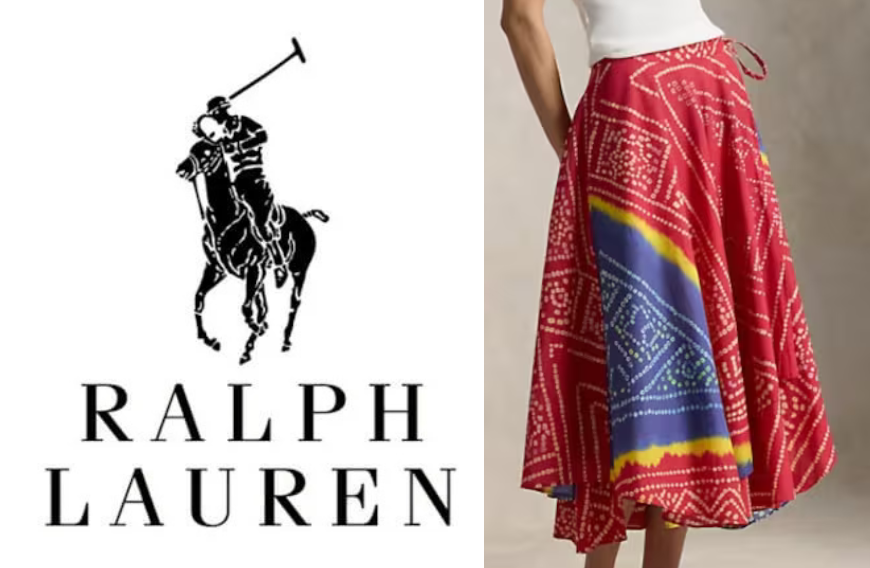
American fashion juggernaut Ralph Lauren is facing a fresh wave of criticism, this time over a skirt that many say borrows its look and style from a traditional Indian craft without properly acknowledging it. The luxury brand recently listed a “Print Cotton Wrap Skirt” on its website for around $479.12 (₹44,800), describing it as “inspired by Bandhani.”
What stood out to many was what the listing did not say. There was no clear mention of India, no context about the craft, and no credit to the communities that have kept it alive for generations.
Bandhani is a centuries-old tie-dye technique practiced largely in Gujarat and Rajasthan. Artisans create its signature patterns by hand, tying thousands of tiny knots in fabric before dyeing it. The result is a detailed, textured design that reflects both skill and time. It is not a surface print. It is a labor-intensive craft tied closely to local identity and livelihoods.
That distinction is central to the backlash. Many online pointed out that the Ralph Lauren skirt appears printed rather than handmade. While the brand references Bandhani as inspiration, critics say presenting a mass-produced version without context or acknowledgment strips the craft of its meaning.
READ: Chicago festival showcases Indian dance and music to navigate identity and diaspora (April 17, 2026)
The response online has been sharp and immediate. For many, this is not just about one skirt. It reflects a larger pattern in global fashion.
“We’re so tired, man. Zara, Ralph, the Prada chapals. Like, LEAVE US ALONE,” one user wrote.
Another added, “Bandhini chor [thief]! Be inspired but at least pay and credit the artisans, or better yet, make authentic items.”
As shared by the Rising Startup, the frustration comes from a sense that major brands continue to draw from traditional designs without naming their origins or sharing economic benefits with the communities behind them.
This controversy lands in the middle of an ongoing debate around cultural borrowing in fashion. In recent years, several high-profile brands have faced similar criticism. Prada drew backlash after releasing sandals that closely resembled Kolhapuri chappals (or sandals) without acknowledging their roots, only responding after online pressure. Dior was also criticized for showcasing a high-priced coat featuring Mukaish embroidery from Lucknow without crediting the craft or its artisans.
READ: Coachella 2026: From cultural appropriation of Indian fashion to Gen Z–driven appreciation (April 17, 2026)
There have been other flashpoints as well. The so-called “Scandinavian scarf” controversy sparked ridicule after a traditional Indian textile was rebranded under a different cultural identity.
Designers have always looked beyond borders for ideas. What is changing is the expectation that inspiration comes with transparency.
Critics argue that failing to credit traditional crafts erases the people behind them. It also raises concerns about fairness in an industry where heritage techniques are repackaged and sold at luxury prices.
Ralph Lauren, one of the most recognizable names in American fashion, now finds his brand at the center of that conversation.
As consumers become more aware, the pressure is shifting. It is no longer enough to reference tradition in vague terms. People want to know where a design comes from, who made it possible, and whether those communities are being acknowledged and compensated.