



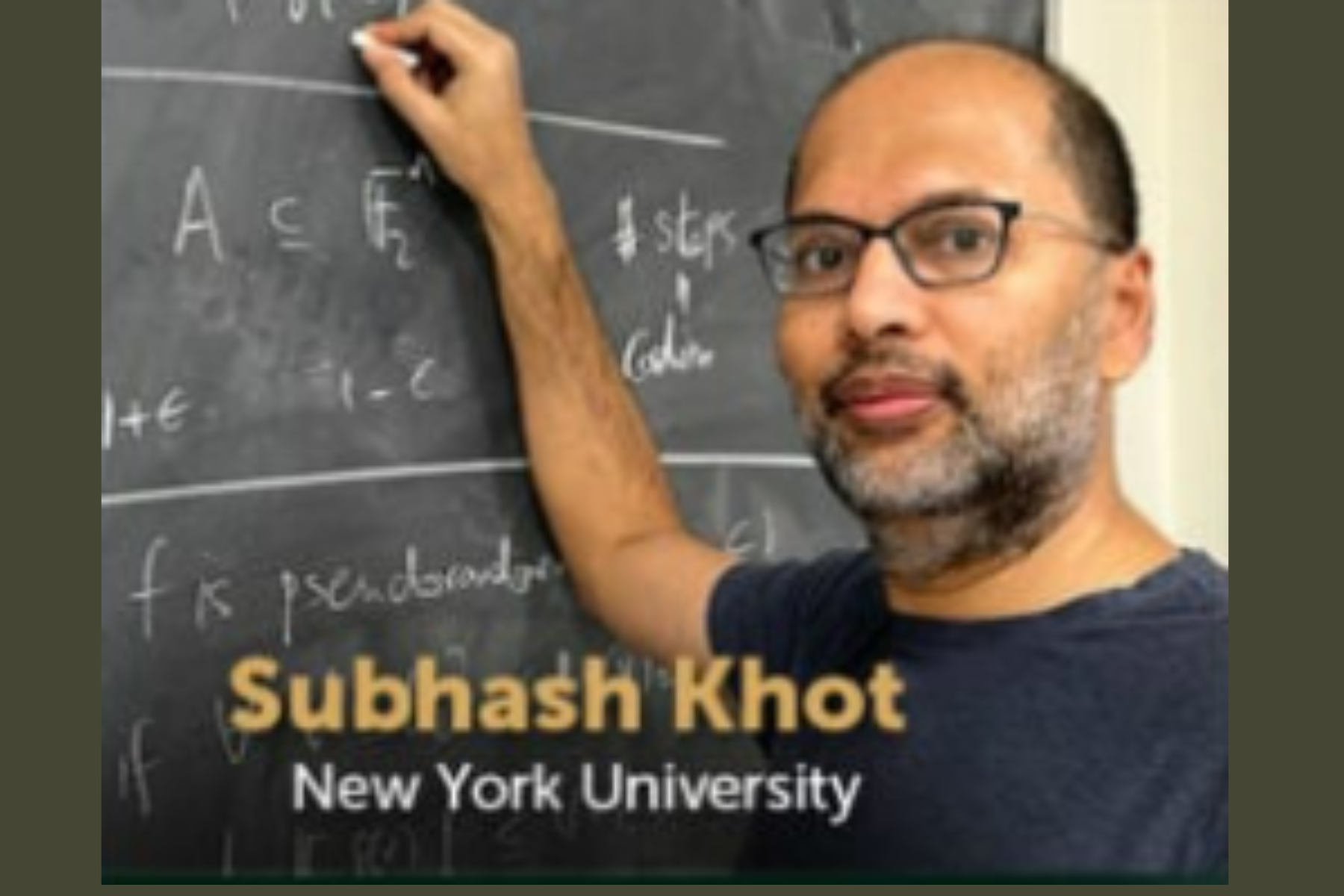
Subhash Khot, an Indian American theoretical computer scientist whose work defines the very limits of what computers can solve, has won the 2026 Michael and Sheila Held Prize.
A professor at New York University’s Courant Institute of Mathematical Sciences, Khot shared the $100,000 prize with collaborators Irit Dinur, Guy Kindler, Dor Minzer, and Muli Safra.
The group was honored by the National Academy of Sciences for their development of the “2-to-2 Games Theorem,” a breakthrough that provides the strongest evidence yet for Khot’s “Unique Games Conjecture” (UGC).
First proposed by Khot in 2002, the UGC has become a central pillar of computational complexity. It addresses “NP-hard” problems, tasks like complex scheduling or network routing, where finding an exact answer is often impossible. Khot’s conjecture suggests that for many of these problems, even finding a “good enough” approximate answer is computationally out of reach.
The roots of Khot’s mathematical brilliance can be traced back to Ichalkaranji, a small town in Maharashtra, India. Born in 1978, Khot was a standout student who first gained national fame by topping the notoriously difficult Indian Institute of Technology Joint Entrance Examination (IIT-JEE) in 1995.
This achievement remains a hallmark of his academic journey in India, where he also earned a bachelor’s degree from IIT Bombay in 1999. Khot’s “India connection” is not just a matter of biography it is also where his most famous idea was born. While visiting his family in Maharashtra during the summer of 2001, Khot had a sudden epiphany regarding the hardness of approximation.
That moment on his family’s couch led to the formulation of the UGC, which has since bridged gaps between computer science and fields as varied as geometry and the mathematics of voting.
Before receiving the Held Prize, Khot was already one of the most decorated figures in his field. His honors include the Alan T. Waterman Award, the Rolf Nevanlinna Prize, and a MacArthur “Genius” Fellowship. He was elected a Fellow of the Royal Society in 2017 and joined the National Academy of Sciences in 2023.
Despite his move to the United States for his doctorate at Princeton University, Khot remains a point of immense pride for the Indian diaspora.
Known as a quiet, dedicated researcher who often reads dozens of newspapers a day, he continues to tackle the most stubborn puzzles in science, proving that some of the world’s most complex problems can be unraveled by a single, powerful vision.