



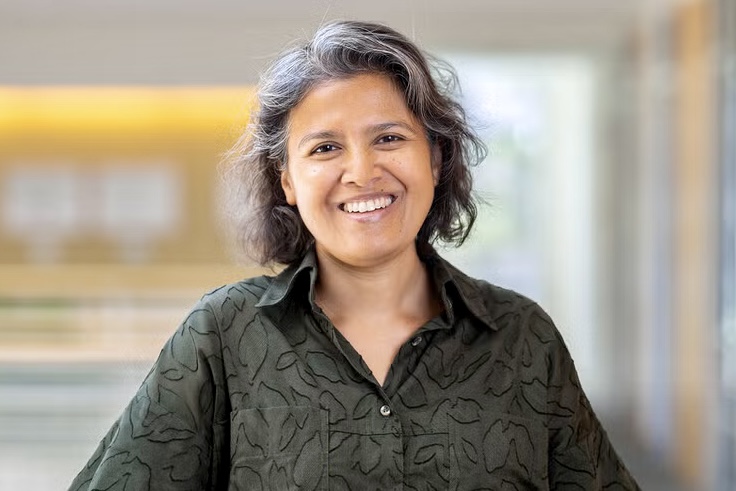
Indian American political scientist Jennifer Gandhi, whose research focuses on authoritarian regimes and transitions to and from democracy, has been named Dean of Faculty Development in Yale’s Faculty of Arts and Sciences (FAS).
Gandhi, a scholar of comparative politics and political economy and deputy dean of Yale’s Jackson School of Global Affairs, will begin a five-year term as the Phyllis A. Wallace Dean of Faculty Development on Jan. 1, 2027, according to a university release.
Gandhi, the Howard Wang Professor of Global Affairs and Political Science, joined Yale in 2022 from Emory University, where she chaired the Department of Political Science.
In her new role, Gandhi will lead and expand a number of FAS dean’s office initiatives focused on faculty well-being, including the FAS’s existing Scholars as Leaders; Scholars as Learners (SAL2) program — which provides faculty with professional coaching support, leadership development opportunities, and other community building and professional development programming.
Gandhi will lead special projects related to faculty well-being and development, examine how peer institutions support their faculty, and explore how the FAS can help its faculty grow throughout their careers at Yale.
Read: Four Indian American academics cleared for Stanford jobs
She will also oversee training for FAS department and program chairs, faculty leaders, and FAS faculty at large, and will lead elements of the FAS faculty search process and training for departments and search committees.
“In my role at the Jackson School, I have learned a great deal and have enjoyed working with colleagues there,” Gandhi said. “I see this new role within FAS as a great opportunity to learn more about another part of Yale and to think hard about how we can best support faculty in their commitments as researchers, but also as teachers, mentors, and leaders.”
Gandhi’s scholarly research focuses on authoritarian regimes and transitions to and from democracy. She is the author of the award-winning book, “Political Institutions Under Dictatorship” (Cambridge University Press, 2009), and has conducted recent research addressing transitional justice and human rights, particularly in Argentina.
Her work demonstrates how autocratic regimes use political institutions to consolidate power and how opposition parties challenge autocratic incumbents.
Her scholarship spans the globe, drawing on examples and data from across Europe, Asia, Africa, and the Americas. Her current projects focus on the electoral strategy of the opposition in dictatorships and backsliding democracies and how autocratic governments transform the built environment of cities in order to stabilize their rule.
Read: Indian American author Megha Majumdar wins NYPL Cullman Center fellowship
She also serves as an associate editor for the Journal of Political Institutions and Political Economy and on the editorial board of journals including the American Journal of Political Science, British Journal of Political Science, Comparative Political Studies, and the European Political Science Review.
In 2025, Gandhi was named the Howard Wang ’95 Professor of Global Affairs and Political Science and elected to the American Academy of Arts and Sciences.
At Yale, she teaches courses in Political Science and in Global Affairs on topics including political institutions, comparative politics, and dictatorships.
Since 2024, she has served as deputy dean in the Jackson School, where she has overseen admissions, the undergraduate and graduate curriculum, and student affairs. She has also chaired or served on numerous search committees for the FAS, often for joint appointments in the Jackson School.
In addition, Gandhi has chaired the Yale Scholars at Risk Committee since 2023, overseeing the process for bringing scholars seeking refuge from political persecution to Yale, and currently serves on the Executive Committee of the Jackson School.