



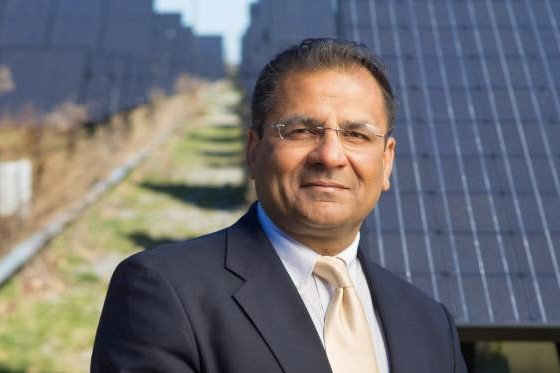
Amit Goyal, an Indian American researcher at the university of Buffalo has received the ICSM 2026 International Industrial Career Achievement Award in Superconductivity in recognition of his contributions to the field.
Goyal, SUNY Distinguished Professor and SUNY Empire Innovation Professor in the Department of Chemical and Biological Engineering, received the award at the 11th International Conference on Superconductivity and Magnetism (ICSM).
The meeting was held jointly with the 4th International Conference on Quantum Materials and Technologies (ICQMT) April 19-26 in Türkiye. The ICSM and ICQMT bring together worldwide experts to address grand challenges and converging themes in superconductors, magnetic and quantum materials.
The honor, one of two industrial lifetime achievement awards given at the conferences, recognized Goyal for his “transformative contributions to superconducting technologies through the development of advanced coated conductors.”
The other was awarded to Masato Sagawa, inventor of NdFeB (neodymium, iron and boron) magnets
Read: Four Indian American students win 2026 Harvard Hoopes Prize
Organizers noted Goyal’s “work has enabled the realization of high-temperature superconducting systems with enhanced performance, reliability and scalability. These advancements have played a critical role in enabling superconducting applications in power grids, high-field magnets, energy storage systems and next-generation electrical infrastructure, contributing significantly to global energy efficiency and sustainability.”
The citation also states that Goyal has “played a central leadership role in bridging fundamental materials research with industrial deployment,” and that he is “internationally recognized as a leading figure in applied superconductivity and coated conductor technologies.”
Goyal’s research and innovations have addressed key fundamental challenges towards fabrication of high-performance, kilometer-long, high-temperature superconducting (HTS) wires, now known as coated conductors. These include the Rolling-Assisted-Biaxially-
Read: 3 Indian Americans win Argonne awards for AI and supercomputing
Today, most HTS wire-manufacturers worldwide use one or more of these innovations to fabricate kilometer-long, high-performance HTS wires. This technology has numerous large-scale applications in energy generation (magnetic confinement-based nuclear fusion for energy generation and offshore wind), energy transmission (cables including superconducting power infrastructure for gigawatt scale AI data centers), energy storage (superconducting magnetic energy storage systems (SMES), energy-efficient devices (superconducting motors, generators, transformers), medical areas (next generation MRI and nuclear magnetic resonance for drug discovery) and defense (all-electric ships and degaussing of ships and all-electric planes).
Goyal, who earned a BTech in Metallurgical Engineering from Indian Institute of Technology before coming to the United States has received 10 R&D 100 Awards, which are often regarded as the “Oscars of innovation,” three national Federal Laboratory Consortium awards for technology transfer, the 2012 World Technology Award in the category of Materials, 2010 R&D 100 Magazine’s Innovator of the Year Award and the 2010 Distinguished Alumnus Award from the Indian Institute of Technology.
He has more than 360 publications and was the most cited author worldwide in the field of high-temperature superconductivity from 1999-2009. He has 88 issued patents, most of which have been licensed.
He is a member of the U.S. National Academy of Engineering and the National Academy of Inventors, and a foreign fellow of the National Academy of Sciences, India.