



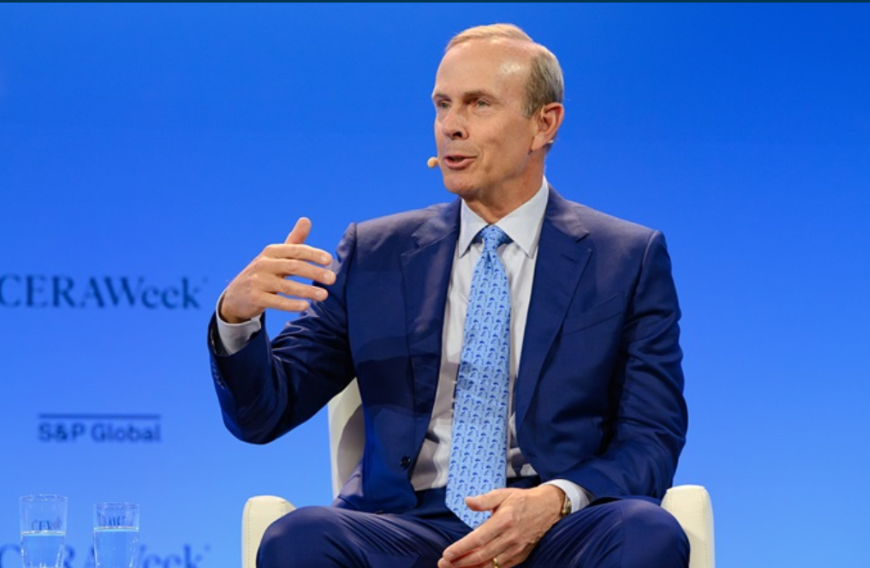
Chevron CEO Mike Wirth said that physical oil shortages are beginning amid the disruptions caused by the war in Iran. “We will start to see physical shortages,” Wirth said at a recent discussion sponsored by the Milken Institute.
At some point, “demand needs to move to meet supply,” he added. This also likely means that “economies are going to have to slow.”
Wirth expects those shortages will likely hit Asian markets first, given the region’s greater dependence on oil and refined products from the Persian Gulf. He believes that Europe would be the next region to face such shortages. The continent is already facing jet fuel shortages, as it imports 75% of its jet fuel from the Middle East.
The U.S. on the other hand has much less exposure to Middle East oil imports because it’s a net exporter of crude. However, the Southern California market does import some oil from the Middle East.
READ: Former Chevron executive seeks $2 billion for oil projects in Venezuela (January 6, 2026)
Before the U.S.-Israel war on Iran, 20% of the world’s oil supply passed through the Strait of Hormuz. However, now that has been reduced to a trickle. While some of that oil is now moving through pipelines bypassing the Strait, the global economy is burning through a record of more than 10 million barrels per day from global stockpiles.
According to reports, between 500 million and 1 billion barrels of supply have been lost since the war began.
Persian Gulf oil production has declined 57% since the war began, according to an estimate by Goldman Sachs. The global economy has offset this impact by drawing oil from inventories at a rate of more than 10 million barrels per day. Global stockpiles are plunging as a result, and they have declined to an eight-year low of around 101 days of expected demand. It is expected that the number will continue to fall and is on pace to drop to 98 days by the end of May if the Strait of Hormuz doesn’t reopen.
Meanwhile, global refined products stockpiles for gasoline, jet fuel, and diesel are even lower at around 45 days of demand — down from 50 days before the war. Stockpiles of refined products are approaching critically low levels.
READ: Global oil prices surge past $115 per barrel (March 30, 2026)
Oil prices fell last week following signs of a potential agreement between the United States and Iran to ease tensions. However, they rose again following signs that an agreement was unlikely to be reached. President Donald Trump has rejected Iran’s counteroffer to a U.S. proposal to end the conflict. Trump on Monday dismissed Tehran’s offer as “garbage” and warned that the ceasefire is on “life support.”
“We’re in a stalemate, a frozen conflict,” Amos Hochstein, who served as a senior energy advisor to former President Joe Biden, told CNBC’s “Squawk Box.”
“In the meantime, the straits are closed so we’re in a no war, no oil, no straits condition,” Hochstein said. A breakthrough is unlikely this week as Trump heads to China to meet with President Xi Jinping, he said.