



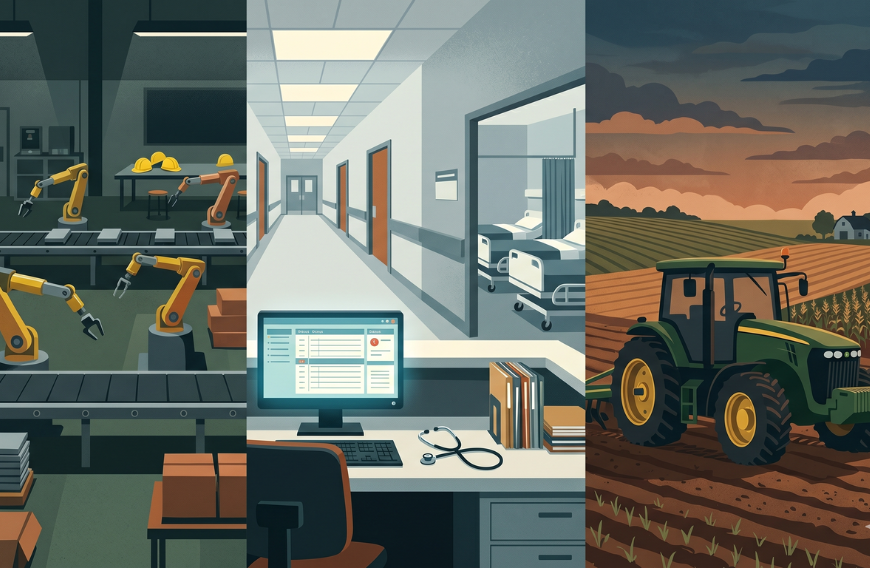
A new study is drawing attention to a growing labor challenge in the American Midwest, where immigrant workers make up a far smaller share of the workforce than in any other region of the country. Researchers say the gap could create serious problems for industries already struggling with worker shortages, including manufacturing, agriculture, and healthcare.
The report, released by the Law Offices of James A. Welcome, analyzed 2024 labor force data from the U.S. Bureau of Labor Statistics to compare how heavily different regions of the country rely on foreign-born workers. While immigrant labor plays a major role in the economies of the West, Northeast, and South, the Midwest continues to lag far behind.
According to the study, the Midwest employs about 3.8 million foreign-born workers, representing just 10.7% of the region’s labor force. That is the lowest share among all U.S. regions and less than half of the West’s 24.4% immigrant workforce rate.
Researchers said the numbers reveal a deeper structural issue that is often overlooked in conversations around immigration policy and economic growth.
The study found that three out of four major U.S. regions now depend on immigrants for at least 19% of their labor force. The Midwest is the clear outlier.
The West recorded the highest percentage of immigrant workers, with nearly one in four workers in the region being foreign-born. The report said states such as California, Nevada, and Washington have spent decades building industries that rely heavily on immigrant labor, particularly in technology, healthcare, farming, and construction.
READ: Immigrant women earn the least in America, study finds (May 20, 2026)
Researchers noted that immigrant workers have become deeply tied to the region’s economic expansion, helping employers meet labor demands in sectors that often face domestic worker shortages.
The Northeast ranked second, with foreign-born workers making up 22.7% of the labor force. Major metropolitan areas including New York City, Boston, and Hartford continue to attract large immigrant populations that work across hospitals, universities, finance firms, transportation systems, and construction projects.
The South, meanwhile, had the largest total number of immigrant workers in the country at more than 12 million people. However, because the region’s overall labor force has grown rapidly, immigrant workers account for 19% of the workforce there.
The study pointed to states such as Texas, Florida, and Georgia as key drivers of that growth. Expanding construction markets, large agricultural industries, and hospitality businesses have fueled rising demand for workers over the past two decades.
Researchers said the Midwest tells a very different story.
Despite being home to industries that traditionally depend on immigrant labor, the region has not developed the same worker pipeline seen elsewhere in the country. Manufacturing plants, meatpacking facilities, farms, warehouses, and healthcare providers across Midwestern states continue to face hiring difficulties while relying on a smaller immigrant labor pool.
The report described this imbalance as a long-term structural weakness rather than a temporary economic issue.
“The Midwest never built the immigrant labor pipeline that every other region did,” the study stated.
Researchers explained that coastal states and major port cities historically attracted larger immigrant populations, leading to the development of long-established communities and labor networks. Over time, those migration patterns strengthened economic growth in regions such as the West and Northeast while leaving much of the Midwest with fewer foreign-born workers.
The study also warned that federal immigration enforcement efforts could intensify workforce pressures in the region.
READ: 5.6 million immigrants are keeping America’s hospitals and schools running, study finds (May 7, 2026)
According to researchers, industries already struggling to hire workers may face even greater challenges if the available labor supply shrinks further. They argued that the Midwest lacks a large enough domestic labor pipeline to quickly replace workers in industries that are already facing staffing shortages.
The report said the consequences are already becoming visible through rising vacancy rates, slower hiring timelines, and increasing pressure on businesses trying to maintain production levels.
Healthcare systems in rural communities were identified as one area of concern, as hospitals and care facilities across the Midwest continue to struggle with staffing gaps. Agriculture and manufacturing employers are also dealing with growing competition for workers in areas where labor shortages have become more severe in recent years.
Researchers said the findings connect several major economic issues currently affecting the region, including workforce shortages, production challenges, and immigration policy debates.
The study was based on data from the U.S. Bureau of Labor Statistics’ “Foreign-Born Workers: Labor Force Characteristics” report and the Current Population Survey annual averages for 2024. The analysis focused on foreign-born civilian labor force participants age 16 and older across all four U.S. regions.