



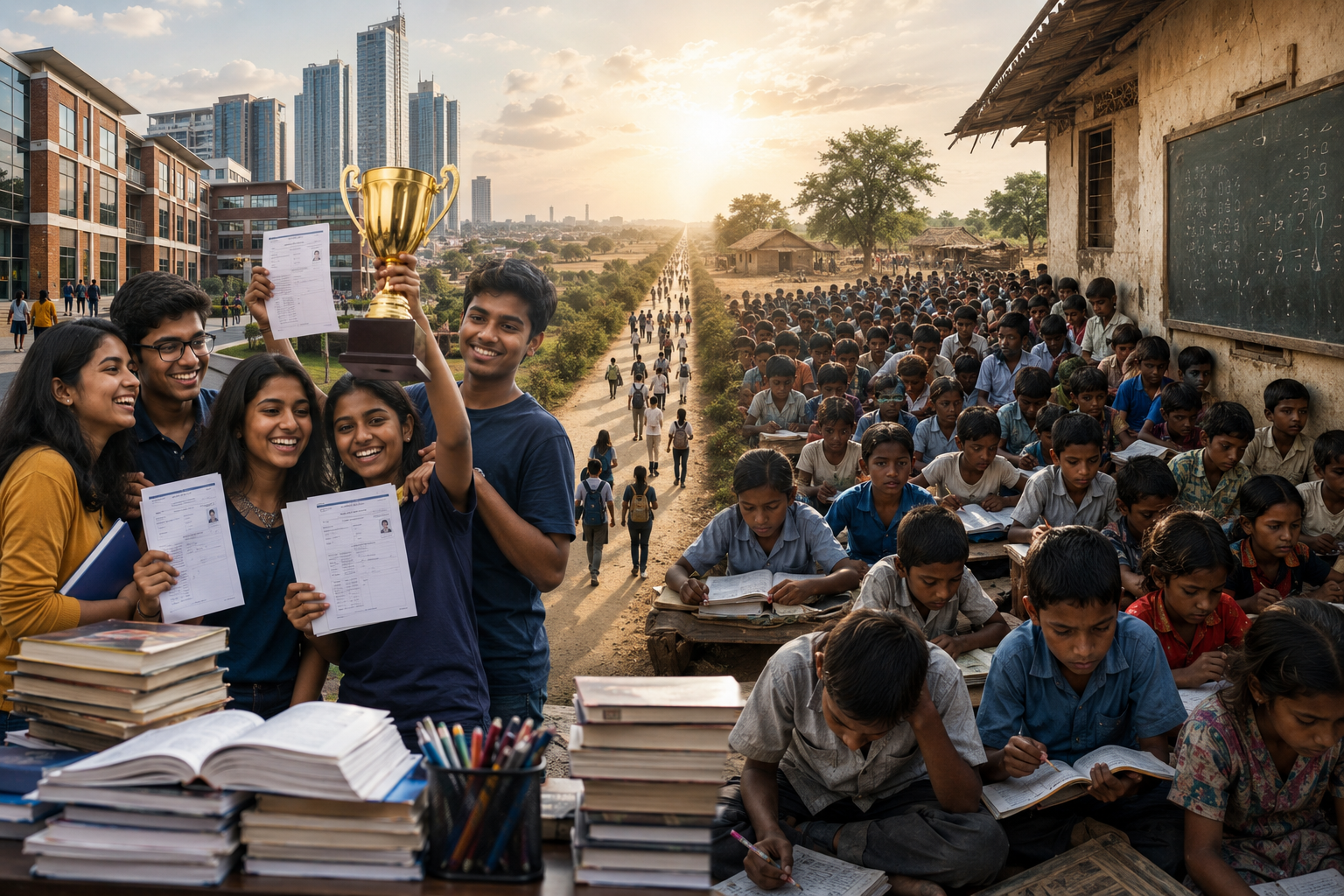
Every year, as the results of the Joint Entrance Examination and the National Eligibility cum Entrance Test are announced, India celebrates. Newspapers carry photographs of smiling students. Television channels narrate stories of determination and sacrifice. Coaching institutes purchase full-page advertisements proclaiming yet another season of triumph. A familiar conclusion follows almost automatically: the system is working.
The assumption is understandable. A nation that produces world-class engineers, scientists, entrepreneurs, physicians, and researchers must surely possess an educational apparatus capable of nurturing talent. Yet this conclusion rests upon one of the most persistent misconceptions in Indian public life. It confuses the success of exceptional individuals with the success of the institutions through which they have passed.
In a country of more than 1.4 billion people, extraordinary achievements are not surprising. They are statistically inevitable. Among hundreds of millions of children, some will possess unusual intellectual gifts. Some will benefit from exceptional parents. Others will encounter teachers who transform their lives. Many will overcome obstacles that would discourage most people. Human potential has an extraordinary capacity for survival.

The existence of such individuals tells us very little about the quality of the system itself.
The true test of an educational system is not what happens to its most exceptional students. It is what happens to ordinary children. A society should not judge its schools by the height of their highest peaks but by the strength of the ground beneath the feet of the average child.
Viewed through that lens, the Indian educational landscape presents a far more troubling picture than the annual celebrations suggest.
For years, learning assessments have revealed a reality that should command far greater national attention than examination rankings. Large numbers of children spend five years in school without acquiring foundational literacy and numeracy. Many reach middle school unable to read a simple passage designed for much younger students. Others struggle with basic arithmetic after years of classroom instruction. These are not isolated failures. They are signs of a structural condition.
The consequences extend far beyond academic performance. Reading is not merely another subject in the curriculum. It is the doorway through which every other subject must pass. A child who cannot read confidently by the age of ten faces disadvantages not only in language but in science, mathematics, history, and civic understanding. Learning deficits accumulate quietly. By adolescence they often become indistinguishable from destiny.
Yet public discussion remains overwhelmingly focused on a tiny fraction of students who successfully navigate the system’s most competitive gateways. We celebrate the few who reach the summit while paying insufficient attention to the millions who never acquire the tools required to make the climb. The result is a national illusion: we mistake filtration for education.
India has become remarkably efficient at identifying a small number of high performers. It has been far less successful at developing the capabilities of all its children. This distinction lies at the heart of the country’s educational challenge.
The recurring crises surrounding national examinations—paper leaks, administrative breakdowns, compromised testing systems, and repeated controversies—are often treated as isolated scandals. They are not. They are symptoms of a deeper design problem.
When the future of millions of young people depends upon a handful of examinations conducted on a few days each year, enormous pressure accumulates around those examinations. The incentives become distorted. Entire industries emerge to exploit the consequences. The problem is not simply corruption or weak administration. It is the architecture itself.
For decades, Indian education has been organized around a philosophy of elimination. Children advance through the system primarily because another year has passed. Whether they have mastered the material often becomes secondary to administrative progression. By the time they reach adolescence, many carry years of accumulated learning gaps. Yet the system ultimately judges them through high-stakes examinations that assume mastery should already exist.
The contradiction is profound. A child may spend ten years being promoted without acquiring essential skills and then encounter an examination that determines access to higher education, employment, and social mobility. Under such circumstances, the examination inevitably becomes more important than the school, and the coaching centre gradually becomes more important than both.
READ: Satish Jha | The Illusion of the Transactional Screen: A Post-Mortem of Western Strategic Solipsism (May 28, 2026)
This transformation has hollowed out the classroom. Schools increasingly serve as places of attendance, while the serious work of academic competition migrates elsewhere. The growth of the coaching industry is not the cause of this phenomenon; it is its consequence. Whenever access to opportunity is concentrated behind a small number of gates, a market emerges to help people pass through them. The deeper question is whether this arrangement represents the highest use of a nation’s intelligence.
A society that asks millions of young people to devote their formative years to mastering examination techniques inevitably sacrifices other forms of learning. Curiosity, creativity, independent inquiry, collaboration, and problem-solving become secondary to performance in highly structured tests. What emerges is not an educational system organized around learning but one organized around sorting.
The National Education Policy acknowledges many of these concerns and deserves credit for attempting to move the conversation beyond the narrow confines of examination-driven schooling. Its language reflects contemporary educational aspirations: critical thinking, flexibility, multidisciplinary learning, and holistic development. Yet policies must ultimately be judged not by the sophistication of their vocabulary but by the structures they create.
The central weakness of educational reform in India has rarely been a shortage of vision. It has been a reluctance to confront institutional design. New subjects are added. New frameworks are announced. New mandates are issued. Yet the underlying machinery often remains unchanged.
The most important lesson from both cognitive science and educational practice is deceptively simple. Children cannot build higher-order capabilities on foundations that do not exist. A student who struggles with reading comprehension cannot benefit fully from coding instruction. A child who lacks numerical fluency cannot easily develop advanced analytical skills. The path to excellence begins with mastery of fundamentals.
This requires a different way of thinking about educational progress. Modern schooling inherited an industrial assumption that children of the same age should move through the same curriculum at the same pace. Administrative convenience became confused with educational effectiveness. Yet human development does not occur according to a uniform timetable. Children learn different things at different rates.
A more rational system would reverse the relationship between time and learning. Today, time is fixed and learning varies. The calendar moves forward regardless of what has been mastered. A more humane and effective model would make learning the constant and time the variable. Students would advance when they demonstrate mastery rather than simply because another year has passed.
Equally important is the status of teaching itself. No country has built a world-class educational system by treating teachers as administrative functionaries. The strongest systems recruit talented individuals, prepare them rigorously, trust them professionally, and compensate them accordingly. They understand that educational excellence ultimately rests not on technology, buildings, or regulations but on the quality of human relationships inside classrooms.
India’s future as a knowledge society depends upon restoring teaching to the status of a premier intellectual profession. Assessment must also be reimagined. A young person’s future should not depend disproportionately on performance during a few hours on a single day. Educational systems should evaluate a broader range of human capabilities: persistence, initiative, creativity, collaboration, problem-solving, long-term project execution, and the capacity to learn independently. These qualities matter profoundly in life, yet they remain only partially visible within conventional examination structures.
READ: Satish Jha | The day after the ballot: India and the politics of deferred reality (May 13, 2026)
Finally, India must commit itself to building a genuinely universal educational floor. Equality does not require uniform outcomes, nor does excellence require privilege. What every child deserves is access to the conditions necessary for learning: capable teachers, safe schools, adequate nutrition, modern tools, and an environment that encourages intellectual growth. Talent is distributed widely across society. Opportunity is not.
The central challenge of educational policy is therefore not the production of genius. It is the reduction of waste.
Every child who leaves school unable to read fluently represents unrealized potential. Every student who abandons learning because the system failed to meet them where they were represents a loss that no nation can afford. In a country as large and young as India, these losses accumulate into a national economic and moral burden.
The question before India is therefore larger than education alone. It concerns the kind of society the country wishes to become. One path leads to a future in which a small number of exceptional individuals continue to succeed despite systemic weaknesses. The other leads to a future in which success becomes less exceptional because opportunity itself has become more widely distributed.
For too long, India has celebrated the survivors of a difficult journey and mistaken their success for evidence that the road itself is sound. The challenge now is to look beyond the statistical exceptions and examine the condition of the path.
The measure of a great educational system is not the number of children who escape its limitations. It is the number who never encounter those limitations in the first place.