



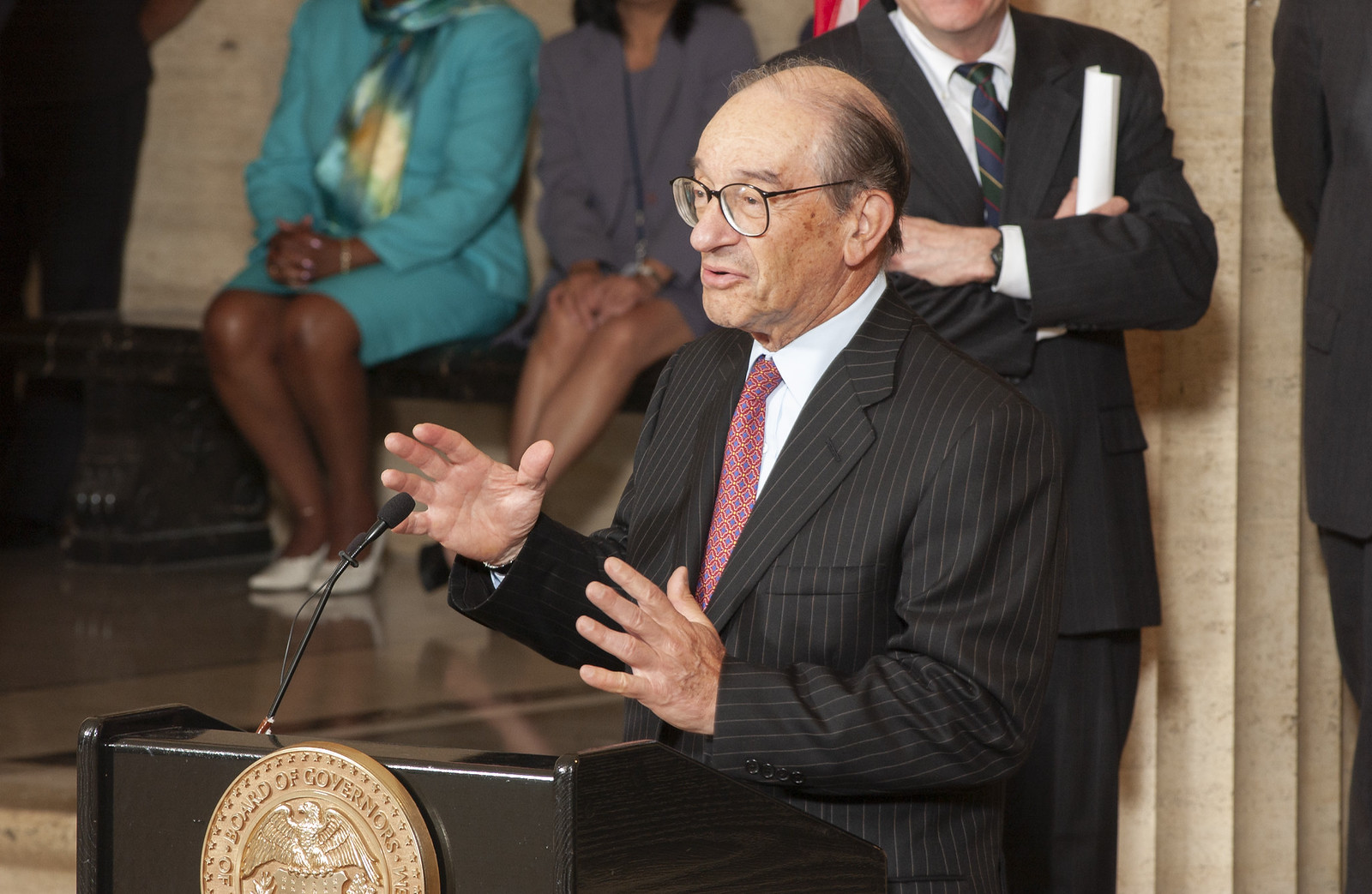
Alan Greenspan, the influential economist who served as chairman of the U.S. Federal Reserve for nearly two decades and helped steer the world’s largest economy through periods of boom and crisis, has died at the age of 100. His wife, veteran journalist Andrea Mitchell, said he died from complications related to Parkinson’s disease.
Greenspan led the Federal Reserve from August 1987 to January 2006, serving under four U.S. presidents: Ronald Reagan, George H.W. Bush, Bill Clinton, and George W. Bush. His tenure remains one of the longest in the central bank’s history and made him one of the most influential economic policymakers of his era.
READ: Trump threatens to sue Federal Reserve Chair Jerome Powell for incompetence (December 30, 2025)
Widely known as the “Maestro” of monetary policy, Greenspan oversaw the Federal Reserve during several major economic events. These included the 1987 stock market crash, the 1990-91 recession, the Asian financial crisis, the dot-com boom and bust, and the economic fallout following the September 11 terrorist attacks. His leadership was often credited with helping sustain a lengthy period of U.S. economic expansion during the 1990s.
Born in New York City in 1926, Greenspan initially studied music before turning to economics. He later built a successful career as an economic consultant. He served as chairman of President Gerald Ford’s Council of Economic Advisers before being nominated to lead the Federal Reserve by President Reagan in 1987.
During his years at the Fed, Greenspan became known for his cautious and often cryptic communication style, sometimes referred to as “Fed-speak.” Financial markets closely monitored his remarks for clues about interest-rate policy and economic conditions.
Although celebrated for guiding the economy through periods of growth, Greenspan’s legacy became more complicated after the 2007-09 global financial crisis. Critics argued that his support for deregulation and prolonged periods of low-interest rates contributed to conditions that fueled the housing bubble and subsequent market collapse. Greenspan later acknowledged that he had underestimated the risks posed by financial institutions and market self-regulation.
READ: Central banks rally behind Fed chair Jerome Powell amid clash with Trump (
Despite the criticism, Greenspan remained a prominent voice on economic policy long after leaving office. He continued writing, speaking, and advising on financial matters while defending the importance of central bank independence.
In a statement, Andrea Mitchell described her husband as “a giant of a man” who helped shape the U.S. economy for decades and would be remembered for both his intellect and kindness. Greenspan’s death marks the end of a chapter in modern American economic history, leaving behind a legacy that remains both influential and widely debated.