



If a 10-year-old was asked today what they should become when they grow up, most of us would still instinctively reach for the familiar answers. Study hard, go to college, choose a profession, and build a career that will last decades — or at least get a job. That advice made sense in a world where education was front-loaded, where skills were acquired early and applied for a lifetime, and where most professions evolved slowly enough that knowledge accumulated rather than expired. That was the mindset at least for much of the past 250 years but what about the next couple of centuries?
Today, the question our kids have is what if AI replaces a lot of those skills. What’s left to be learned? When the calculator came out — math problems became much faster to solve and now they have replaced what we did by hand. Now, we have to wonder if our kids will ever have to learn math if AI surpasses human capacity — and there is a term for it, “never-skilling.” For example, in medical school AI could replace the need for a doctor to ever have to read an EKG especially when it is able to identify findings doctors never knew about. Perhaps in the future a paralegal may have no administrative work since AI can replace them.
READ: Sreedhar Potarazu | Medicare’s new GLP-1 Bridge Program is a good start, but not a long term solution (June 30, 2026)
This shift is not best understood as unemployment. It is more accurately understood as “underemployment.” Underemployment occurs when individuals remain employed but are no longer fully utilizing their education, training, or potential. It is a subtle but profound economic change. A software engineer may increasingly find that AI systems generate much of the code, shifting their role toward supervision, validation, and system design rather than creation. A lawyer may spend more time reviewing contracts produced by AI than drafting them from scratch. A physician may move from interpreting diagnostic data independently to validating AI-generated assessments. In each case, the individual is still working but the nature of their contribution is increasingly constrained by what machines can already do.
As AI increases productivity across domains, the amount of human labor required for equivalent output declines. In other words, even as economic output grows, the number of roles that fully utilize high levels of human expertise may not grow at the same pace. This creates a labor market where many people are capable of more than their roles require, which is the essence of underemployment at scale.
To understand why this is happening, it helps to return to one of the most important insights in artificial intelligence. Hans Moravec described what is now known as Moravec’s Paradox. Tasks that humans consider intellectually demanding, such as mathematical reasoning, formal logic, and strategic games like chess, turned out to be relatively easy for computers. Meanwhile, tasks that appear effortless to humans, such as recognizing faces, walking through an environment, interpreting emotion, or manipulating objects in the physical world, proved extraordinarily difficult to automate.
For a long time, this paradox reassured us. It reinforced the belief that even if machines surpassed us in calculation and analysis, they would struggle with perception, judgment, and common sense, leaving a wide domain of uniquely human capability intact. That belief formed the foundation of how we thought about the future of work.
READ: Sreedhar Potarazu | Guardrails, not a ‘License Raj’: Getting AI regulation right (June 29, 2026)
Modern AI is increasingly capable of tasks that once defined what makes humans unique. They generate language, code, images, and analysis at levels that rival human performance in many domains. Computer vision systems can recognize patterns and objects with extraordinary accuracy.
Robotics is steadily improving in dexterity and adaptability. Large language models demonstrate reasoning and synthesis across vast bodies of information. As these systems move toward more general intelligence and potentially superintelligence, the assumption that humans retain permanent cognitive advantages becomes harder to sustain.
What makes this shift particularly important is not simply that machines are becoming capable, but that the pace of capability expansion is accelerating. As a result, the shelf life of human expertise is shrinking. Skills that once defined a career may now evolve significantly within a few years, requiring individuals not just to adapt once, but repeatedly over the course of their working lives.
This is where never-skilling becomes essential as a framework for understanding the future. It reflects the idea that learning is no longer preparation for work but is itself a continuous form of work. The most valuable individuals will not necessarily be those who master a single discipline early in life, but those who can repeatedly acquire new skills, move across domains, and remain effective in environments that are constantly being reshaped by intelligent systems.
For children, this fundamentally alters the question we must answer when they ask what they should become. The traditional response of naming a profession becomes less meaningful, not because those professions disappear entirely, but because they will evolve in ways that are difficult to predict and increasingly mediated by AI systems. The more important preparation is not for a specific role, but for a lifelong pattern of adaptation.
A child entering elementary school today may retire around 2080. Over that span, they will likely experience multiple waves of technological transformation that reshape entire industries. Some of the jobs they will hold do not yet exist, while others will change so significantly that they become unrecognizable compared to today’s versions. In such an environment, stability will not come from choosing the right career early, but from developing the ability to continuously reskill and remain relevant as conditions change.
READ: Sreedhar Potarazu | The White Rabbit Effect: How AI is changing our relationship with time (June 25, 2026)
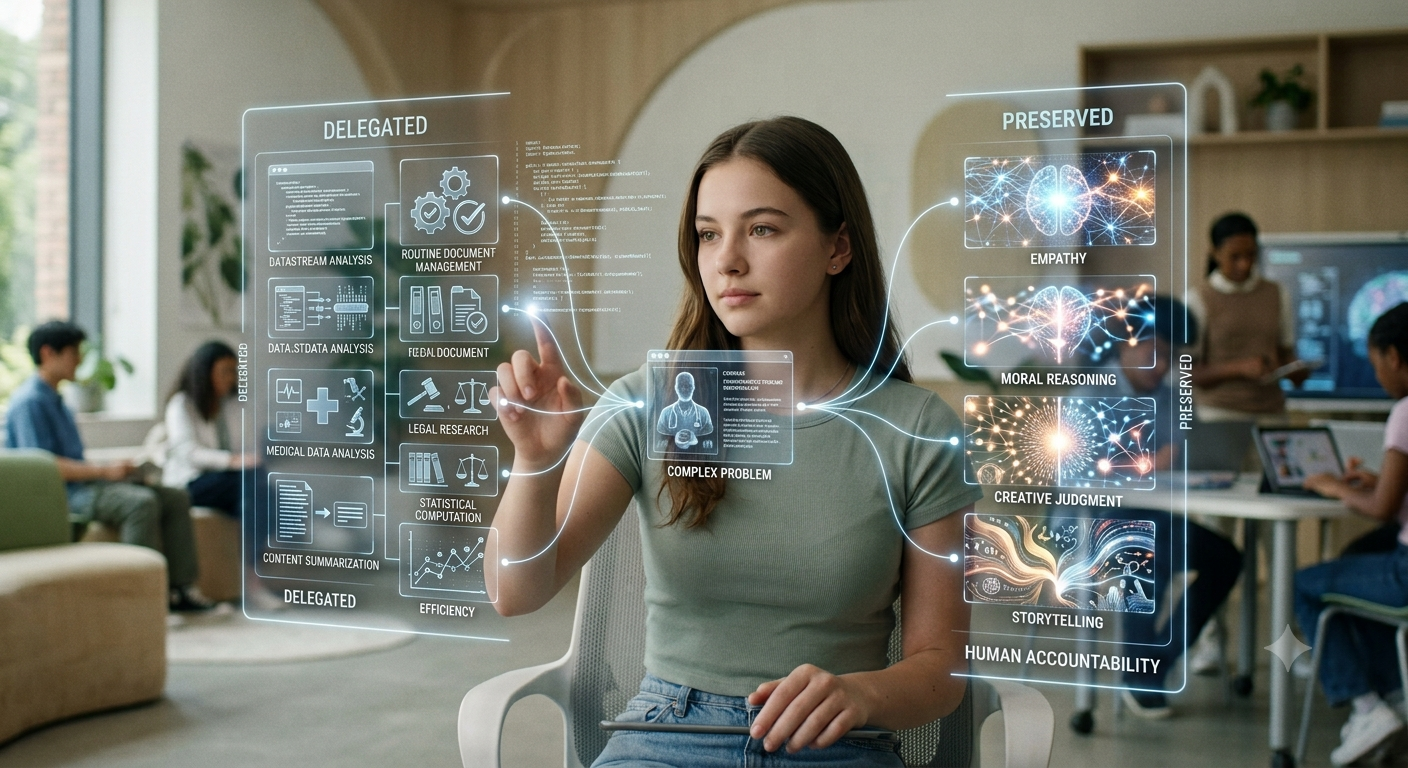
When a 10-year-old asks today what they should become, the most honest answer may no longer be a job title. It may be a description of a mindset. What will matter most for the next generation is discernment, the ability to separate what should be delegated to machines from what must remain fundamentally human.
In medicine, for example, AI may become better at reading imaging studies, flagging abnormal lab results, or summarizing a patient’s history, and there is no reason to resist that progress. But it does not follow that we surrender clinical judgment, patient trust, or the ability to sit with uncertainty when a diagnosis is not clear. A machine can recommend a treatment pathway, but it cannot fully carry the responsibility of explaining it to a frightened patient or weighing options in the context of a family’s values and fears.
In law, a similar line will emerge, where AI can draft contracts, analyze precedent, and surface risks in seconds, yet it cannot replace the human responsibility of arguing intent, interpreting fairness, or deciding what should be contested even when the algorithm suggests settlement.
The mindset required is not one of resignation but of intentional partnership, where professionals and society decide what to delegate for efficiency and what to preserve for human accountability, empathy, and moral reasoning. In that balance lies the real skill of the future, not resisting AI, but choosing wisely where humanity must remain in control.