



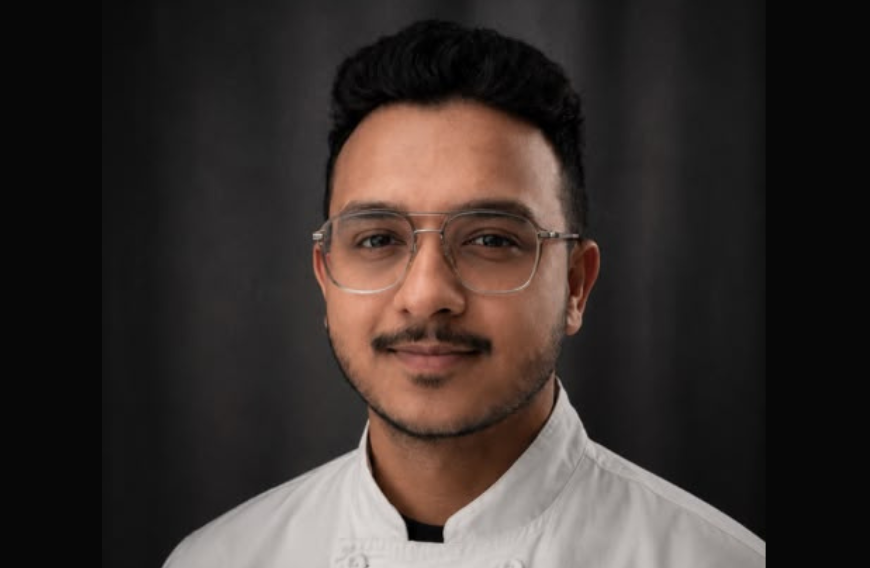
A chef who trained at Michelin-starred restaurants in Switzerland and now leads culinary programs for one of Wall Street’s leading financial firms says Indian creative professionals have yet to fully explore the opportunities offered by U.S. work visas.
“The Indian American success stories are dominated by software engineers, finance professionals, doctors, and lawyers. I wanted to challenge it through my creative pursuits and making it big in the United States,” said Ankish Shetty, corporate executive chef at Restaurant Associates in New York. Shetty oversees the culinary program for a major Wall Street financial company and has honed his craft at some of the world’s top restaurants.
In a conversation with The American Bazaar, Shetty explained why he walked away from a technology career—long considered one of the most reliable paths to a U.S. work visa—to pursue his passion for culinary arts. Instead, he chose to chase the American dream through a creative profession, building a career as a chef.
Born in Mumbai, Shetty initially followed a conventional career path. He earned a degree in computer science engineering and worked in the technology sector before realizing it was not where his passion lay.
“I didn’t feel that I was doing something that excited me,” Shetty said. “I always wanted to do something that made me happy, and culinary arts was my calling.”
READ: H-1B visa holders turn to the UK while keeping their US dreams alive (June 27, 2026)
Although careers in the food industry have gained prestige through the rise of celebrity chefs and cooking shows, Shetty knew he would have to start over to build a career in hospitality.
He noted that relatively few Indians who move abroad for higher education or work pursue creative professions, with STEM careers often viewed as the most reliable path to professional success.
Undeterred, Shetty chose to pursue his passion. “I wanted to get into the heart of the culinary industry, and Switzerland is the place for hospitality and food,” he said.
Shetty said his time in Switzerland opened new doors professionally.
“I worked in Michelin-starred kitchens in Geneva such as Rasoi by chef Vineet Bhatia—the first Indian chef to receive a Michelin star. I also trained at the Kempinski Grand Hotel des Bains in St. Moritz,” he said.
After his stint in Europe, Shetty returned to Mumbai, where he founded a cloud kitchen startup.
His journey to the United States began when his wife received a job opportunity there.
“While in Mumbai, my wife got a chance to work in the United States. I decided to come along with her on an L-2 visa,” he said.
Once in the U.S., Shetty faced another challenge: breaking into the American culinary industry. He began preparing well before his move.
“I started applying for jobs three months before I landed in the U.S.,” he said.
After arriving, he quickly realized he would need to adapt to a different culinary landscape.
“It wasn’t easy because every continent has a different food culture, and I had to change my approach,” he said.
Shetty said one of his biggest challenges was overcoming preconceived notions about Indian chefs.
“The challenge was to put my perspective out there. I was more into fusion foods, but most of the people I met thought that an Indian chef is good at making curries and tikka masala. This was like a roadblock,” he said.
To overcome those perceptions, Shetty changed how he presented himself during job interviews.
“I started making specific menus for interviews, and I told the people interviewing me that I could make that tasting four-course meal for them within two hours. This made me stand out from the pool,” he said.
READ: ‘Spend my final days as an Indian citizen’: 94-year-old woman gives up US citizenship (
When Shetty landed his first job in the United States, the transition was not without challenges.
“I began working with two restaurants. One was an American diner and the other was a Greek restaurant,” he said. “I struck a balance between the food cultures, and people began appreciating my food.”
Shetty hopes more Indians recognize that U.S. work visas are also available to professionals in creative fields such as hospitality, the arts, and music. He believes many talented people assume there is little opportunity for them in the United States simply because they do not work in STEM fields.
“This can’t be far from the truth. Avenues such as O-1 visas are meant to recognize individuals who show extraordinary abilities in professions that are very often off-beat,” he said.
While acknowledging that the technology industry has helped countless Indians build successful careers in the United States, Shetty said creative professionals should not hesitate to pursue similar opportunities.
“While tech got Indians a lot of recognition in the U.S., there is so much to explore if you have a creative side. The need is to believe that you can bag an H-1B or an O visa even as a chef, or an artist or a musician,” he said.