



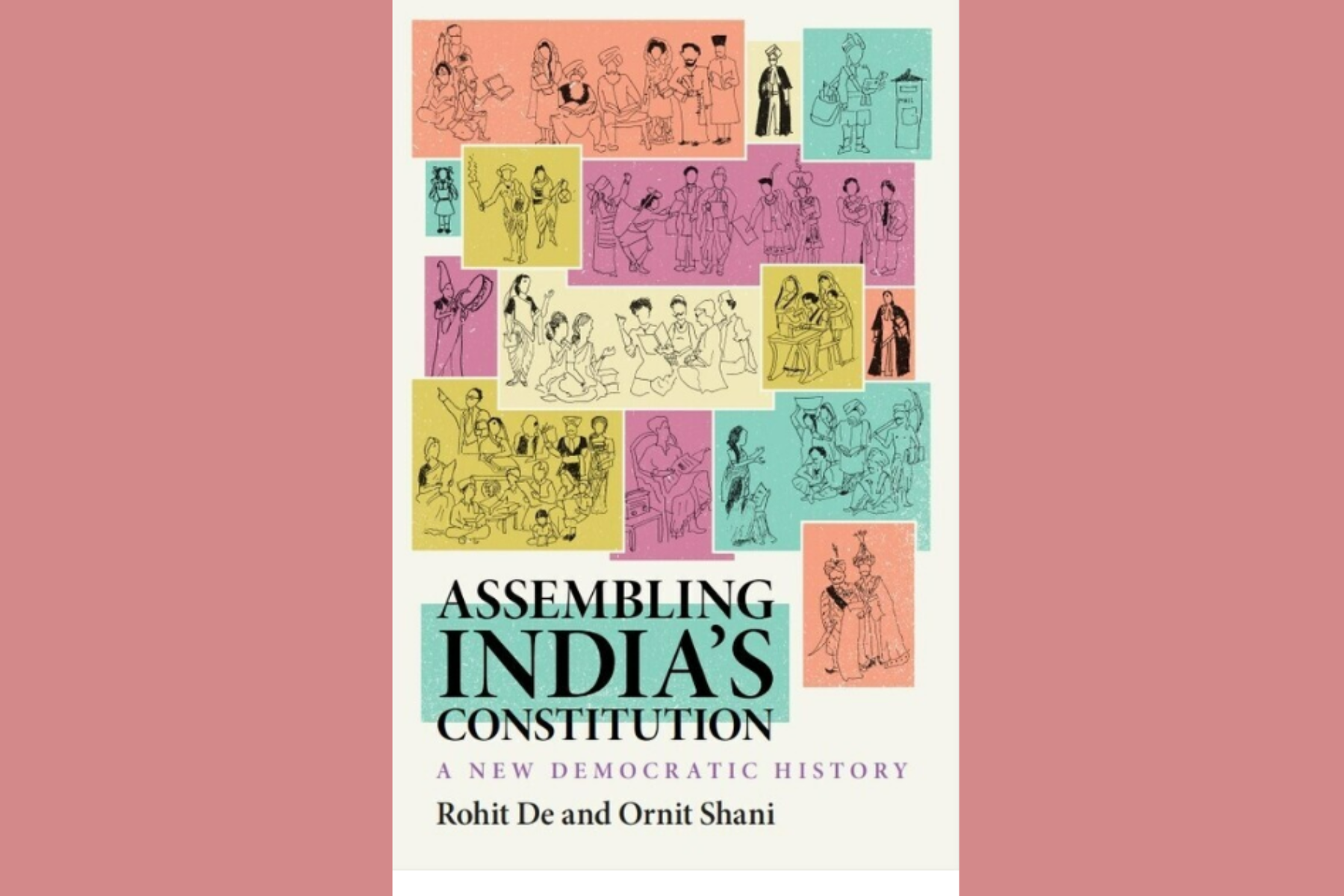
The International Society of Public Law has awarded its prestigious 2026 ICON-S Book Prize to historians Rohit De and Ornit Shani for their collaborative work re-examining the foundation of modern India.
The annual prize, which celebrates monumental contributions to public law scholarship, recognizes their joint volume, Assembling India’s Constitution: A New Democratic History.
Published by Cambridge University Press, the book challenges the long-held belief that India’s founding document was purely the creation of a select group of elite lawyers and politicians sequestered in the Constituent Assembly. Instead, De and Shani reconstruct a story about how the public actively shaped their own sovereign future.
“The people were actually inserting themselves into the constitution-making process,” De said during a book talk at Cornell University’s Jeb E. Brooks School of Public Policy.
Read: Indian American Avani Ahuja receives Henry Ford II Scholar Award
(June 4, 2026)
Rather than a top-down manual, the researchers discovered that the constitution was a deeply dialogic project. Across the subcontinent, citizens from all walks of life flooded the assembly secretariat with letters, petitions, and demands, asserting their expectations long before the final draft was signed.
The authors unearthed a rich archive of public engagement, showing how Dalit associations, women’s collectives, tribal communities, and religious groups negotiated the draft.
Furthermore, the researchers traced how several of the country’s hundreds of princely states were busy drafting their own local constitutions, sometimes outpacing the central assembly demanding representative local governance and fundamental rights.
For De, a legal historian who serves as an associate professor of history at Yale University, the project is a culmination of a lifelong commitment to understanding how ordinary people interact with state power.
De received his law degrees from the National Law School of India University in Bangalore and the Yale Law School.He later earned his PhD from Princeton University, where he was elected to the Society of Woodrow Wilson Scholars.
Read: Two Indian Americans win Harvard leadership board seats
(June 1, 2026)
Before his academic career, De assisted Chief Justice K.G. Balakrishnan of the Supreme Court of India and worked on constitutional reform projects in Nepal and Sri Lanka. He also held fellowships at the University of Cambridge, the National University of Singapore, and Melbourne Law School.
His academic research remains deeply focused on the legal history of the Indian subcontinent and its common law connections, studying how marginalized groups transformed constitutionalism into a medium of everyday struggle.
Shani is an Associate Professor in the history of India’s democracy and South Asia politics at the University of Haifa and is the Henry Hart Rice Visiting Professor at Yale University in Spring 2025.
By showcasing how diverse publics established ownership over the constitution, De and Shani argue that this widespread, grass-roots participation is precisely what gave Indian democracy the resilience to endure.