



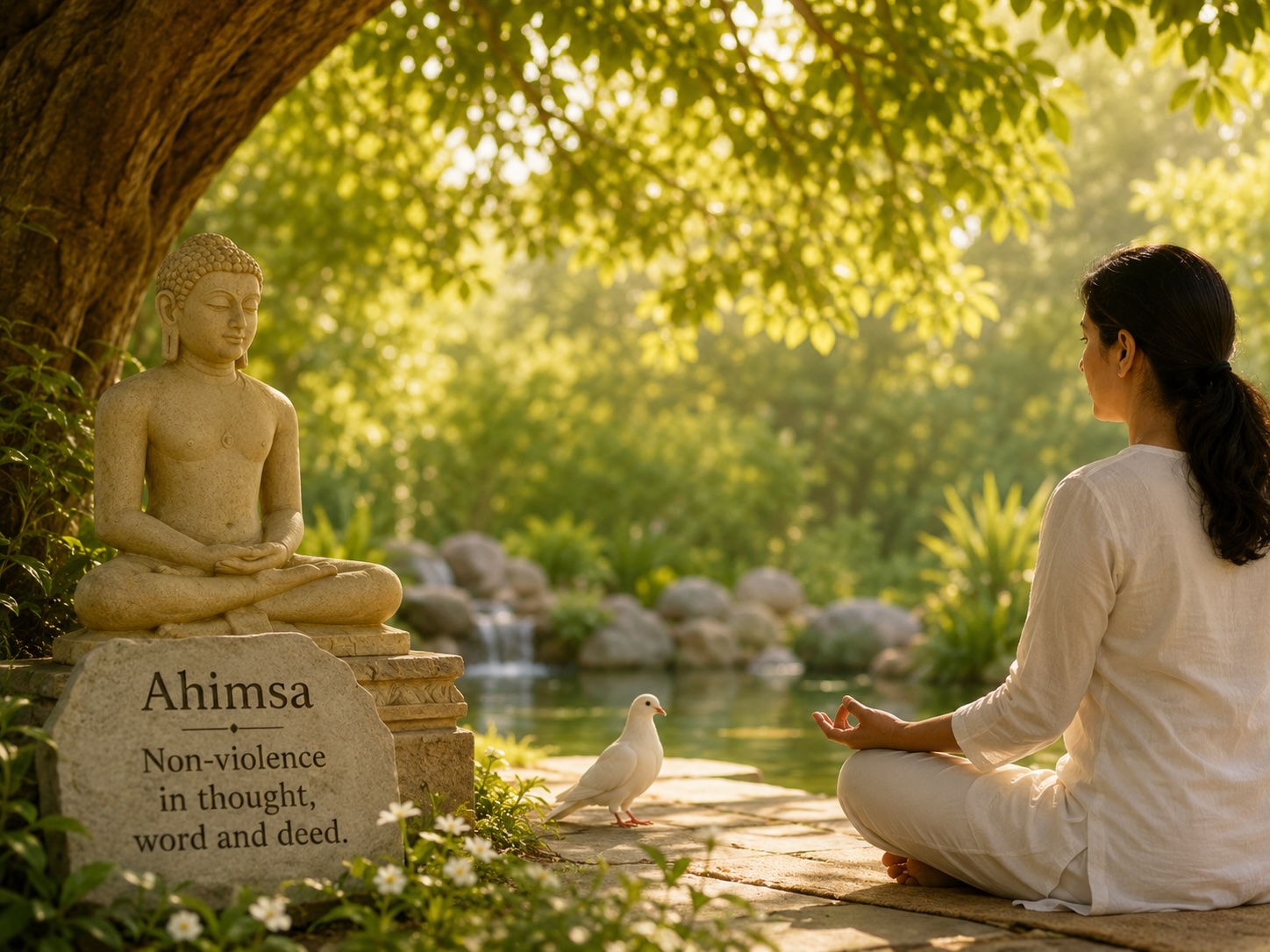
Jainism’s timeless principle of nonviolence offers a powerful framework for reducing inner conflict, cultivating self-compassion, and fostering lasting psychological well-being.
By Dr. Jasvant Modi
Having immersed myself in both rigorous science and ancient wisdom, I believe few principles hold greater unexplored therapeutic potential than ahimsa. Translated broadly as nonviolence, ahimsa is among the most foundational ethical commitments in Jainism, a tradition that regards every living being as deserving of dignity, care, and protection.
Yet ahimsa extends far beyond its moral dimension. Practiced genuinely and consistently, ahimsa functions as a living framework for psychological restoration. Mental wellness conversations in the Western world have grown considerably more sophisticated in recent years, with therapy, medication, and mindfulness-based interventions each carrying real and documented value.
Still, the internal culture of quiet violence that many people sustain without recognizing it as such remains unaddressed in those conversations. From the relentless inner critic to resentment carried for years, many people live with forms of internal violence they scarcely recognize. Add to that the low-grade moral friction that develops when one’s deepest values and daily behavior remain persistently out of alignment. Ahimsa, understood in its fullest sense, speaks directly to each of these.
Understanding ahimsa beyond its literal meaning
Most people first encounter ahimsa as a prohibition, which is accurate as far as it goes but also incomplete. The Jain conception of nonviolence is considerably more active and demanding. Ahimsa encompasses thought, speech, and deed equally. Hostility held privately in the mind is still hostility. Words deployed carelessly carry the same fracturing weight as physical harm.
For anyone genuinely committed to psychological well-being, recognizing the full architecture of ahimsa reframes the nature of the work itself. There is a direct and unsentimental line between the inner violence people often dismiss or overlook and the psychological difficulties that eventually surface as a result.
READ: Dr. Jasvant Modi | Minimizing harm in advocacy: Integrating Jain philosophy into law (July 12, 2026)
What we permit in our own minds, the contempt, the grudges, the self-condemnation, has consequences that medicine alone cannot fully address. Ahimsa asks us to be honest about where harm is actually originating, and very often, it originates within.
That honesty is itself a form of healing, and when a person begins auditing their inner life through the lens of nonviolence, patterns come to light with uncomfortable clarity. Repetitive negative self-talk mirrors the very cruelty one would readily condemn in another person.
Blame directed outward without reflection can become a mechanism for avoiding the discomfort of growth. This insight is increasingly supported by modern psychology. Cognitive behavioral research has consistently shown that identifying and challenging harmful thought patterns produces measurable improvements in anxiety, depression, and emotional resilience.
The hidden cost of carrying internal conflict
Chronic stress is rarely framed in moral terms, yet the relationship between unresolved inner conflict and physiological strain is increasingly well-documented. Sustained resentment is metabolically expensive. Living in persistent contradiction taxes the nervous system in ways that accumulate over time and eventually manifest as burnout, anxiety, or emotional numbness.
Ahimsa, embraced as an integrated life philosophy instead of a single dietary or behavioral rule, removes many of those generative sources of friction. One should deliberately separate the principle’s depth from the diluted versions that occasionally surface in popular wellness culture.
Ahimsa is a rigorous commitment to reducing harm at every level, including the harm we inflict on our own peace of mind through dishonesty, through ego-driven conflict, and through a persistent refusal to forgive.
Self-compassion as nonviolence turned inward
Western therapeutic traditions have steadily moved toward recognizing self-compassion as a critical factor in psychological well-being. Researcher Kristin Neff, whose foundational work has reshaped clinical thinking on the subject, identifies self-kindness as central to emotional resilience. What is rarely acknowledged is how precisely her framework reflects the internal logic of ahimsa directed inward.
Ahimsa practiced toward oneself means refusing to sustain the internal violence of perfectionism, chronic shame, or unrelenting self-punishment. The mind cannot flourish in an environment it has made hostile. Softening that environment through principled nonviolence creates the psychological conditions under which genuine growth becomes sustainable.
READ: CSU-led Jain studies summer school to bring global scholars to Rajasthan (June 3, 2026)
My own experience has reinforced this understanding. When I look at the people who struggled most deeply, they were often the ones waging the most ferocious war against themselves. Ahimsa offered them a different relationship with their own humanity and with it, a way forward.
Nonviolent awareness as a practice for emotional stability
Practicing ahimsa in a contemporary environment is not without its complications. The pace of modern life, the ambient aggression of competitive culture, and the constant exposure to conflict in public discourse all create pressure against the values nonviolence represents. Yet scholars of Jain philosophy argue that the sustained effort required to maintain nonviolent awareness is itself mentally stabilizing. Attention directed consistently toward reducing harm focuses and quiets the mind in ways that produce benefits comparable to formal meditation.
Equanimity is a concept that appears throughout both Jain philosophical literature and clinical mental health research. Ahimsa cultivates equanimity by interrupting the reactive patterns that make emotional dysregulation likely. When the reflex to condemn, retaliate, or diminish is consistently met with a commitment to nonviolence, the nervous system absorbs fewer disturbances and the mind becomes measurably more stable over time.
Ahimsa and the architecture of inner coherence
Mental wellness, at its most complete, describes a state of internal coherence — an alignment between values, thought, language, and behavior that allows a person to move through the world with a sense of wholeness. Ahimsa, practiced earnestly and with full awareness of its scope, fosters precisely that alignment. Each dimension of the principle reinforces the others, creating a self-sustaining foundation for both ethical clarity and psychological well-being.
Each dimension of the principle reinforces the others, creating a self-sustaining structure of both ethical clarity and psychological health. For anyone genuinely searching for something more durable than a wellness trend or a seasonal practice, the ancient discipline of ahimsa offers a starting point that has withstood centuries of philosophical scrutiny and, increasingly, the examining lens of modern science.
My perspective was shaped equally by medical training and a lifelong engagement with Jain philosophy. Some of the most powerful tools for healing the mind were articulated centuries before the first clinical trial was ever conducted.
READ: California couple Drs. Jasvant and Meera Modi help establish $1 million vegan studies professorship (May 20, 2026)
(Dr. Jasvant Modi is a retired gastroenterologist and philanthropist based in Southern California. Born in Godhra, Gujarat, India, he received his medical degree from B.J. Medical College in Ahmadabad and completed his gastroenterology residency in Chicago. Alongside his wife, Dr. Meera Modi, he supports initiatives in education, healthcare, and Jain studies, including the Tirthankar Shantinath Endowed Professorship in Jain Studies at Rice University.)
1 Comment
I really appreciated this piece on ahimsa and mental wellness—it’s such a refreshing angle to see nonviolence framed not just as an ethical ideal but as a practical tool for inner peace. The idea that we can turn that same gentleness we offer others toward our own thoughts really resonated with me, especially in a world that often pushes us toward harsh self-criticism. It made me think about how much of our mental suffering comes from the way we fight ourselves internally. If you’re curious about applying these kinds of reflective practices in your daily workflow, I’ve found some thoughtful resources among the best tools for vibe coding that help create a calmer, more focused creative space. Thanks for sharing such a meaningful perspective—it’s given me a lot to sit with today.