



Editor’s note: This article is based on insights from a podcast series. The views expressed in the podcast reflect the speakers’ perspectives and do not necessarily represent those of this publication. Readers are encouraged to explore the full podcast for additional context.
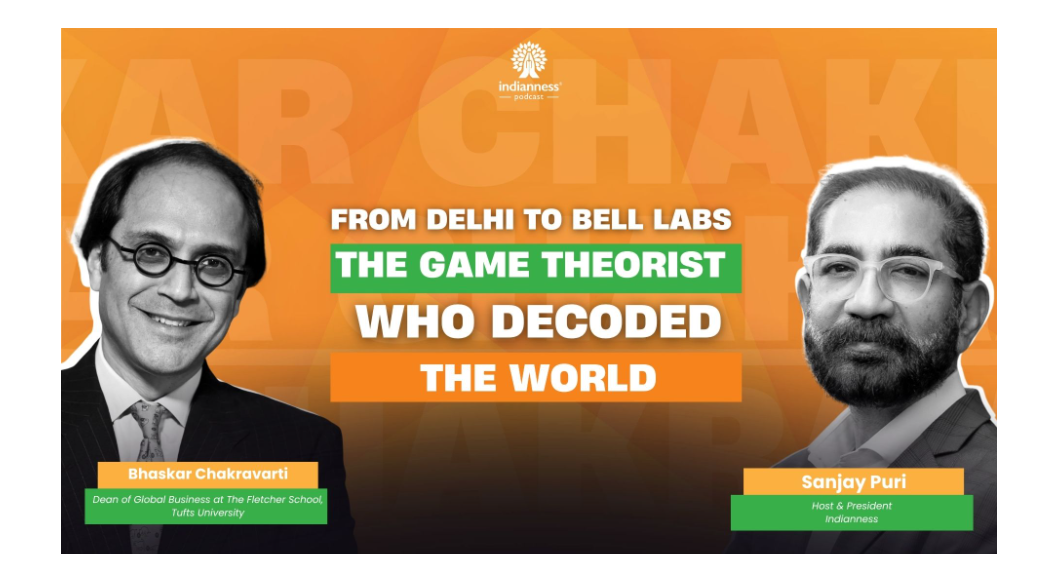
On “The Indianness Podcast,” host Sanjay Puri sat down with economist, strategist, and academic leader Bhaskar Chakravorti for a deeply reflective conversation about identity, institutions, and the evolving relationship between business and nation-building.
As the dean of global business at The Fletcher School at Tufts University and the force behind “Digital Planet” research, Chakravorti spent his career studying how technology reshapes economies. But in this episode, he took listeners back to the origins of his thinking, his childhood, education, and first exposure to the private sector in India.
The result is a story about how personal history, institutions, and industry together shaped a global perspective.
Born in Delhi to Bengali parents originally from present-day Bangladesh, Chakravorti grew up in a household rich with intellectual curiosity. His father, an economist, academic, and later bureaucrat was a storyteller with a photographic memory who brought history alive at the dinner table.
The family culture revolved around literature, politics, and music. The poetry and songs of Rabindranath Tagore filled their home, often accompanied by discussions about India’s freedom movement and the country’s future.
READ: Data, not just AI models, will shape India’s AI future, says EY partner Alexy Thomas (July 7, 2026)
One of Chakravorti’s earliest memories captures the emotional atmosphere of that era. As a young child, he sat on his father’s shoulders in Delhi, watching crowds gather for the funeral procession of India’s first prime minister, Jawaharlal Nehru. The moment symbolized how deeply personal and national histories were intertwined for his generation, “in many ways, Nehru was an embodiment of the kind of, intellectual, Fabian socialist that my father was. And so that was the environment in which I grew up.”
When the conversation turned to education, Chakravorti credited his time at St. Stephen’s College in Delhi as a turning point.
Admission was highly competitive, but once inside, the real impact came from the people he encountered. The campus was a meeting point for brilliant minds who would later become influential leaders and thinkers. Among his contemporaries were historian Ramachandra Guha, economist Arvind Subramanian, and future World Bank president Ajay Banga.
For Chakravorti, true education happened as much outside the classroom as inside it through late-night debates, friendships, and intellectual exploration.
He later continued his studies at the legendary Delhi School of Economics, “that’s where I started developing an interest in economics as a profession, as in terms of an academic direction. And because the DelhiSchool has this incredible legacy of people from Amartya Sen and Kaushik Basu was actually my professor, Jagdish Bhagwati, Sukumar Chakraborty, I mean, these are legends in the economics pantheon.”
Looking back, he describes that era as a “golden age” of Indian higher education.
Chakravorti also shared that he met his future wife during the period between finishing high school and starting college. Their lives and careers have evolved together ever since.
READ: ‘Don’t fear failure. Go for it’: Jena Zangs on building responsible AI strategy in higher education (July 6, 2026)
It’s a reminder that while institutions shape our minds, relationships often shape our journeys.
Chakravorti’s worldview expanded further when he joined the Tata Group through the Tata Administrative Service. He said, “… coming from an economics background, you thought about government and policy and the Planning Commission as being the foundation for development. And this was, I thought, just a fascinating exposure to seeing a really sincerely committed, honest conglomerate, eager to be a part of India’s growth.”
During his rotations across different Tata companies from steel and hotels to power and infrastructure he witnessed how industry could directly influence economic progress. Interactions with leaders such as Ratan Tata reinforced a powerful idea: companies could pursue profit while contributing meaningfully to national development.
Even small observations stood out. Reliable electricity in Mumbai, provided by Tata Power, highlighted how efficient private infrastructure could transform urban life.
In the conversation, Chakravorti emphasized that the relationship between profit and nation-building isn’t contradictory, especially in developing economies.
Businesses rely on thriving consumers. For companies to grow, the broader economy must grow too. In that sense, the goals of businesses and nations often align.
Chakravorti’s story reflects the arc of modern India itself from post-independence institutions to global leadership.
His journey shows that careers are rarely linear, but the influences that shape them: family, education, partnerships, and industry can create perspectives that resonate far beyond borders.
And sometimes, the biggest insights come from realizing that the forces shaping a nation’s future may come not from policy alone but from the powerful intersection of ideas, people, and enterprise.