



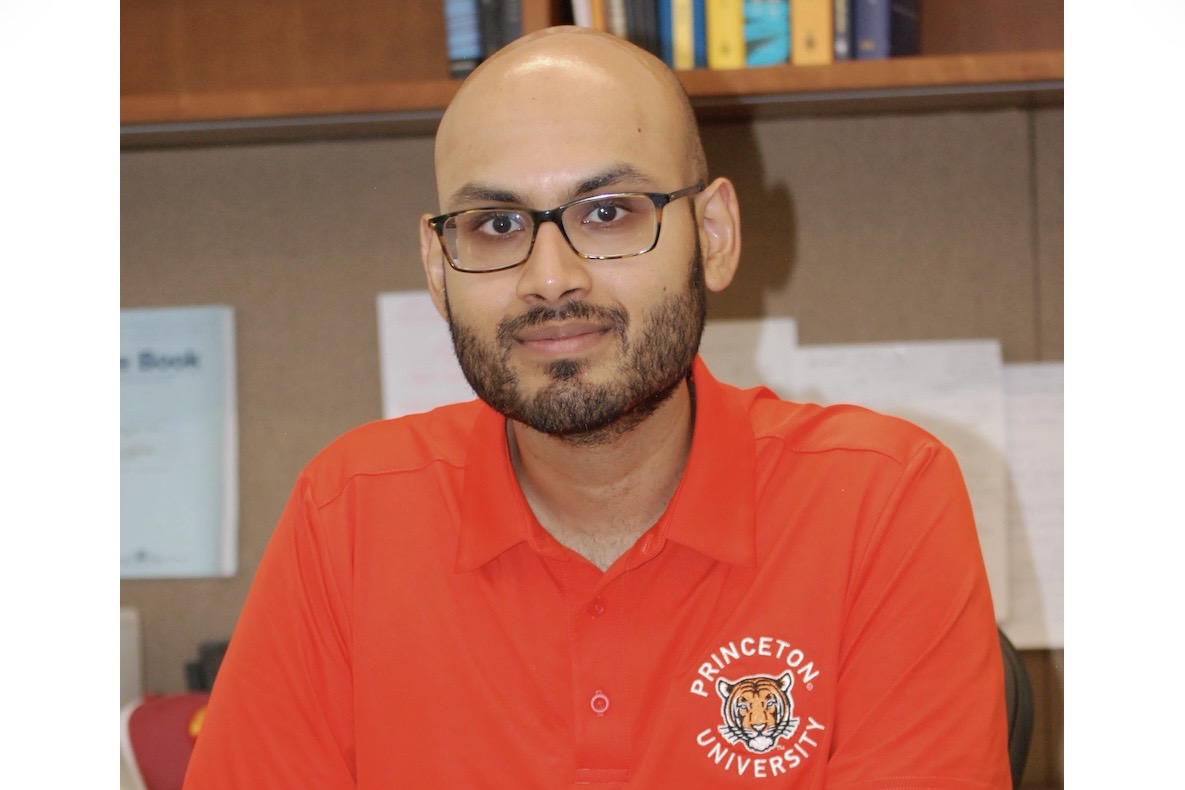
Karthik Sastry, an Indian American assistant professor of economics and public affairs at Princeton has been awarded a three-year University preceptorship from July 1, 2026, through June 30, 2029.
Sastry, who is also an executive committee member of Princeton University’s M.S. Chadha Center for Global India, has been appointed to the John Witherspoon Bicentennial Preceptorship.
He is a macroeconomist with broad interests that intersect economic theory, the economics of innovation, and environmental economics. Two specific themes in his work are understanding the role of bounded rationality and social dynamics in business-cycle fluctuations and modeling how societies adapt to climate change through policy changes and technological innovation.
Read: Indian American researcher hunting for clean, affordable hydrogen energy (July 9, 2026)
Sastry received an AB in Economics from Princeton in 2016 and a PhD in Economics from MIT in 2022. He is also a Faculty Research Fellow of the National Bureau of Economic Research in the Economic Fluctuations and Growth program and the Environment and Energy Economics program.
His publications include “Food Policy in a Warming World” with Allan Hsiao and Jacob Moscona. Econometrica; “Disagreement About Monetary Policy.” American Economic Journal: Macroeconomics; and “A Theory of Supply Function Choice and Aggregate Supply,” with Joel P. Flynn and Georgios Nikolakoudis. American Economic Review.
Princeton’s preceptorships are awarded annually to support junior faculty members in their research endeavors. The two types of preceptorships offered are Bicentennial Preceptorships, which last three years with one full year of leave at full salary, and University Preceptorships, which last three years with one semester of leave at full salary. Both awards include an annual fund to assist with research expenses. The University awarded five of each preceptorship type.
Read: Indian American energy researcher Arif Sarwat wins economic impact award (July 10, 2026)
Recognizing the career-changing potential that defines one’s formative experiences within the academy, Princeton supports promising junior faculty in the humanities and social sciences through competitively awarded preceptorships.
Established following Princeton’s bicentennial in 1946 through university funds and by university donors, preceptorships offer additional research support to honorees.