



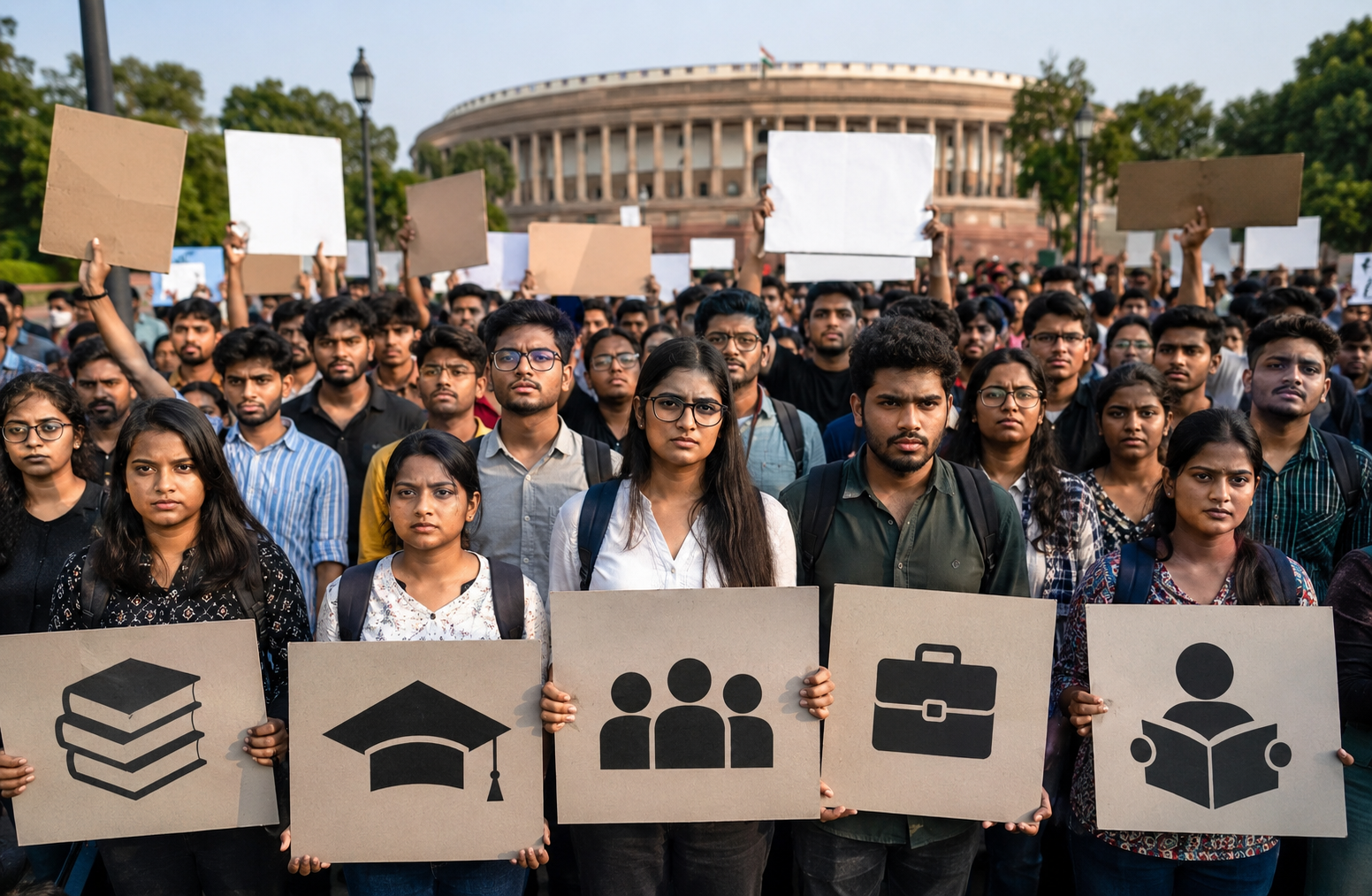
Before we celebrate what the Cockroach generation has achieved, or declare it a new dawn for Indian democracy, let us be honest about where this generation came from and what was done to it before it found its own voice.
The young man who swung a pickaxe at the Babri Masjid dome on December 6, 1992 was not a monster. He was twenty-two years old. Unemployed or underemployed. Economically frustrated. Politically naive. He had been brought to Ayodhya by buses organized by people who would never pick up a pickaxe themselves. He was told that this mosque was the source of his humiliation. That tearing it down would restore his dignity. That his empty stomach and his empty future had an address — and the address was a sixteenth-century structure in a small UP town.
He swung the pickaxe. The dome fell. His stomach remained empty. His future remained unchanged. The men who brought him to Ayodhya went home to their houses.
The young Sikh-killing rioter of 1984 was the same young man. The Gujarat 2002 burning was the same young man. The Bombay 1993 rioting was the same young man. The gau raksha lathi-wielder of 2017 was the same young man. Different decades. Different targets. Identical mechanism — economic frustration, political exploitation, a neighbor presented as the source of the problem.
The US National Intelligence Council warned in 2017 that India needs to create nearly 10 million jobs annually to accommodate its newly entering labour force — otherwise a section of the youth might get radicalized and lead to social unrest.
The warning was accurate. The radicalization happened. It was called Hindu nationalism. It was called cow protection. It was called love jihad. It was called anti-national. All of it was the same economically frustrated young man being handed an identity and a target in lieu of a job and a future.
These young men were not evil. They were used. There is a difference. And the difference matters enormously for understanding what is happening in India right now.
The Continuity Nobody Names
Since 2004 there have been 110 incidents of major exam paper leaks affecting 22.5 million candidates — the overwhelming majority of them since the BJP took office in 2014.
The young man who burned in Gujarat in 2002 had a younger brother. That younger brother grew up watching the burning. Grew up in the RSS ecosystem. Attended shakhas. Was told that the system was working — that Hindu raj was arriving, that the golden age was coming, that the Muslim threat was being managed, that his future was secure in the new India.
He sat for NEET. The paper leaked. He sat again. He paid five lakh rupees to a coaching factory. He failed. He sat for JEE. The paper leaked. He got an engineering degree and found that TCS and Infosys were cutting jobs because of AI.
The same political machinery that mobilized his older brother against the Muslim neighbor — that promised the Hindu rashtra would deliver prosperity — has not delivered the prosperity. The identity without the economic dividend has expired.
And he is angry.
READ: Boston student alleges Cockroach Janta Party website was taken down (May 23, 2026)
Not at the Muslim neighbor this time. At the system that failed him while promising he was on the winning side.
This is the political shift that India’s establishment has not fully processed. The communal mobilization worked as long as the economic promise remained credible. The moment the economic promise collapsed — the anger, which was always economic at its root, redirected itself toward the system that made the promise.
The same young man. The same rage. The same frustrated ambition. Different target.
Modi Lost His Own GenZ
Here is the sentence that should be keeping Narendra Modi awake at night.
The young people marching on Parliament — the 24 million Instagram followers, the students at Jantar Mantar, the hunger strikers, the protesters who absorbed tear gas and came back the next day — these are not Congress voters. These are not AAP voters. These are not the children of the liberal secular intelligentsia that BJP has spent twelve years dismissing as the Khan Market gang.
These are BJP’s own children.
The young man at the NEET protest whose older brother attended the Howdy Modi rally in Houston. The young woman holding a “Pradhan Go Back” sign whose family voted BJP in 2014, 2019, and 2024. The ABVP member who quietly removed his badge before joining the protest because his examination was leaked and his anger was real regardless of his party affiliation.
For twelve years BJP built its political dominance on a generational bargain. Give us your identity — Hindu, nationalist, proud — and we will give you a future. The Ram Mandir for your soul. The infrastructure for your aspirations. The strong leader for your pride. The economic growth for your ambition.
The bargain was accepted. Three Lok Sabha victories. State after state. A dominance unprecedented for a non-Congress party.
But a bargain requires both sides to deliver. And on the morning after the NEET paper leaked for the second time — the morning after Dharmendra Pradhan had survived accountability for the third consecutive examination scandal — the young Indian who had kept his side of the bargain looked at what he had received in return.
A leaked examination. A five lakh rupee coaching factory that did not guarantee a fair test. A minister who could not be sacked because his RSS credentials protected him from accountability. A government that responded to his protest with tear gas.
The bargain was broken. Not by the young man. By the system that made the promise.
Modi has faced protests before. Farmers in 2020-21 — he managed them, absorbed thirteen months of pressure, and eventually repealed the laws when the electoral cost became unacceptable. Shaheen Bagh in 2019-20 — he let it run and used it as a counter-mobilization tool, the Muslim protest that validated the Hindu nationalist narrative.
The CJP protest cannot be used as counter-mobilization. You cannot mobilize Hindu voters against a protest led by Hindu students demanding exam accountability. You cannot label them anti-national when their demand is that the national examination system stops leaking. You cannot say they are foreign-funded when the foreign-educated founder returned to India specifically to fight for its students.
BJP’s communal toolkit — which has managed every previous protest — is useless against a protest that does not have a communal identity to attack.
This is why Modi lost sleep. Not because Dharmendra Pradhan resigned. Ministers can be replaced. What cannot be easily replaced is a generation.
BJP spent twelve years building a young voter base on the promise of Hindu pride and economic aspiration. The pride remains — the Ram Mandir is built, the G20 was hosted, the moon was landed on. But the aspiration — the job, the examination, the future — has been betrayed by the same system that promised to deliver it.
A voter who feels culturally validated but economically betrayed is the most dangerous voter in a democracy. He is not going to the opposition because his cultural identity is still BJP’s. But he is not going to the polling booth for BJP because his economic reality is now BJP’s failure.
He stays home. Or he protests.
Both outcomes are electorally catastrophic for a party that won its last three majorities on the enthusiasm and turnout of exactly this demographic.
What Is Genuinely New
Every previous mobilization of economically frustrated Indian youth had one common feature. The leaders came from outside the generation. The Babri Masjid mobilization was led by men in their fifties and sixties — LK Advani, Murli Manohar Joshi — who organized young men as foot soldiers. The Gujarat violence was orchestrated by mature political operatives who used young men as instruments. The gau raksha gangs were directed by political machinery that gave young men permission and protection but not agency or leadership.
The young men were always the energy. Never the leadership.
The CJP is different. And the difference is not ideological. It is structural.
Abhijeet Dipke is thirty years old. He studied at Boston University. He built a 24-million-follower Instagram operation in 78 hours. He negotiated directly with Union Ministers. He made strategic decisions — halt the Delhi march to protect students from injury, pivot to nationwide simultaneous district protests instead — that showed political maturity beyond any youth movement India has seen since JP’s students in 1974.
Neha Bora went on a 23-day hunger strike and addressed press conferences. She was not managed by a party handler. She managed herself.
Sonam Wangchuk provided moral authority from outside the party system. He was hospitalised. He obtained a High Court order for proper medical care. He did not ask any party for permission to protest.
For the first time in post-independence India — the educated elite of a generation is leading the economically frustrated mass of the same generation. Not using them. Not pointing them at a neighbor. Leading them. With a coherent, verifiable, non-communal demand — exam accountability, ministerial resignation, institutional reform.
The elite GenZ is negotiating for the old GenZ.
And the old GenZ — the one that was mobilized against Babri Masjid, against Sikhs, against Muslims, against Christians — is listening. Because the elite GenZ is speaking in a language that economic reality has made universally comprehensible.
The NEET paper leaked. It did not leak for Hindus. It did not leak for Muslims. It leaked for everyone. The coaching factory economy charges five lakh rupees per year equally. The 2.2 million annual surplus graduates are surplus regardless of religion.
The Political Masters — And Their Loss of Control
The BJP IT cell that once directed the online anger of young Indians toward Muslim neighbors — that organized the trolling, the harassment, the coordinated campaigns against journalists and minorities — is watching the same young Indians organize their own online operations with greater sophistication. The CJP went from zero to 24 million Instagram followers in less time than any BJP campaign ever achieved comparable numbers. The tools the political masters gave the young men — social media fluency, online organizing, the language of outrage and resistance — have been turned against the system that gave them those tools.
This is the political masters’ nightmare. Not the protest itself. The independence of the protest from their control.
A protest that BJP can label anti-national, Soros-funded, or Congress-sponsored — it can manage. The label delegitimizes the movement among the BJP base, provides the media ecosystem talking points, allows the mobilization of counter-protests.
A protest led by young Indians whose older siblings attended shakhas, whose families voted BJP in 2014 and 2019, whose grievances are about a leaked examination paper rather than any ideology — this cannot be labeled. The ABVP cannot counter-protest against NEET accountability without counter-protesting against its own base. The RSS cannot issue a statement against the CJP without issuing a statement against the students whose families have been Sangh supporters for a generation.
The political masters created the instruments. The instruments became agents. The agents have their own leadership now.
READ: Indian American ‘3 Idiots’ star Omi Vaidya backs Sonam Wangchuk (July 14, 2026)
The JP Moment
India has been here before. Once.
In 1974 — Jayaprakash Narayan stood at the convergence of student anger, economic frustration, and institutional failure and channeled it into the most powerful opposition movement post-independence India had produced. The Bihar Movement became the Total Revolution became the Emergency became the Janata Party government that ended Indira Gandhi’s dominance.
JP was not a student. But he led students. And the students he led were the same economically frustrated, institutionally betrayed young Indians that every generation produces. The difference was leadership that gave the frustration a democratic direction rather than a communal one.
Abhijeet Dipke is not JP. The CJP is not the Total Revolution.
Not yet.
Movements built around examination leaks rarely become nationwide political phenomena unless they tap into broader grievances. India’s nearly 400 million young people face persistently high unemployment despite years of impressive headline economic growth.
The broader grievances exist. The 400 million young people exist. The unemployment exists. The inflation exists. The Iran war energy costs exist. The coaching factory suicides exist. The AI displacement of IT jobs exists.
What the 1984 rioters, the 1992 Babri demolishers, the 2002 Gujarat burners did not have — was their own leadership with a democratic demand.
What the CJP has — for the first time — is exactly that.
The same young men. Finally with their own leaders.
Whether those leaders can hold the movement together long enough to force structural change — or whether the political masters find a way to fragment, absorb, or redirect this energy as they have redirected it for thirty years — is the question that will define India’s politics between now and 2029.
Modi has managed every protest that came before.
He has not faced a protest from the generation he built.
The young man who swung the pickaxe in Ayodhya had no one to negotiate for him.
The young woman at Jantar Mantar in July 2026 has Neha Bora.
And somewhere in New Delhi tonight — in the residence of a Prime Minister who has navigated twelve years of political storms — there is the quiet, unsettling recognition of something that has never happened before.
He did not lose the opposition’s children.
He lost his own.
That is the difference.
That is everything.
That is why he lost sleep.