



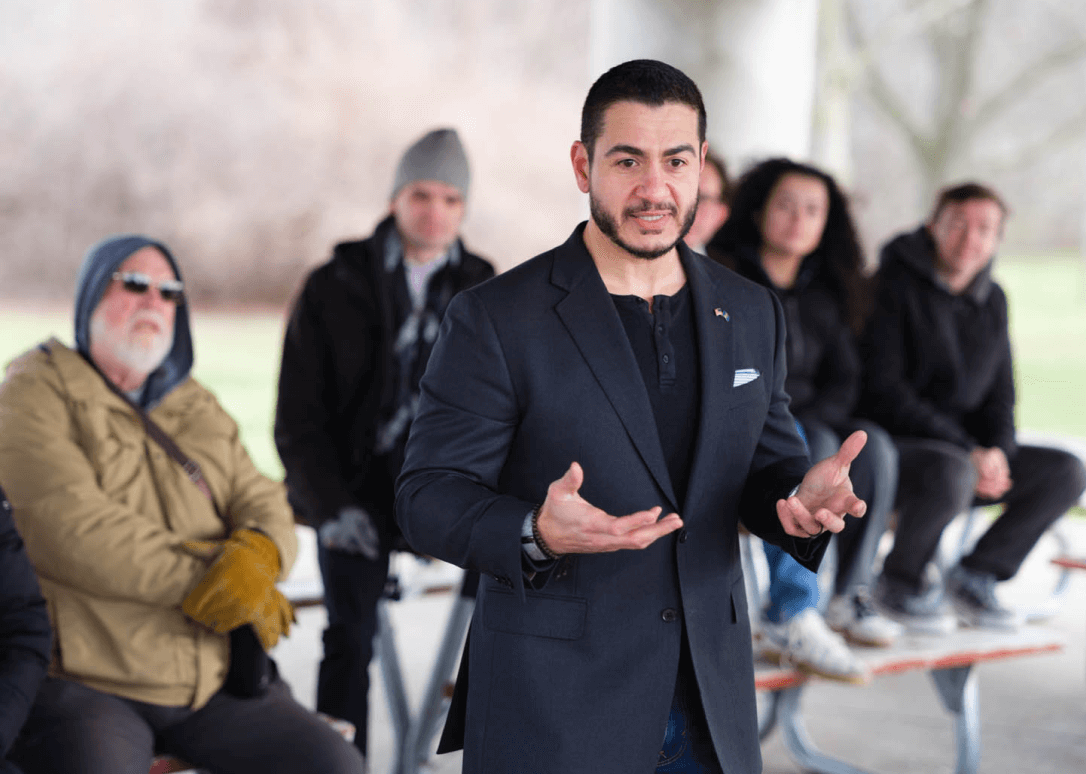
Backed by a grassroots campaign and a message challenging money in politics, Abdul El-Sayed’s victory over a Democratic establishment favorite has intensified questions about whether the party’s future lies in progressive populism or centrist pragmatism.
In Michigan’s Democratic Senate primary, something significant has happened. Former public health director Dr. Abdul El-Sayed, known for his progressive politics and willingness to challenge the status quo, won the nomination by a narrow margin. El-Sayed defeated Rep. Haley Stevens, who was backed by prominent Democrats including Michigan Gov. Gretchen Whitmer, Attorney General Dana Nessel and former House Speaker Nancy Pelosi. Despite Stevens’ political support, it was El-Sayed’s message that appeared to resonate with voters. A segment of Democratic primary voters seemed to embrace his promise to champion the working class and reject big-money politics.
After El-Sayed’s victory, Whitmer endorsed him for the general election, saying in a video: “Congratulations to Jocelyn Benson, Abdul El-Sayed and every Democrat who won up and down the ballot. They’ve got my support as we fight like hell together to win in November.”
The victory in a key swing state now shifts attention to the general election. But according to political observers, the bigger question may be what the result signals within the Democratic Party itself. While progressives have long advocated a grassroots economic agenda, centrists have generally favored a more pragmatic approach. Is the party beginning to shift from within? Former member of the U.S. government’s Senior Executive Service and public affairs strategist Parag V. Mehta believes so.
READ: Suhas Subramanyam wins Democratic primary in Virginia’s 10th Congressional District (August 5, 2026)
“Dr. Abdul El-Sayed’s victory in the Michigan primary is further proof that Democrats are demanding change from our leadership and our candidates. Standing for ‘money in our pockets and money out of politics’ and against genocide should be a no-brainer for any politician today, regardless of party. But, of course, the money from corporate, foreign and special interest groups is a significant lure. So, whenever a candidate like Dr. El-Sayed wins, we must celebrate that the interests of the people won over the influence of the powerful.”
The result also raises another important question: Has the Democratic Party underestimated the political power of younger voters who are demanding a different approach to foreign policy and domestic priorities? Former New Jersey state legislator Sadaf Jaffer, who represented the 16th Legislative District from 2022 to 2024 and is now a postdoctoral research associate at Princeton University, believes so.
She said, “Corporate Democrats have been trying their best to crush dissent within the ranks, but voters have shown they are tired of business as usual. Democratic voters are no longer willing to settle for Democrats who support genocide and work for donors rather than the public. We even see one of the national co-chairs of the Uncommitted movement, Abbas Alawieh, win his seat in the Michigan Legislature.”
Not surprisingly, the issue of Israel also figured prominently in the primary. El-Sayed frequently argued that the American Israel Public Affairs Committee, or AIPAC, spent $30 million to support Stevens’ campaign, while Stevens said of El-Sayed: “He’s made this whole race about Israel and AIPAC and I have made it about lowering costs for Michiganders, about standing up for the state that we love.”
But the primary results may have sent a different signal. “Clearly, the majority of Democratic primary voters in Michigan disagree with Rep. Stevens’s perspective. They thought Dr. El-Sayed spoke to their needs and concerns,” Mehta said. He added, “El-Sayed just made the self-evident connection to the fact that those tax dollars ought to be spent in Michigan, not on Israel. Sounds to me like he was talking very much about Michigan and its people.”
READ: Indian American Rep. Shri Thanedar loses Michigan Democratic primary to Donavan McKinney (August 5, 2026)
Jaffer agreed that El-Sayed’s platform put Michiganders first. “Abdul himself is a remarkable person who represents the best of Michigan and the best of the United States. Though endless amounts of money were spent to malign him and mislead voters, the public saw the truth of his message, character, and political program,” she said.
While many are celebrating what they see as a new era in Democratic politics, researchers and political strategists believe this shift has deeper historical roots. “Abdul El-Sayed is part of a long line of progressive and populist Democrats who choose to center their politics on working-class Americans,” Mehta said. “What he achieved is impressive, but it is not new. We’ve seen Democrats win with this positioning since the days of Woodrow Wilson. In spite of their best efforts, corporate and other moneyed interests can’t compete with a message that meets the moment and a messenger who reflects the electorate.”
Mehta believes the trend extends well beyond Michigan. “We are seeing it with Nithya Raman in Los Angeles, Francesca Hong in Wisconsin, Troy Jackson in Maine, James Talarico in Texas, Donavan McKinney in Michigan, Melat Kiros in Maine, Claire Valdez in New York, Justin Pearson in Tennessee, and the list goes on.”