



What happens when the Sun can no longer support life on Earth? While scientists have long accepted that our planet will eventually become uninhabitable, one researcher believes humanity may not have to abandon it.
A new concept published in the Journal of the British Interplanetary Society outlines an ambitious roadmap that imagines keeping Earth habitable for another 9.1 billion years through a series of massive engineering projects. The proposal comes from independent researcher Gabriel Harry, who argues that a sufficiently advanced civilization could reshape the Solar System instead of relocating to another world.
Scientists estimate that the Sun will become increasingly brighter over the next billion years, eventually heating Earth enough to evaporate its oceans and make the planet incapable of supporting life. Much later, the Sun will expand into a red giant, engulfing the inner planets. Harry’s proposal focuses on delaying those consequences by altering Earth’s environment rather than accepting its fate.
READ: Astronaut Anil Menon undertakes his first spacewalk on orbit station (August 6, 2026)
The first step involves shielding Earth from the Sun’s growing heat. Harry suggests building an enormous sunshade about 700,000 kilometers wide and placing it just beyond the Moon’s orbit. The structure would be anchored near the Sun-Earth L1 Lagrange point, where gravitational forces between the two bodies are balanced.
Although the shield would stretch across an enormous area, the proposal says it could be built from aluminum just 0.1 millimeters thick, similar in concept to the multilayer sunshield used by the James Webb Space Telescope but on a vastly larger scale.
Constructing such a structure would demand resources on an equally extraordinary scale. The scale of the project is enormous. Harry estimates it would require aluminum obtained from about 0.01 percent of the Moon’s total mass. It would also need around two million kilometers of carbon cable, consuming an estimated 40 percent of the material available on the dwarf planet Ceres.
Blocking sunlight, however, would leave Earth dark and frozen. To solve that problem, Harry proposes creating an artificial replacement for the Sun.
READ: Three Indian American researchers earn NASA awards for visionary technology concepts (July 31, 2026)
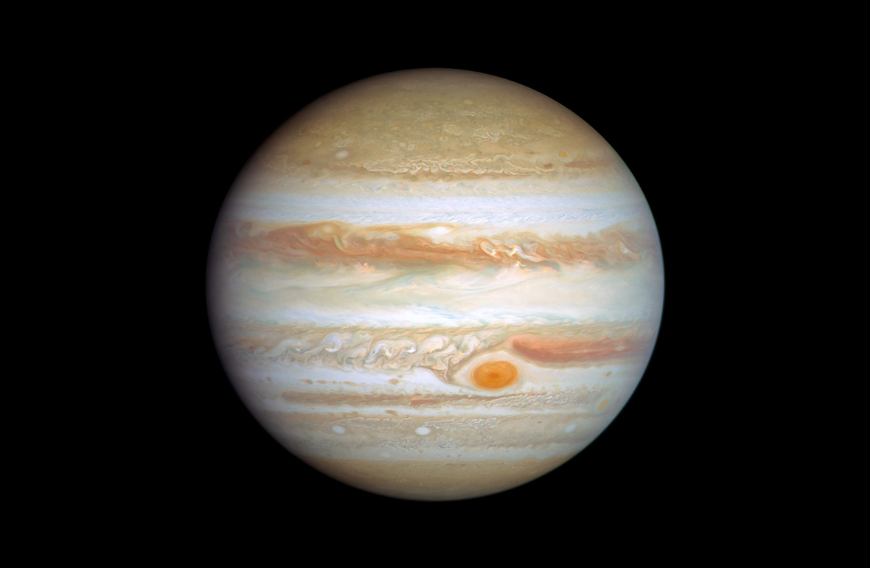
His idea involves placing fusion reactors deep within Jupiter’s atmosphere, where they would use the planet’s abundant hydrogen and helium to generate energy. That power would then be transmitted to relay stations before being directed toward Earth through high-powered laser systems, effectively providing a new source of light and heat.
The proposal also includes another long-term objective. As the Sun continues evolving, Earth’s orbit would eventually need to move farther away. Harry suggests that future civilizations could use a powerful particle beam to gradually push Earth into a safer orbit, allowing the planet to remain within a habitable zone for billions of years.
For now, the proposal remains entirely theoretical and far beyond current technological capabilities. Still, it offers a glimpse into how some researchers are thinking about humanity’s distant future, asking not whether Earth can be saved, but what it would take to keep it alive on cosmic timescales.