



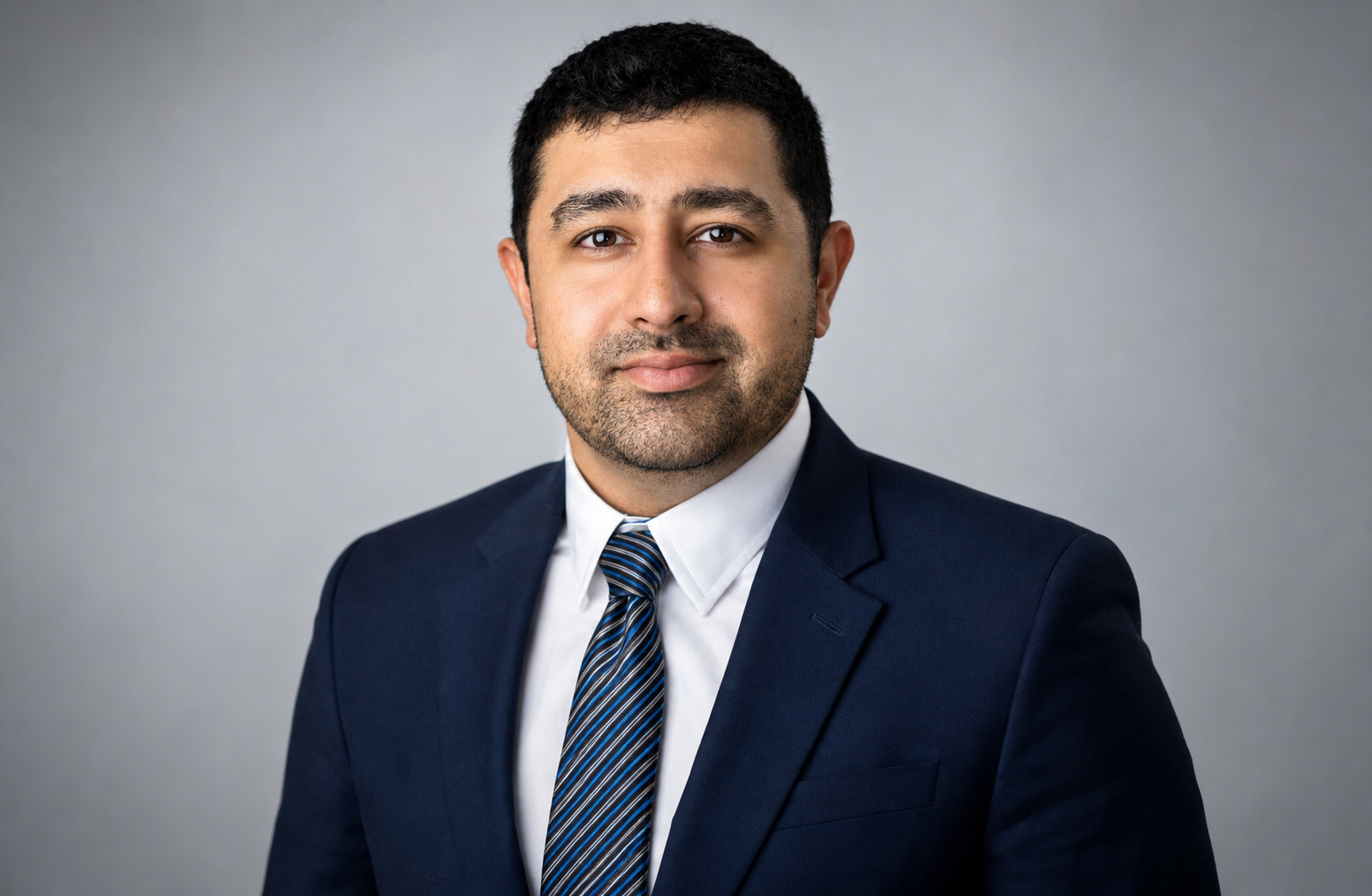
Opinion: The South Asian American activist turned candidate built an unusually diverse coalition in his first countywide campaign, bringing together communities often separated by politics, religion and history
By Zubair Hossain
I met Hamza Khan when I was a senior at UMBC and he was an 18-year-old freshman who couldn’t sit still. He was in a dozen clubs, running half of them, and he had this habit of dragging people who disagreed with each other into the same room to talk it out over chai — Jewish and Muslim students arguing about the Nakba, Pakistani and Bangladeshi students getting into it over the Bengali genocide and Partition, campus Republicans and Democrats trying to figure out if civility was even possible. He hadn’t turned 19 yet. He didn’t touch coffee until his 30s.
That was 20 years ago. I finished my degree and went on to grad school at UMBC while he was still working through his undergrad, and I got to watch the rest of it happen in real time. In the years since, Khan has built a career most people never hear about unless they’re paying close attention — he worked on Maryland’s Juvenile Restoration Act in 2021, was part of the effort behind Adnan Syed’s exoneration in Baltimore, and lobbied for COVID-era debt relief for Maryland families. People in the disability advocacy world know him as one of the few in the party who’s actually pushed back on Governor Moore’s proposed cuts to disability spending, instead of just saying the right things at hearings.
I remember him as the kid who wore two mismatched socks to class most days, more an activist than anything resembling a professional. His parents didn’t want him going into politics — they worried he cared too much about people on the losing end of things to survive in a business that rewards the opposite. They had a point. Hamza’s stubbornness about the underdog has cost him relationships with people who could have made his life easier, and more than a few of his allies in office have wondered aloud whether he was built for activism and nothing more. This year answered that question, one way or another.
READ: Reach Capital closes $265 million fund to back AI startup founders (August 25, 2026)
What happened before any of this
Fewer people know the part of the story that came before the activism. While he was still in college, his family’s small business took a bad hit in the Great Recession. Hamza ended up caring for his two disabled siblings while working full-time and going to night school, holding things together through a financial crisis that dragged on for the better part of a decade. It took him years longer than the rest of us to finish his degree at UMBC, and years after that to get a master’s from Georgetown while building a career on the side. That’s the part of his story that never makes it into a press release, and it’s the part that explains most of what came after.
It’s also part of why his run for Montgomery County Council this year felt like such a strange fit on paper. It was a 17-candidate jungle primary for four at-large seats, and every winner was an incumbent or someone who’d already held office and had countywide name recognition to show for it. Khan had never run countywide, but he wasn’t new to politics — he’d already helped push reforms through in Rockville and Annapolis, and he’d built enough of a public profile going on Fox News and Fox Business as a Democrat, alongside stops on Al Jazeera, CNBC and NPR, that people in Montgomery County politics knew his name even if voters didn’t yet.
What a lot of people openly doubted was whether a Muslim candidate could actually win a countywide race here. No practicing Muslim has ever been elected to county office in Montgomery County, and only one person, Saqib Ali, has represented the county in Annapolis at all. Hamza’s own AP Government teacher once told him flatly that he shouldn’t bother running for office because he’s Muslim. He finished with 11,525 votes. That doesn’t erase the assumption, but it’s a decent rebuttal to it.
A campaign run on no time at all
The timeline is what still gets me. His campaign qualified for the county’s public financing system in 40 days — fast for anyone, let alone a first-time candidate. But the certification of those funds took much longer to come through, so by the time the money actually landed, there were only three weeks left before Election Day. Everything a normal campaign spends a year on — building a donor base, recruiting volunteers, putting together a policy team — his team had to do in three weeks, all while running on an anti-corruption message in a county where barely a quarter of eligible voters typically bother to show up.
What they managed to build in that window is honestly the more interesting story than the loss itself. Something like a quarter of his donors were African immigrants, and more than half of all his donors had never given to a political campaign before in their lives. His policy advisors came from Harvard, Georgetown and Yale, and some of his informal mentors had worked as senior White House staff across five different administrations. Over a hundred volunteers knocked more than 10,000 doors, and more than 75 friends flew or drove in from as far as Canada and Alabama just to work the polls for a few days.
Some real contradictions, not just alliances
For a lot of South Asian Americans following the race, this was never just a council seat. Khan is an ethnic Pathan, the son of Pakistani immigrants, and his mother’s side carries part-Iraqi heritage — and he’s made something of a habit out of walking straight into divisions most candidates go out of their way to avoid. He’s spoken openly about the Bengali genocide of 1971, condemned Pakistan’s history of backing the Taliban, and shown up during the campaign alongside Afghan Americans, Kashmiri and Indian Hindu leaders, anti-Hindutva clerics and several rabbis and Jewish community leaders — people who don’t usually end up standing together.
READ: Trump praises Micron’s $10 billion investment in US for AI research (August 28, 2026)
He’d be the first to tell you none of that is tidy. He was once president of Alpha Epsilon Pi, a historically Jewish fraternity, and he’s spent more energy than most Muslim candidates trying to prove he’s serious about Palestinian statehood. His public criticism of Pakistan’s role in Kashmir has cost him support among diaspora communities that you’d think would be natural allies, though the recent military crackdowns in Khyber Pakhtunkhwa,
Balochistan and Kashmir seem to be changing some minds on that front. And his refusal to soften his position on Hindutva ended his relationship with Lt. Governor Aruna Miller — a former ally whose coalition includes significant Hindutva support — over his belief, stated plainly, that if Muslim supremacism in Pakistan is a problem, Hindu supremacism next door is too.
But that same stubbornness is also why he’s spent most of the last twenty years quietly building relationships that have actually held up. He’ll go to bat for rural white farmers trying to protect the county’s Agricultural Reserve just as readily as he’ll show up for Latino immigrants facing ICE raids, and he criticizes Bangladesh and Pakistan for how they treat their Hindu and Christian minorities with the same directness he used criticizing the Obama and Bush administrations over extrajudicial killings. It’s not a made-for-TV kind of consistency. It’s just where he’s always landed.
None of that changes the math: Khan lost, clearly, to opponents who’d been building name recognition for years before he entered the race. He was 38, noticeably younger than the field — the winners were, on average, about fifteen years older than him. But building a coalition like the one his team put together in a matter of weeks is usually a multi-year project for a campaign, and that doesn’t disappear just because Election Day did.
Campaigns end. The relationships don’t. Hamza never asked people to fall in line behind an ideology — he asked them to trust him, and a lot of people across a lot of different communities did, even ones that don’t often trust each other. Whatever he decides to run for next, I don’t think this was the last time we hear #YesWeKhan. In so many ways, Hamza Khan is the South Asian hero Maryland doesn’t just need, but deserves.