



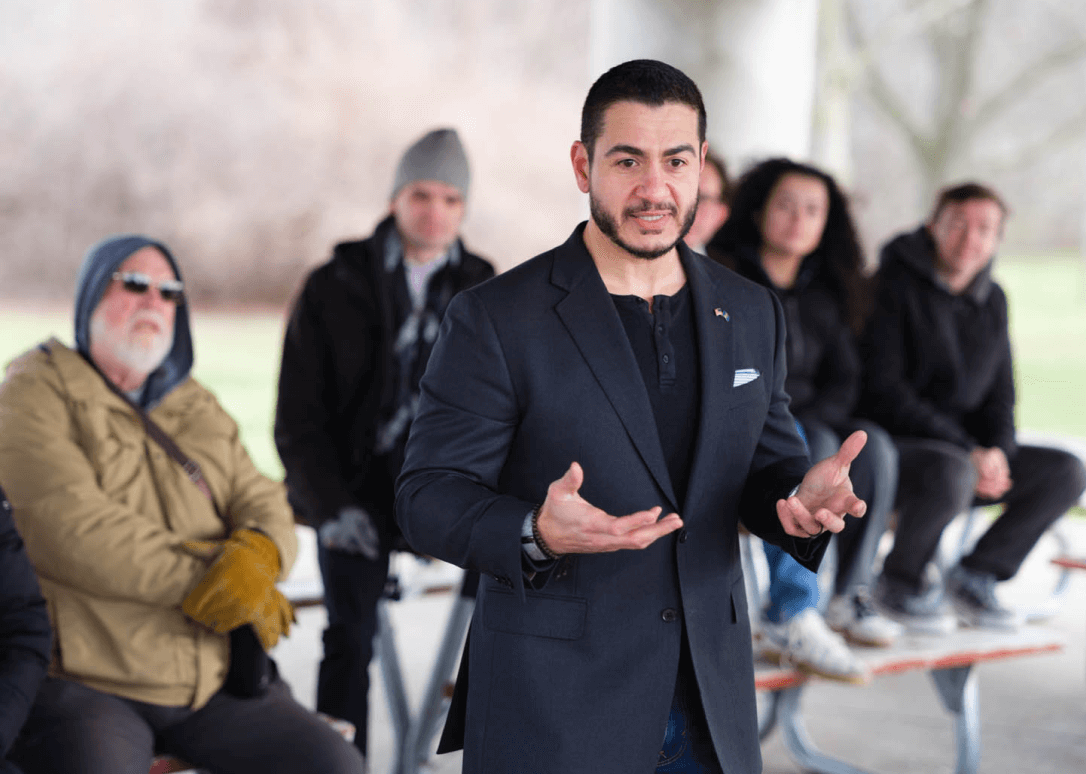
Michigan Democratic Senate nominee Abdul El-Sayed highlighted his wife’s connection to Karnataka, India, while telling Pakistani Americans that democracy requires people to have the freedom to seek public office without facing imprisonment or intimidation.
El-Sayed, who is seeking to become the first Muslim elected to the U.S. Senate, made the remarks while addressing a Pakistan Independence Day gathering organized by the Pakistan Association of America in Michigan on August 23.
“My wife is desi. She’s from the other side of the partition line,” El-Sayed said, referring to his wife, Sarah Jukaku, whose family has roots in India.
READ: Suhas Subramanyam wins Democratic primary in Virginia’s 10th Congressional District (August 5, 2026)
Jukaku is an Indian American psychiatrist whose family connection to India has previously drawn attention during El-Sayed’s Senate campaign. El-Sayed has written in his book “Healing Politics: A Doctor’s Journey into the Heart of Our Political Epidemic” that his wife’s parents came to the United States from a village in India. The couple met while studying at the University of Michigan and married in 2006. They have two daughters.
Jukaku’s family also has a direct connection to Karnataka. Financial disclosures filed by El-Sayed show that his wife owns a rental property in Bengaluru. The property was listed in an earlier disclosure and was valued between $100,001 and $250,000. A more recent filing also listed a rental property in Dubai. El-Sayed has said the properties were inherited by his wife’s family.
El-Sayed criticizes Pakistan’s democratic record
During his address to the Pakistani American community, El-Sayed turned to the question of democracy in Pakistan.
He said democratic government cannot function when people are prevented from seeking public office through imprisonment or intimidation, an apparent reference to former Pakistani Prime Minister Imran Khan and the political restrictions surrounding his supporters.
“Democracy requires that all people get to run for public office rather than be subject to jailing and intimidation simply because they would have a voice in our public office,” El-Sayed said, according to a report on his remarks.
He also referred to Pakistan’s former prime minister without naming Khan directly, saying that regardless of an individual’s views about the former leader, democracy requires freedom of speech and the ability to participate in elections.
El-Sayed drew a comparison between Pakistan and his family’s Egyptian background. His parents immigrated to the United States from Egypt, a country he described as lacking democratic government.
The Michigan Democrat said his own ability to run for the U.S. Senate was possible because he was born in the United States.
Indian American connection
El-Sayed’s remarks have also brought renewed attention to his relationship with Jukaku and her Indian American background.
Jukaku, a psychiatrist affiliated with University of Michigan Health, is the daughter of Indian immigrants. Her family’s history and the Bengaluru property have become part of public discussions about El-Sayed’s personal background as his national political profile has grown.
El-Sayed won the Democratic nomination for Michigan’s U.S. Senate seat in August, defeating Rep. Haley Stevens in a major victory for the party’s progressive wing. Reuters described the result as a jolt to Democrats ahead of the November general election.
READ: Indian American Rep. Shri Thanedar loses Michigan Democratic primary to Donavan McKinney (August 5, 2026)
He will face Republican candidate and former Rep. Mike Rogers in November.
If elected, El-Sayed would become the first Muslim elected to the U.S. Senate. His campaign has focused on healthcare, economic inequality and progressive policy, while his positions on Israel and the Gaza war have made him a prominent figure among the Democratic Party’s progressive wing.
For Indian American and Pakistani American communities in Michigan, El-Sayed’s comments also underscore the increasingly diverse personal and political connections shaping the state’s Senate race.